Adding Tips & Hints to Festive Duck Leg – Seasoning, Baking, Confidental, Extras

Continuing an additional miracle in roasting duck leg which is crumbly that it melts in your mouths

One of my favorite dishes for the upcoming holidays is the duck steak, quite precisely the roast duck leg, which has red-crispy skin, but its flesh is so crumbly that it melts in our mouths. To achieve this perfect texture, it doesn’t take much to be aware of all the ins and outs of roasting duck meat with the a little trick. Here are a couple to keep in mind what are these!

Seasoning:
Never miss the seasoning of thighs in the first step … need big-grain salt and freshly crushed pepper, nothing else. Mix the two together and rub the duck leg around it thoroughly everywhere, thoroughly. May even do this the night before and let the thighs stand in the fridge until baking.

Baking:
The most common mistake most people make while roasting duck legs is to fry the meat at a high temperature for less time than necessary. In this case, it will not be crumbly inside, but hard, chewy.

We can act in three ways … Bake high to lower! Place the meat in the baking dish so that the thighs do not touch each other, and then add the garlic and onion cut into larger pieces. Some folks even add bay leaves and others thyme or rosemary to the meat.

If it is made for 3-4 people, then having 4 duck legs, pour at least 3 deci of water under them. First bake at a very high temperature (220-240) for 15 mins, then lower the temperature to 150 degrees and bake for at least 1.5-2 hours. The thighs are good if the flesh is crumbly and soft on the inside, but it is already crispy on the outside and the fat has escaped from it.

Confidential:
It’s an old procedure with a very urising and trendy sound that can scare many away, as long as it’s what makes duck meat (not just) really crumbly, buttery and juicy. The essence of confit is to roast the duck in plenty of fat for a long … very long time at a low temperature. The fat used in the confit essentially protects the duck from drying out, but if wish to save time, the end result will be tough again.

Before placing it in the baking sheet, fry the thighs, starting with the skin, in a frying pan, at a high temperature. They can then go to the baking sheet and pour the previously melted fat over it. Choose a baking sheet that is large enough so that the meats don’t touch each other and the fat completely covers them! Roast the duck legs at 100-120 C degrees for at least 4 hours. If lower the temperature, need to increase the baking time. When done, remove it out of the fat. Can also toast the skin on a baking sheet, but can even toast the top in another dish in the oven.

If the duck is older, the frying time may increase further. So be sure to test it before taking it out of the oven. Insert a meat needle or fork into the thickest part of the thigh. If it easily penetrates it, it’s done.

Extras: An additional miracle of roasting duck leg is duck fat, which have already written about being one of the healthiest animal fats and the other being a crumb fired from sliced ​​skinned duck skin.

© Aggie Reiter

Holiday Duck Trousers with Red Wine Symptoms – Ünnepi Kacsacomb Vörösboros Meggyel

Receipt – Preparation time: 90 min … For 6 persons

Ingredients: for the duck: 6 fattened duck legs, large grain salt, pepper, 2 teaspoons brown sugar, 1 head onion, 10 cloves garlic, 2 tbsp fresh ginger or, 1 teaspoon ground ginger, 3 squeezed oranges or 3 dl orange juice, 1 branch rosemary, 1 nutmeg flower, 2 nutmeg flowers, 2 nuts.
For cherries: 1 bottle of pitted cherries compote or 40 dkg frozen cherries, 1 pinch of salt

Cooking: The duck legs are cleaned, shaped, then rubbed with salt, pepper, brown sugar and left to stand until the other ingredients are prepared.
Peel the onion, garlic and ginger and cut into rustic pieces. Squeeze the orange juice into a deep baking sheet, then place the duck legs on top and arrange the onions, ginger, and rosemary around it. The fat is analyzed on a crab, then the baking sheet is covered with aluminum foil and we bake it slowly, at 90 degrees for 8 hours or even overnight, and we confit it in a technical language. When the time is up, we take the duck legs out of the fat with a shovel spoon, on a baking sheet that we want to bake and let it cool down. We can even put it in the fridge and only finish it fresh in the next 1-2 days.

When the time comes to eat, take the baking tray out of the fridge and simply put it in the oven at 200 C degrees and bake it crispy, then eat it fresh!

For the Holiday Duck Trousers with Red Wine Symptoms – Ünnepi Kacsacomb Vörösboros Meggyel, the canned sour cherries are filtered or the frozen sour cherries are thawed and then inspected one by one to remove the seeds. Boil the cherries with salt, pepper and red wine. The starch is mixed with a little water and quickly added to the sauces to thicken it.

When done, remove from the heat and butter and stir in the honey. It can be consumed immediately or reheate.

To be continued with Tips and Hints

 © Aggie Reiter

Floating Island – Madár Tej – Hungarian Deliciousness Creamy Dessert

This is another famous and classic easy recipe among Hungarian families.  

The Hungarian “Bird’s milk” – “Madártej” is a vanilla custard containing foam dumplings whipped from egg whites, and originates from France. In 1834 this sweet dessert made from milk and eggs made its way to Hungary as deeply loved delight for sweet tooth individuals.

Bird milk is an imaginary name, more than probably a wandering term that originally referred to an imaginary food (its history dates back to antiquity).

The word bird milk has appeared with different names in many European languages since the middle of the 18th century. The Hungarian name as Bird’s milk – Madártej is known in the world having named differently …

The dessert made its success all through the Continent. It can be found in almost all the countries in Europe and even in India … e.g. “Oeufs á la neige” – (eggs on the snow) or “Ile flottante” – are often available in French bistros. The floating islands are known by the English speakers and also for Spaniards. In addition to us, the Romanians also follow the bird’s milk line. The Austrians go on calling it canary milk “Kanarimilch”. In India, “Rasmala” is made without eggs and cardamom, which is also flavored with pistachios and saffron.

Receipt – Ingredients – for 4 person – peparating time: 20 mins.


For the basic cream … 6 eggs separated, pinch of salt, 150 g sugar, 1 liter milk, 12 g vanilia sugar (1 packet), 3 tbs flour, 10 dkg raisins Instead of the 1 packet of vanilla sugar or a little aroma, if possable choose 1 real vanilla stick, it’s worth it, it gives the bird’s milk a yummy taste.

Step-by-step Cooking … Meringues beat egg whites with a pinch of salt until soft peaks form. Add 3 tbs of sugar and beat until stiff. Bring half of the milk and scraped seeds of vanilla stick to boil in a large pot, then reduce to a simmer. Scoop up egg-sized peices of beaten egg white mixture and gently slide into the simmering milk. When the meringues rise, carefully turn them and cook on the other side. (about 1 min. egy side) Set then after aside.

For the vanilla sauce … add the rest of the milk into the pot and let it start to simmer again. Mix the yorks with the remaining sugar and flour. Add the vanillia suger to the simmering milk. Remove from the heat, pour slowly – ladia-by-ladie – into the york mixture, whisting constannly. Then pour the mixture in the warm milk. Add thróe raisin Place the pot back on to the heat and cook over low heat until the sauce sóbegins to ticken.

To assemble and serve, spoon meringues into a glass bowl. Pour the vanilla souce on top sprinkle with raisins. Best is when cold, so store in the fridge for a while before serving, but maybe in between someone has discovered it and many are missing. Then off you go it only take 20 mins to get this yummy dessert ready again.

© Aggie Reiter

Dried Plum-Mazipan Bejgli

According to some sources, bejgli is originally from Silesia, a type of cake known in Europe since the 14th century. Others write about Armenian origins, and as is customary, the exact history of origins is obscured by the past. What is certain: bejgli was originally made in the form of a horseshoe, from which its German name is derived, and then it was introduced into the Hungarian language through Austrian mediation in the second half of the 19th century.

According to the old folks saying … if the walnut bejgli gets on the table at Xmas, it protect from spoilage. And also a poppy sead bejgli, then inhabitants of the house be in great abundance and happiness next year. And last but not least … the new year will soon bring a husband to the young girl/s

Surely there are gourmets who improve on the traditions with the Xmas chestnut bejgli with other various fillings.

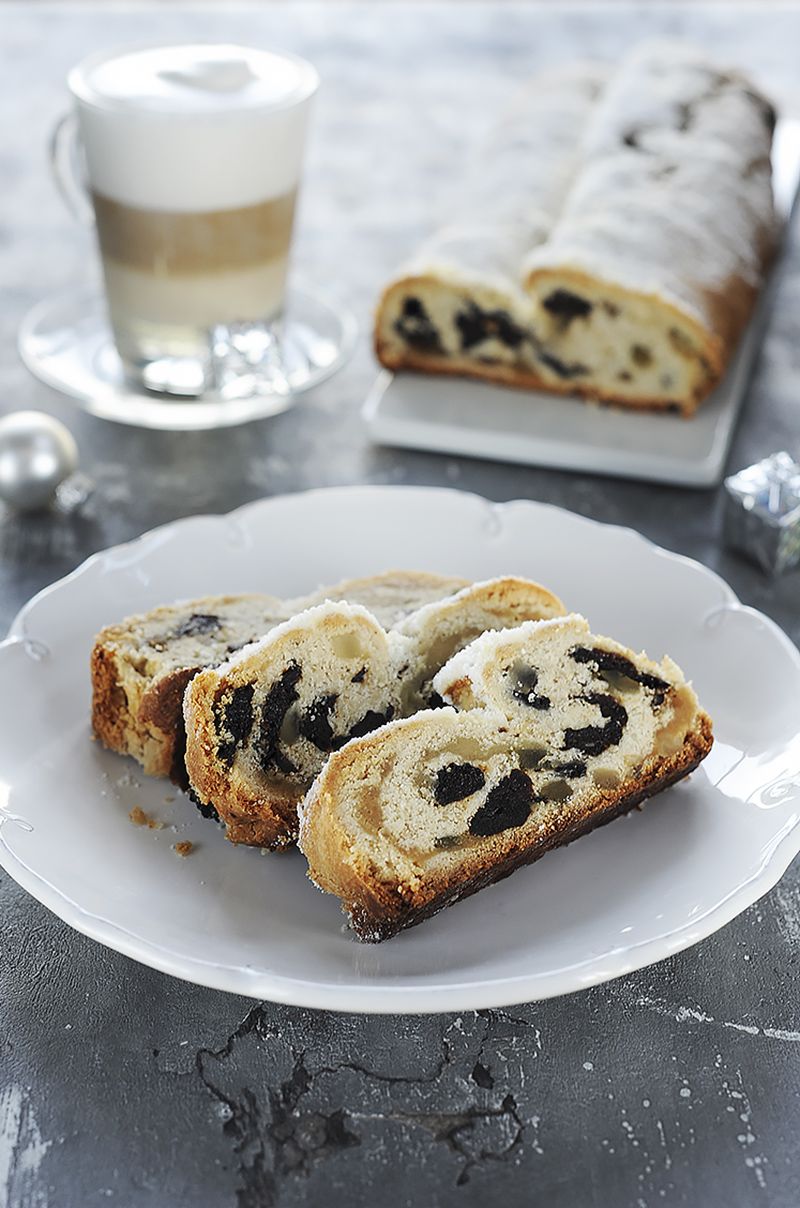
During the high holiday season in December the scent of the baking  begli in your home is a dream itself.The Dried Plum-Mazipan Bejgli stands  # 1 for me next to the chestnut, walnut and poppy seed  bejgli.

Now let’s go the the next level … Receipt – Dried Plum-Mazipan Bejgli

Ingredients for 2 roll bejgli: 30 dkg flour, 7.5 dkg butter, 5 dkg of fat, 4 dkg powdered sugar, 1 dkg of yeast, 1 egg yolk, small pinch of salt, 1 dl milk. (+1 egg for greasing the top).

For the marzipan filling: 25 dkg prunes, 15 dkg of marzipan paste, 10 dkg candied minced almonds, 1 dl plum pálinka (but not nessesary, but it brings an extra taste.

Meanwhile prepare the marzipan filling: Cut the marzipan into small cubes and heat it with the sugar, add the prunes soaked in pálinka, and finally add plum jam.

Preparation step-by-step … making bejgli cake:
Sift the flour and then crumble the yeast. Add several ingredients of the dough to the flour and knead the elastic dough from the whole with a machine or quick movements. Divide the kneaded dough into two equal pieces and then form into two loaves from the dough and cover with a kitchen towel a place it at cool place for at least 1 hour. Thenafter, stretch the dough (without undercutting) into a rectangle. When making bejgli,  make sure that the filling and dough are the same amount.Spread the cooled filling on the dough, leaving a 1 cm section on each side. Fold the edges of the dough inwards and then roll up the bejgli evenly. Be sure to make the same amount of filling and dough when making bejgli.

Stir in the egg yolk and thinly with it the bejgli. Place the smeared bejgli in a dry, cold place until the egg layer is dry.

Prick the side of the bejgli (this is needed so that the steam can come out and not crack) and the top. Bake the bejgli in a preheated 180 °C oven.

© Aggie Reiter

One of the Hungarians Most Classic Cake for Xmas – Sugar-free Snowball Cake

As getting closer to the Season Holidays, many are wondering what kinda cake to come up with which is baked so quickly, easy to bake and being heavenly in taste. Naturally, there are many quicky and tasty Hungarian’s love to taste, so tune in or should I say roll over to this site but the meantime give this one a try.

Ingredients:cake pan shape size 26 cm will do just fine.
For the cocoa sponge cake: 8 eggs, 2 tbsp erythritol, 2 tbsp cocoa powder, 1 packet baking powder, 1 pinch of salt, 10 dkg flour, 15 dkg wholemeal flour, 1 dl water
Liquid sweetener equivalent to 20 dkg of sugar
For the cream: 10 dkg flour or 1 packet of coconut pudding powder, 5 dl milk, 4 tbsp coconut shavings, 10 dkg erythritol or liquid sweetener, 20 dkg butter, 5 tbsp erythritol
Covering the outside: about 10 dkg of coconut shavings
On the topping: 1 bar of sugar-free chocolate, 2 teaspoons of oil.

Baking instructions:
For the sponge cake, separate the eggs and beat the protein to a foam with the erythritol. Cocoa powder, baking powder, salt and flour are mixed. Stir in the egg yolks in the protein mousse, in small portions, then add the water and flour alternately to the dough gently to keep the dough frothy and gently stir in the sweetener. Bake in a buttered, floured cake tin at 180 degrees for about 20 minutes. When cooled, cut into three parts.

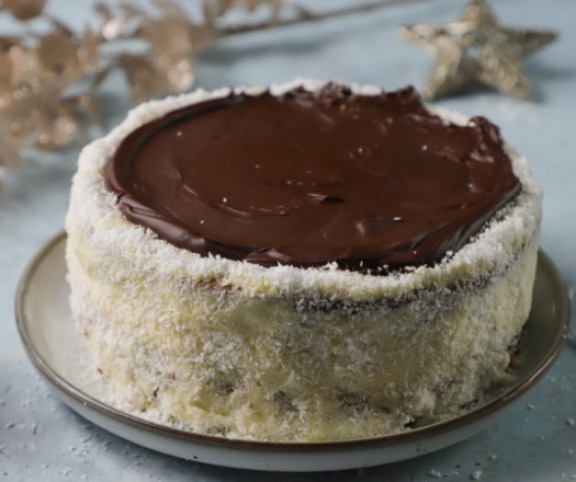
For the cream: Mix the custard powder (flour) with a little milk. Bring the remaining milk to a boil point, then pour in the custard powder and cook until thickened, stir in the coconut, sweetener and allow to cool. Stir the butter into the foam with the erythritol and then work together with the cooled coconut cream. When assembling the cake, smear the sponge cakes with the cream and then layer the sheets on top of each other … the top sheet should be the smoothest sponge cake … spread the top only thinly with cream, but spread around the side thicker, thereafter also sprinkle with coconut shavings … may garnished also be to covered with chocolate chips. Melt the chocolate with oil on top of the cake over water vapor and spread on top of the cake. Place in the fridge until it gets slightly frosty.

It’s soft, creamy, coconut and even chocolatey, so it’s basically incapable and very delicious.  It looks so good that it fits anytime and very well on the Xmas table too!

© Aggie Reiter

“Hanukkah” in the Air Tonight – “Festival of Light” – Tradition – Story – Food @ 2020

Hanukkah is a Jewish holiday, often referred to as the “Festival of Lights.”

Hanukkah is celebrated for eight days and nights.

The Hebrew calendar determines when Hanukkah begins and ends each year, which is based on the lunar cycle and the seasons. It was created in ancient times based on observations of the appearance of the crescent moon. This means that the dates of holidays vary from year to year based not on the Gregorian calendar but on the phases of the moon (which last 29.5 days). Some years are longer or shorter than others, but instead of adding a leap day every four years, the Hebrew calendar adds a full lunar month to seven out of every 19 years. The Chinese calendar is also calculated based on a combination of the movement of the moon and the sun. Following the lunar cycle just as in the Jewish calendar.

In 2020 Hanukkah runs from the evening of December, 10 to the last candle lighting evening of Dec. 18.

Not at all Jewish Xmas, Hanukkah commemorates the rededication of the Second Temple in the second century B.C. The Hanukkah story is based on historical events that took place in 165 BCE in Jerusalem. After the Second Temple in Jerusalem was desecrated by the Seleucid Emperor Antiochus IV and his Greco-Syrian troops, Jewish priest Mattathias and his sons rebelled. Retaking Jerusalem and the Temple, they lit the holy lamp (the menorah) but had only enough oil for one night. Miraculously, the lamp stayed lit for eight days until enough holy oil could be procured.

Hanukkah is a minor Jewish holiday and it became a more significant holiday in the western world because of its proximity to Xmas and the desire among more secular Jews to participate in the cultural build-up to the winter solstice. Also as a result, gift-giving became more popular in the west than in other parts of the world. While the traditions of Hanukkah are similar around the world, each country has its own unique twist.

Hanukkah means “Dedication” and also called Feast of Dedication, Festival of Lights, aka Feast of the Maccabees, or Jewish festival that begins on Kislev 25 (in December, according to the Gregorian calendar) and is celebrated for eight days. Hanukkah reaffirms the ideals of Judaism and commemorates in particular the rededication of the Second Temple of Jerusalem by the lighting of candles as the sun goes down on each day of the festival.

All over the world, candlelight celebrations are celebrated in some form. Let’s visit some parts of the World, what and how they are celebrating …

In parts of France, for example, families light a double-decker (16-candle) menorah, while in Morocco fried treats are made with fruit juice and orange zest.

Butter sculpture – Buddhist New Year’s custom. It is also a Tibetan custom for Buddhist monks to carve meticulously made statues of yak butter at New Year’s Eve, bringing to life a different story and teaching tale each year. The statues sometimes reach a height of 10 meters and are illuminated by special butter lamps. The most successful sculptures will receive an award.

Solstice in Scotland: The Feast of Solstice is held on the eve of the shortest day of the year. In the first millennium of our time, the ancestors of the Scots today, the Druids, celebrated the God of the Sun at solstice, rejoicing that it would then return and become stronger again. The customs still live today in Vikkan traditions, in English-speaking areas, and in various variations in other parts of the world. A large block of wood — the Column of Julias — is set up in the middle of a clearing and set on fire. Everyone then dances around the fire. It is said that the more noise they make, the better, because it awakens the god of the sun and thus the process of revival.

Night of Hikes – Mexico:  An unusual ceremony takes place in Oaxaca, Mexico on December 23 each year. It began in the middle of the last century when the Spaniards brought the first radish to Mexico. In Oaxaca, they grow very large, but due to the stony soil, they turn into all sorts of strange, twisted shapes. Local folk artists then carve all sorts of interesting things out of these, scenes from the Bible, and local Aztec legends. Cash prizes will be won by the best sculptors and the evening will end with a dazzling fireworks display.

Befana – Italy: “Bifana” – a friendly witch, flies down the chimneys on a broom to place presents in the hanged stockings. Legend has it that Bifana was just sweeping when the Three Kings knocked on him. They offered to take it with them, but he said he didn’t have time. He changed his mind later, but it was too late. That’s why he still goes into every house at Christmas and leaves gifts everywhere.

China New Year: It begins on the first day of the New Moon and ends fifteen days later, at full moon. The fifteenth day is called the Lampion Festival, the celebration begins after sunset when lanterns are lit all over and people march through the streets with lanterns hanging on their sticks in their hands.

The Chinese calendar is calculated following the lunar cycle just as in the Jewish calendar. It is about 29.5 days long. To correct the shift, the Chinese occasionally insert an extra year into the calendar, a total of seven times during a 19-year cycle. This is the same as the way we do an extra day  a.k.a. leap year every four years at the end of February. However, this is the reason why according to the day-based calendar, Chinese New Year always falls on a different date.

Dozmocse – Celebration of the Dying Year in Tibet: The center of the five-day celebration is a column adorned with stars and other decorations made of colored yarn. Dancers wearing scary masks bounce around to scare away bad spirits for years to come. The next few days will be filled with daring and prayers, and as a finale, the people will knock down the pillar together and take apart the decorations.

One of the cakes connected to Hanukkah is the Sufganiyot which are deep-fried jelly doughnuts. These delicious dessert treats are made with yeast and must be allowed to rise. They’re often topped with confectioners sugar and/or in-and-out-side with home-made apricot jam. Yeast is allowed in foods year-round except during the Passover holiday when Jews eat unleavened bread in commemoration of their flight from Egypt (as described in the Old Testament).

Receipt … Sufganiyot which are deep-fried jelly doughnut

Overall time from preparation to consumption: 1 hour 45 minutes

Ingredients for 20 piece of donuts: 2.5 dl milk, 30 g yeast, 1 month + 50 g powdered sugar, 500 g fine flour, salt, 6 egg yolks, 60 g soft butter / margarine, frying oil
vanilla powdered sugar for sprinkling

Preparation: Lighten the milk, mix in 1 dl of yeast and 1 tbs. icing sugar. Sift the flour into a bowl, make a recess in the middle, pour in the yeast milk, mix a little flour from the edges, then cover with a kitchen towel and let it double, i.e. make sourdough (15 minutes). In the remaining 1.5 dl of lukewarm milk, mix the remaining 50 g of icing sugar, 1 pinch of salt and egg yolks, then add to the flour and work together with a wooden spoon. Knead the butter / margarine in 2-3 portions, cover and double-boil in a warm place (30 minutes). Knead the dough on a floured worktop, flatten and flatten with a floury palm, and puncture with a 6-8 cm diameter cake tongue (or glass) dipped in flour (knead the falling parts without flour, re-tear). The discs are stacked at a distance of 5 cm on a floured tray or board, the tops are lightly smeared with oil (so as not to crust), then covered loosely first with folpack and then with a kitchen towel and doubled again. Pour 2-3 fingers of oil into a medium-sized pan (25-28 cm in diameter) and heat it – it should not be smoky-hot, because the outside of the donut will blush too soon, but it is feared that the middle will remain semi-raw! Press the center of the dough discs with your thumb and place them in the oil with the half that was on top (about 4-5 pieces because they will grow during baking). Cover the legs (this will make them “ribbon”), bake the donuts on a moderate heat for 4-5 minutes, then turn them over with a sieve spoon and bake them until golden brown without a lid. Soak up the excess oil on a paper towel, arrange on a preheated bowl, sprinkle with vanilla powdered sugar and serve freshly hot. Home-made apricot jam in-and-outside of the donutsnare just heavenly. Also may have them aside and in a separate bowl.

© Aggie Reiter

5 Weeks – 5 Blockbusters & Pathbreaking Films of India on Channel 6 Hungarian TV

The film festivals have become very popular in today’s world. Imagine, if you had to go to someplace to get a taste of the finest of world movies and you are surrounded by breath-taking and chewing viewers to watch would be less enjoyable. 

The Indian Embassy contacted the board of the TV Channel 6 to request in hosting the Bollywood blockbusters instead at the annual screened venue the Pushkin cinema because of the epidemic, and as a result of successful negotiation fans of Indian films may watch artist, award-winning, regional films and enjoy the colorful Indian culture and themes in their comfy seat/sofa at home.

This year will be one-of-a-kind broadcasting through the “Hatoscsatorna” – Hungarian TV Channel 6  –  India Film Week during the next 5 weeks.

The virtual opening ceremony was held by the Ambassador of India to Hungary.

The five films are being telecast on the digital platform on the Hatoscsatorna TV – TV channel 6 from December, 7  until January, every Monday at 8 p.m.  Also through telecast at the Szeged TV every Wednesday at 9.30 p.m.

The screenings will be in original language, with Hungarian subtitles.

Here’s a peck into the selected IFF Trailers:

Saaho film-

Indu Sarkar

Thinking of Him-

The Silence-

Jhalki-

Recommended by Aggie Reiter

Just in Time … Traditional Hungarian Scone with Pork or Goose Cracklings  – Sertés vagy Liba Tepertős Pogácsa

The cake is one of the oldest and most popular baked goods in the Hungarian-inhabited areas, but also in many other nations. The origin of the name is derived from the Latin word focus – fire. Although at first its sound not similar to that used in Hungaria, but when we think of the fried dough of Italian bakeries – the Latin focacea – it sounds more familiar. To this day, Italians call focaccia the flatter, smaller variety of bread. The Hungarian language took the name South Slavic pogača (which originally meant pie). In most European countries, “cake” baking sounds familiar. “Pogatschen” for the Germans, “poğaça” for the Turks,”hogaza” for the Spanish, and “fougasse” for the French.

From time travel, let’s just jump back to the present … Hungarians make typical cakes for the coming Xmas feasts, but the Pogács – Scone is popular to bake anytime throughout the 365 days of the year.  It is also a national yummy with wide spread of stuffings. There are so many varieties of  fillings of the “Pogácsa” – “Scone” with different flavors such as: cheese, potato, goose cracklings, sour cream, cottage cheese, sheep’s cheese, crumbly, cabbage, butter, different seeds, onion, green spice, and of course there can be different variations of them, regardless of the variety. In addition to the traditional flavors, may  find at different regions different fillings …  broccoli, chili, wild onion (especially in the town Orfű), bean (City of Sopron).

After a hearty heavy soup …  let’s say the “goulash soup” Scone with Pork or Goose chopped cracklings Tepertős Pogácsa is really heavenly!

Here is a reminder to the Gyulás heavy soup receipt: https://rollinginbudapest.com/2020/05/06/a-1000-year-history-cuisine-of-hungary/ along another receipt of beloved chesse scone – sajtós pogácsa.

Receipt to the Traditional Hungarian Scone Pork or Goose cracklings  –  Sertés vagy Liba Tepertős pogácsa

Preparation time cca. 2 hours. Cooking time ½ an hour up 1 hour.

Ingredients: 60ml /4 tbsp milk, 1 tsp dried yeast, 250g pork or goose chopped cracklings, 500g plain flour – plus extra for dusting, 1 tsp baking powder, ½ tsp salt, 2 tbsp grated parmesan or as taste, 1 tbsp caraway seeds, 120g unsalted butter, 120 ml soured cream,  2 eggs beaten, to cover the scone with beaten egg and a drop of water, to glaze.

Preparation: Gently heat the milk in a pan until it is lukewarm, then pour it into a jug and stir in the yeast. Leave it for 15 mins or so to get working and froth up. Meanwhile, heat a heavy-based pan with the already fried craklings a bits until crisp and golden. Remove them from the pan and leave to cool. Sift the flour into a bowl and mix with the baking powder and salt. Stir in the parmesan or other cheese and caraway seeds. Put the butter in a small pan over a gentle heat and allow it to melt until it is just liquid. Take the pan off the heat, stir in the soured cream and add the beaten eggs – make sure the butter isn’t too hot or the eggs will scramble. Add the cooled crispy cracklings and stir in the yeasty milk. Pour the buttery egg and chopped mixture into a large bowl, then add the flour and other dry ingredients, for a short time, until everything is combined. Turn the dough out onto a floured work surface and knead for 5 mins or so until elastic. You can do this with a mixer and a dough hook as you like. Put the dough in a lightly oiled bowl, cover with oiled cling film and leave it in a draught-free place for about an 1½ hours until it has doubled in size.

Baking: Turn the dough out again and knock it back with your knuckles. Dust the dough with flour and roll it out to about 4 cm in thick  length.

Preheat the oven to 200 C / 400 F. Place on the a baking tray a baking sheet. Then place and leave  the pogácsa  scone to rest for another 10 mins before putting into the oven.  Brush the scone with the beaten egg and water to glaze and bake them for 25–30 mins until top just begins to turn golden.

© Aggie Reiter

Nick Cave & The Bad Seeds Canceled Their European/Budapest Concert

Nick Cave & The Bad Seeds would have originally performed @ Budapest this summer, but it was canceled by the band in March. Then, due to a European tour, it turned out that they would afterall arrive in Budapest on May, 13. 2021., and hold their concert, but it seems as for the time being, this date has also become questionable, after the band has now signaled that the entire European tour will be blown away concert and will also be missed. The band had made their statement, hoping they can come up with better news next year.

The tickets purchased online are automatic at ticket sellers, and the Ticketportal initiates a refund. The amount of the ticvket(s) will be refunded to the account from which the purchase was made. Holders of tickets purchased online have nothing to do. Due to the large number of tickets sold, the refunding is expected to take place by January, 31. 2021.

Tickets purchased in person can be redeemed at the point of purchase. If the given office is not open, a copy of the ticket must be sent by e-mail to ticketportal@ticketportal.hu, no later than January, 15. 2021.

Update: Aggie Reiter

Collection of Wonders – Extended Art Movie Rental With 30+ Online Movies

128018152_3105189816374322_1724724634949277347_o

In the current situation, at the movie theaters screenings will pause, but of course to ensure that art lovers are not left without interesting sights during cinema closures, the Pannonia Entertainment Ltd., has made available all the previous parts from the series of the “Temple of Art”. Expanded with 9 new films nd nearly 30 art history films, having access to earlier parts of the series at the online movie rental launched by distributor Pannonia Entertainment Ltd. Thus offer is huge and surely provide unmissable artistic experience and real relaxation to watch all episodes in your own enviroment in a comfy setting. Within the screenings, from the very first 2014 film about the Vatican Museum to the latest Modigliani Centenary, which was released in late October 2020.

Art film screenings started six years ago with the “Temple of Art” movie series, the episodes of which showcase outstanding artists, masterpieces and museums of universal art in a spectacular mainly large-screen design.

Fresh creations such as the 2020 episodes depicting the lives of Amadeo Modigliani, Frida Kahlo, Paul Gauguin and Peggy Guggenheim can also be viewed from home.

In addition to the award-winning music documentary art films – including Ella Fitzgerald and Ronnie Wood‘s film portrait – biographical films (Egon Schiele, Mary Shelley, Gagarin) and Hungarian natural history (Wild Forests, Wild Crags) which are also available on the site … http://www.pannonia-entertainment.hu/filmkolcsonzo page.

What’s new in the offer?

With the current expansion of the movie rental, 7 new films have been added to the selection, which were recently shown across Hungary’s cinemas theaters.
The Prado Museum – Collection of Miracles has become available … https://www.youtube.com/watch?v=mngYaQHab8w
… Episode of St. Petersburg’s Monumental Museum, also known as the Venice of the North – Hermitage – The Power of Arthttps://www.youtube.com/watch?v=xSDau6_Ut94
Gauguin in Tahiti presents the legendary art eternal rebel, Paul Gauguin’s footsteps, who was in Tahiti and the islands Marquieses-researched through Paris to Brittany on after the “lost paradise”… https://www.youtube.com/watch?v=r3vFvTi–pg
… The rare impressionist art history speaks revolution launched by the movement in fifty from private collections, exhibited for the first time valuable paintings – including Manet, Caillebotte, Renoir, Monet, Cézanne, Signac, Sisley and Berthe Morisot‘s works … https://www.youtube.com/watch?v=DD-L2aCgJzU
Frida Kahlo multifaceted personality, pioneering and revolutionary art and culture to become an icon processing Viva la Vida, which evokes Frida own words based on letters, diary and personal confessions … https://www.youtube.com/watch?v=VWThZuVlakM
… The cinema shows obsessed by the 20th century’s most famous art collector and art patron, Marguerite “Peggy” Guggenheim career in a comprehensive manner … ttps://www.youtube.com/watch?v=bnMBBh_SBJw
… The list of what’s new in arts movie rental was part of the latest, the end of the series hits theaters in October, close to the centenary Modigliani, in which avant-garde of the 20th century Italian painter and sculptor Amadeo Modigliani‘s life and art from a new perspective, life partner, Jeanne Hébuterne memoirs revealed … https://www.youtube.com/watch?v=5q4ECvPLERY

Movies can be played an unlimited number of times within 48 hours of rental, on any device that is suitable for internet access: on a computer, tablet, smartphone or even a mobile phone – although the latter is less recommended due to its small screen size.

Here’s a peak into last week’s rental movies to have hit the Top10 chart:
1. Peggy Guggenheim – Obsessed with art
2. Gauguin Tahitin – The Lost Paradise
3. Hermitage – The power of art
4. The Prado Museum – Collection of Miracles
5. Modigliani centenary
6. Impressionist rarities
7. Hokuszai: Beyond the big wave
8. Frida Kahlo – Viva la Vida
9. Raffaello – The Prince of Painting
10. Tintoretto – A rebel in Venice

Reviews of some films from the past can also be found @ rollinginbudapest.com – “Temple of Art” series”

Wishing everyone to persevere during the harder period due to the coronavirus situation, take care of yourselves and each other.

© Aggie Reiter