Archive for the ‘Herald News for Hungarians who speaks English!’ Category

Day-By-Day #4 … Hungarian Cruisine – Bean Soup á la Jókai

Bean Soup á la Jókai

(Jókai Bableves)

The soup is named after Jókai Mór who was a famous Hungarian novelist of the 19th century and this soup was his favorit. The bean soup is an exceptionally luscious dish. The flavor of the delicious vegyies mix with knuckle, sausage. At the end  may serve with 1-2 tbs of sour cream it brings the taste you cannot let go, simply marvelous  …  and nowonder just as the novalist you will love this bean soup. It is really a mouthwatering soup with the scrumptious smoky meat  that brings a perfect harmony of taste.

In Hungary the dried beans are grouped according to hardness, most Hungarian sorts have to be soaked well. By soaking the beans will grow and allow a shorter in time for cooking. The soup also preserves the most nutrients, and get the benefits of all proteins, vitamins and minerals.

Good to Know … It is common knowledge that beans are difficult to digest, but if at first only cook the beans in in cold water and after boiling  pour the  hot water off  twice, thenafter in fresh water cook with smoked meat, we get a much lighter soup and less harm to digest.

Receipt for 4 persons  – preparing time: cca 90-120 mins.

Ingredients:  300 g dried beans (soaked overnight), 300 g smoked pork sausage and ham shank, 1 celeriac root, peeled and diced, 3- 4  medium size carrots, 1 parsnip, 2-3 bay leaves, 2 tbs oil, 2 tbs flour 1/2 tbs sweet red paprika powder (but if prefer hot then use stronger one), 2 garlic cloves crushed, salt, peppercorn, vinegar to taste, hot chilli paprika on the top to feel the heat of the soup,  2-4 tbs sour cream, 2-3 tbs tinny rolyale (levesbetét).

Cooking: Soak the beans and the smoked ham overnight seperatly. Discard some of the water if too salty (it depends how smoked it was previously), pour some fresh water in the pot. Put them with bay leaves, peppercorns and sausage in a casserole and bring it boil over low heat. The same pot can be in use as soaking and cooking. Peal and cut the carrots, parsnip and celeriac. After 30-40 mins or when the beans and ham are already tender may add the vegyies to the casserole. Heat the oil in a small frying pan, add flour, keep stirring and heat it until it turns light brown. Take it off the heat, then add papirka powder and  sliced garlic. Take alittle out of the soup and add it to the roux, quickly mix well to get a liquid gravy. Stir th eroux into the soup, so it will thicken and bring it to boil. Add the tiny dry royale into the soup. Within that it will require 10 mins further cooking, best to know when ready seeing the royale slowly floating up to the top of the soup, then cca 3-4 mins and served.

To read more about traditional Hungarian soups, visit previous receipt @ “Q” & “A” Culinary Heritage Into Hungarian Kitchen.

© Aggie Reiter

Day-By-Day #3 … Hungarian Cruisine – Sour Cream Potato Soup with Sausage

As many already know by visiting Hungary or friends who have found out the for the Hungarians generally love soup. Hungarian cuisine is charactersed by light and heavy soups with herbs and also soups made of fresh fruits, creamed veggie side dishes, warm pasta dishes, fricassees, and of course countless variation of selicious sauces. Then comes te variety of fried, braised and cooked beef, pork, lamb an poutry dishes, oh and almost left out the mouthwatering fish from the lakes and river at Hungary. The history of Hungarian is a nutritional evolution accepting combining good ideas and even incorporating dominances … a synthesis of ancient, normadic, Slavic, Turkish, Italian, German, Austrian and French influences.

The Soup is an integral part of a meal at the table, but that doesn’t mean all Hungarians are dieing for soups, Some like it hot … spicey but not nessesary. Soup is an integral part of a meal in Hungary and one of course the first meals that come to your mind will probably the goulash soup.

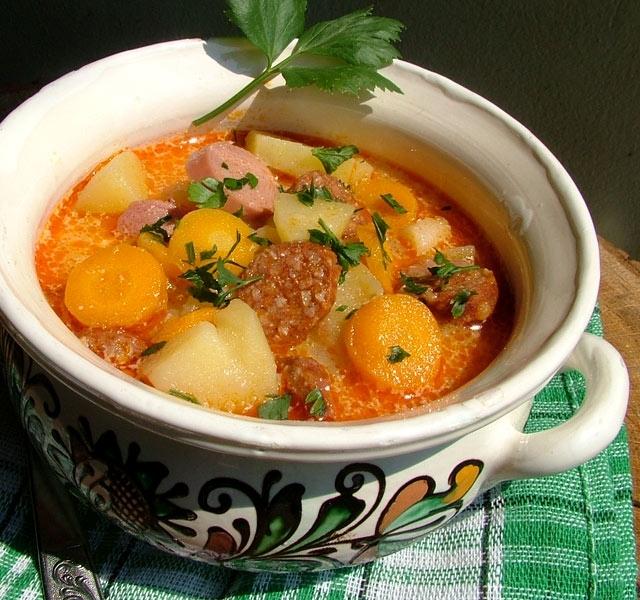
Soup of the Day  – Creamy Potato Soup with Sausage

(Tejfölös burgonyaleves kolbásszal)

Receipt for 4 persons – Preparing time: 45-60 mins.

Ingredients: 4 big potatoes, 150 g smocked sausage, 3 tbs. oil, 2 tbs. flour, 2 tbs. sweet red paprika powder, 2 bayleaves,120 ml. sour cream,1 tbs.  vinegar, 1 small piece celery root, salt and pepper to taste.

Cooking:  Peel, cut the potatoes in large size of cubes.Slice sausage. Chop celery into 4 huge pieces. Add cca 3 times  as much water, salt, pepper and byleaves. Boil it until the potatoes get soft. Be sure to have enough water covering the potatoes. Then when its cooked , prepare the roux (hungarian – rántás) Heat the oil in a pot  then add flour, stirring constantly. After getting light brown, pull away from the fire and add one tsp of red paprika. Mix  some of the roux slowly with the potatoes. Follow sour cream. Take some of th gravy from the soup and mix it with the sour cream. Thenafter bring it to boiling point once more. When cooked as tasting adjust a little vinegar and salt if necessary.

Also, there ar some houeholds and regional variations… some people addsautéed onion as they make the rough, other like to put carrot and/or marjoram. Some people eat  with the potatoe soup the celeriac.

Sour cream (tejföl) it is a diary product that is produced by souring heavy cream very popular in Central and Eastern Europa. Mainly sold with 15% to 20% milkfat. It curdles less when cooked or added to the hot soup.

Hungarian smoky sasauge (Füstölt kolbász) is finely ground and contains nice  color red paprika than the Western sausages.

This soup is a fine example how something so simple can taste so good.

To read more about Hungarian soups, visit previous receipt @ “Q” & “A” Culinary Heritage Into Hungarian Kitchen.

© Aggie Reiter

Day-By-Day #2 … Hungarian Cruisine – Green Pea Soup

Gastronomy, cooking and food have always been quintessential elements of Hungarian culture and consequently Hungarian cuisine boasts a wide array of diverse and unique characteristic flavors. The Hungarian cuisine is an evalution of a 1000 year long history based on Hungary’s favorable geographical conditions as well as the heritage of traditional farming, small scale food and crop production. By-the-way … Pea soup has been eaten since antiquity … it is mentioned in Aristophanes’ The Birds, and according to one source “the Greeks and Romans were cultivating this legume about 500 to 400 BC. During that era, vendors in the streets of Athens were selling hot pea soup.

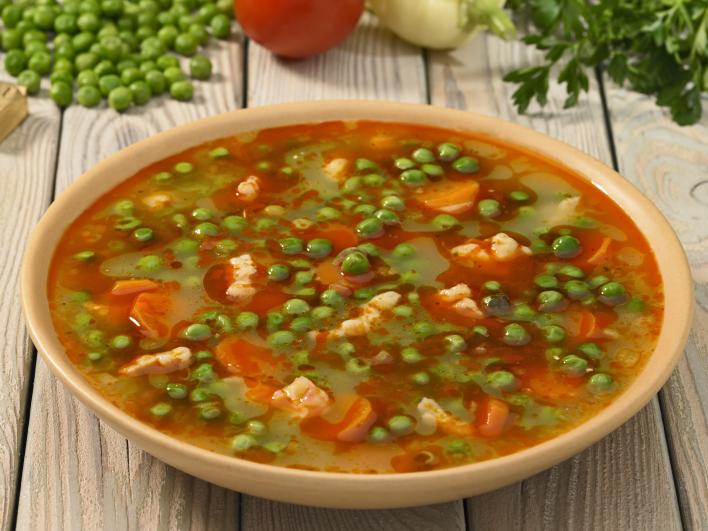
Green Pea Soup

(Zöldborsó leves)

This is a very easy to prepare this delicous soup, especially during the season when fresh peas are out to purchase. A fast and light soup, wonderful on hot summer days. Can use fesh, frozen or canned peas. If using canned peas, rinse them well.

The Hungarian veggie soups can be light soups and thick soups. To make the soup thicker make it with light roux. Depending on the season … green pea, cauliflower, green beans are almost regular soups for the Hungarians.

For 4 person – Preparing time 30 mins.

Ingredients: 500g green peas, 1-2 medium size carrot, 1 parsnip, 1 small chunk celleriac root, 1 small onion, 1 bunch of parsley, 3 tbs. oil, 1 tbs flour, 1 tbs. sweet red paprika powder, salt, black pepper as preferred.

Cooking: Heat the oil in the pot, sauté onion until glistening on medium heat for cca. 5 mins. Adding the cut up vegyies and sauté up 3mins. Scatter flour on top,  stir (practical with wooden soup) for a minute. Removing the pot from the heat add the red paprika. Add cca. 1 liter cold water, let it start to boil. Add the green peas.  When the veggies is done ad the dumplings, cook for 3-4 mins.  until the dumplings and veggies are tender.

Dumplings: 200 g wheat flour (1 cup), 1 egg, pinch of salt, 1 dl, cca 1/2 cup cold water (it should be smooth not hard)

Just a hint … with fresh peas is the best. Can be easily in use of frozen peas, cause peas freeze pretty good. May add alittle sugar, it will not sweeten the soup but the peas will taste yummy.

To read more about traditional  Hungarian soups, visit previous receipt @ “Q” & “A” Culinary Heritage Into Hungarian Kitchen.

© Aggie Reiter

Day-By-Day #1 … Hungarian Cruisine – Lentil Soup with Sausage

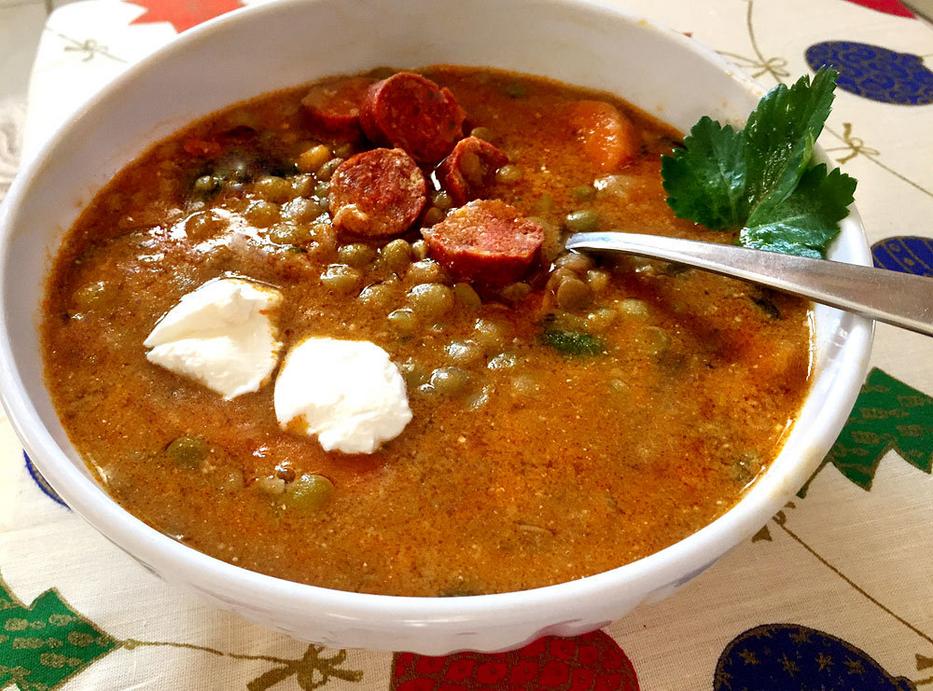
Lentil Soup with Sausage

(Lencseleves kolbásszal)

Lentils are one of our oldest crops, grown in Central Europe as early as the Stone Age.

Not only did lentils play a role as a food in ancient times, but they also gained herbal status: Hippocrates recommended the use of lentils to liver patients. It is good to know that it contains significant amounts of vitamins B1 and B2.

The largest lens-producing countries are Canada, India and Australia. It is grown mainly in the southern and south-eastern parts of Europe, especially in the countries along the Mediterranean. In Hungary only grown area is small.

Lentils at many countries (e.g. England, India) and made into flour, and are also used as an ingredient in food. It is also known as a pie-like state of fried potatoes (crisp), which is an appetizer in Indian restaurants, from which it can be dipped in various sweet sauces.

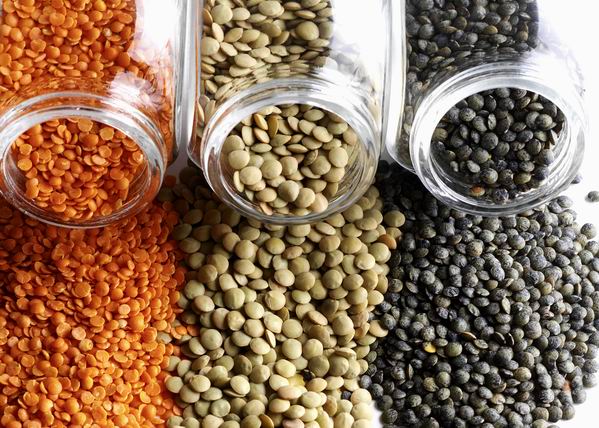
In Hungary, but also elsewhere in Europe, the lentil soup is kinda old traditional way to serve on the first day of the New Year to ensure prosperity for the coming years … It is symbolozing wealth. Lentil soup can be eaten not only at New Year’s Eve, but also a yummy soup at any time. As it is not a light meal, it is recommended to eat it in cold season, it will warm  up the body.  Lentil can also be in use for a salad or steamed as a side dish. In Hungary available three different types of lentils.

Receipt for 4 persons – Preparing time 30-45 mins.

Ingredients: 300 g dry lentils, 1-2 bayleaf, 1 smoked sausage, sliced thin, 1/2 handful parsley to serve, 1 medium size onion, 2 tsp oil, 1-2 garlic clove, minced, 2 tbs flour, 1 tbs sweet red paprika powder, 100 ml sour cream to serve as taste, 1 and a 1/2 liter chicken stock/water, 1tbs mustard.

Cooking instructions:  Place in the oil the cutted onion medium heat until translucent. Add the garlic and stir into it the flour. Remove from the heat  keep stiring whilest adding the paprika power, be careful not to burn the paprika powder. May add the bayleaf then. Pour 1and a 1/2 liter of chicken stock or water and the lentils. Continue slow simmer for 20-30 mins. Add the parsley and continue slow simmer.  Serve the soup with sour cream and season with salt. Some prefer  to add a 1/2 tsp of vinegar in their plate, may also add hot paprika cream as taste requires.

To read more about traditional  Hungarian soups, visit previous receipt @   “Q” & “A” Culinary Heritage Into Hungarian Kitchen.

© Aggie Reiter

Kashmir @ Kupwara District Receives Electric Current – India

This slideshow requires JavaScript.

The Kashmir’s Kupwara District Gets Electric Current Power for the First Time Since Independence.

Last village along LoC ( land of Control

The Keran village is cut off from the district for nearly six months every year due to the heavy snowing- heights of nine to 12 feet during the harsh winters, and the COVID-19 lockdown. The Kupwara district administration connected 3 villages located along the Line of Control in Jammu and Kashmir’s Keran area to the national electricity grid, ending a wait since Independence for power supply. The tasks  ere not easymcaused by the  shortage of manpower for the work after restrictions of lockdown due to the COVID-19 pandemic.

It is an arduous five hours journey to Keran on a fair-weather road that meanders through apple and walnut orchards of the Kashmir Valley and the Pherkian Pass at 10,000 feet in the Shamasbari Ranges.

A power grid has been installed. This will now provide the village with electricity for 24 hours. It will also help residets get rid of noise and pollution caused by the diesel generator set in the area. With the electricity project nearing its completion, the local administration constructed and improved roads in the area.

The government has also given the go ahead to plans to construct 100 new panchayat offices adding to repair another 100 buildings.

For three hours of electricity, the Keran area, with a population of 14,000 in four panchayats, was till recently dependent on three old diesel generator (DG) sets, for which fuel was transported from the district headquarters.

Installed over decade back, the three DG sets were prone to frequent breakdowns further disrupting the meagre power supply, more so in winters when conducting repairs are next to impossible. In 2012, the area’s residents were hopeful that a solution to their power problems was found. The plan was to extend power lines to Keran and establish a grid station. But hopes started to with as no substantial progress was made on the project for nearly seven years, apart from the installation of some solar lighting systems that had limited efficiency even during the summers for some villagers. Not being directly connected to the national power grid threw Keran into extreme backwardness with lack of industries and limited access to medical facilities and television.

All the essential commodities, especially food items and essential drugs are stored in advance for an year in the area to cater to the winter requirements during the cut off area. It was among 112 districts of the country that were chosen for quick and effective transformation.

The Kupwara district administration swung into action deploying multi disciplinary teams to ensure corridor clearance for the entire stretch of the electricity line, that passes through several villages, steep slopes and dense forests.

It may seem as a  small project for the district, but has hugely triggered revolutionary changes in the lives of the common masses starting from switching on a television set as and when they want, to better healthcare, water supply, lift irrigation systems and impacting almost every walk of life now dependent on power supply. The people who were living on the zero line are very pleased for the change to come.

Cultural heritage of Kashmir is multi demensional as the variegated backdrop of its phyisical exuberance which has nursed and inspired it all along. Its sanctity and evergreen stature can be conveniently inferred from the chast shimmering snow, with its virgin top to toe, adorning the towering peaks of its mountainous periphery. Rosy blush lending perennial health to our warbling brooks, roaring waterfalls and sedate and solemn lakes. To crown all, this verynectarine glow has most meanfully groomed out metal  attitude to glean unity  amidst  seeming diversty.  It is a nonstop mental journey with no mile-posts to cool its heels upon. This is a Happy Valley..

Adding Culture – Tradition – Dance, Craftworks and Cuisine.

Culture and Traditional … Jammu’s Dogra is very different from the Kashmiri culture. The Dogra culture is instead much similar to that of neighbouring Punjab and Himachal Pradesh. Traditional Punjabi festivals such as Lohri and Baisakhi are celebrated with great zeal and enthusiasm throughout the region, along with Accession Day, an annual holiday which commemorates the accession of Jammu & Kashmir to the Dominion of India.

It is important to note that Kashmiri culture is predominantly followed only in the Kashmir valley and Doda of the Chenab region. Jammu and Ladakh have their own distinct cultures that are very different from that of Kashmir.

Handicrafts … Handcrafts have been the main-stay of the State’s Economy since Centuries. The dawn of modern era of industries least affected the viability of the crafts that always had the capacity to hold sway in even International Markets. The Wanvun, Roaff, carpet/shawl weaving Kaleenbafi and Koshur Sufiana forms a very important part of Kashmiri identity.

Traditional Dance … The Dumhal is a famous dance in the Kashmir valley, performed by men of the Wattal region. The women perform the Roaff, another traditional folk dance. Kashmir has been noted for its fine arts for centuries, including poetry and handicrafts.

Cuisine … holds a unique place among different world cuisines … having  good resources of  water spread area in the shape of streams, rivers, springs and Irrigation sars. Thus has tremendous  scope for development in fisheries  sector both in trout and food fisheries. Also keeping up with the tradional the Salted tea or Noon Chai also called Sheer Chai is the traditional drink and is cooked in a Samavar, a Kashmiri tea-pot. Kashmir has been noted for its fine arts for centuries, including poetry and handicrafts. Kehwa, traditional green tea with spices like cardamom, Saffron and almond, is served on special occasions and festivals. Kashmiri weddings are regarded incomplete without the Kashmiri traditional food known as Wazwan, which is typically spicy food cooked by the traditional cooks (Waz). Wazwan is a multi-course meal in which almost all the dishes are meat-based.

Kashmir a.k.a. witnessing many spiritual gurus who migrated from their homeland to Kashmir.

© Aggie Reiter


“Q”&”A” Jewish Delicious Food – @ Hungarian Cuisines – Journey Through the Taste Buds

The Hungarian Jewish cooking may be rooted in the past, but its recipes aren’t staying there!

Don’t have to be Jewish to love the Jewish cuisine, it is enough to be a gourmet.


There is hardly a culture in which Jewish food and its preparation are not known in the world.

Just a little insight into the countless inherited and localized Jewish food at Hungary

The first Jewish cookbook was published in Hungarian in the 1880s, followed by several other, practical, kosher recipe collections. Due to the dispersion of Judaism, as many communities, as to many food choices and tastes.

Of course, Hungarian Jewry cannot be an exception. The borders of East and West, the typical Hungarian countryside, or even Budapest’s Jewish circles distinct types of food have become popular with a variety of ages.

The Old Jewish Food, was first published in 1984 and presented traditional Eastern European Jewish food, with the aim of preserving Hungarian Jewish dishes from the turn of the 19th and 20th centuries and the first half of the twentieth century. The food descriptions are a bit concise compared to the recipes, the author entrusts the method of preparation partly to the imagination of the chef or cook.

The Hungarians make many spice mixes at home, most of which include cumin, a few cloves, cinnamon, ginger, coriander, seeds, leaves, mint and, of course, salt, pepper, and the essential peppers, but of course the climate in Hungary is not favorable for all of them. cultivation.

From this abundant gastronomic offer here is one of a good … but  heavy crunchy-munchy

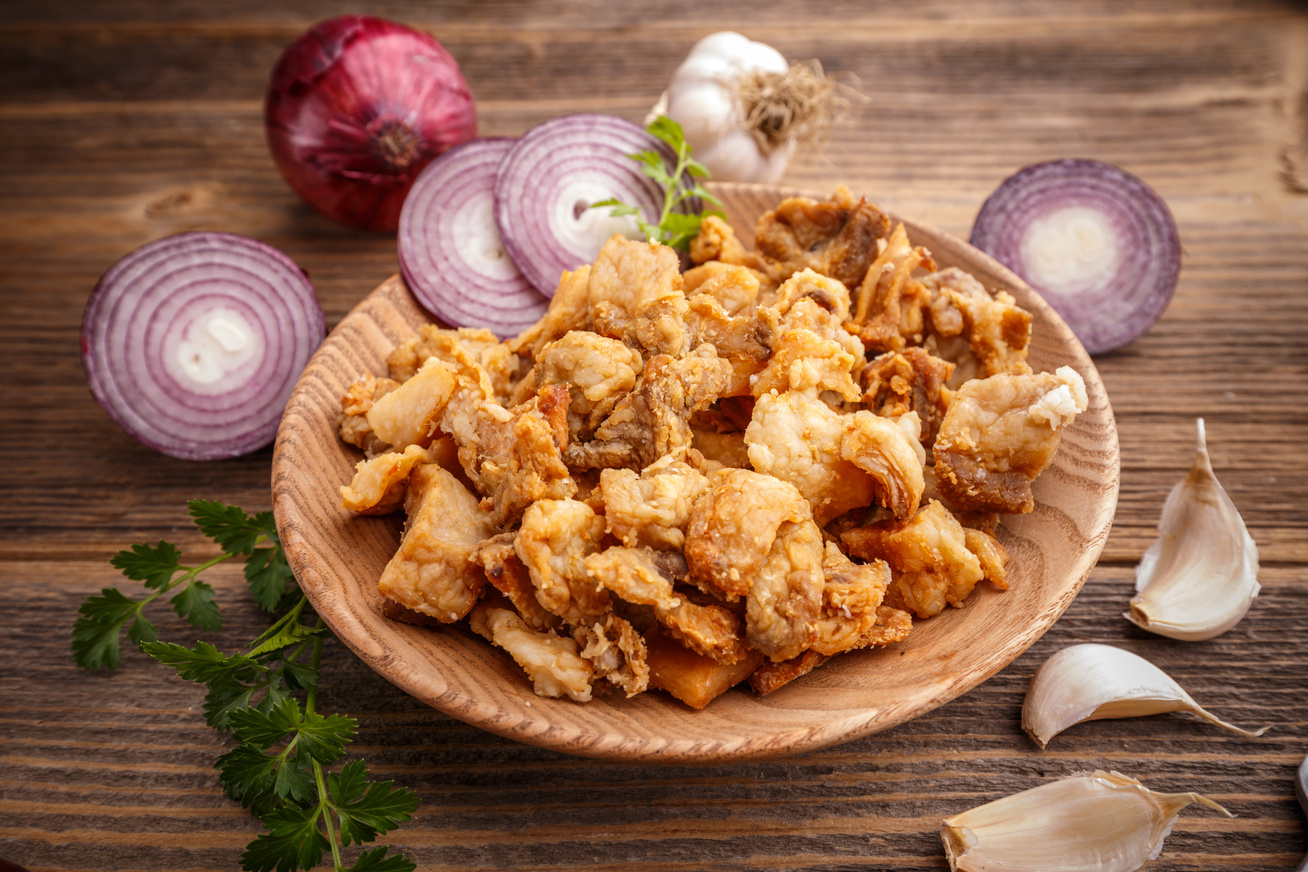
Goose bump with red onion
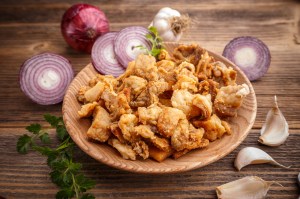
Goose bump It can also be considered akind appetizer. The Hungarians eat it with alot or without red onion.

(Good to know to avoid smelly onion in the breath, eat a tsp of fresh parsley, also when having garlic and its gone.)

Ingredients: cca 1/2 kg of goose skin, little water.
Cooking: The goose skin is carefully peeled off the meat (usually from the breast and back) … usually Hungarians buy at the market goose  bump …  cut into 2 x 2 cm cubes and then placed in a pot. Add enough water to cover it and cook it on a moderate fire, stirring sometimes. By the time the water evaporates, the crumb will turn nice yellow. Bake for a few more minutes, then pour a cca. 2 tbs of water into the fat and squeeze the lid of the pot. This will make the crackling crispy. Filter and pour the goose fat into a jar  and let it cool, later place it in the fridge and can be in use for cooking ie meat soup  by adding 1 tsp to richer the flavor.
Carefully pour the water into the flag fat, it is advisable to pull away from the oven.


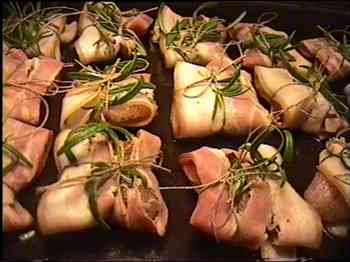
Another yummy appetizing … Chicken Breast Bags with Rosemary
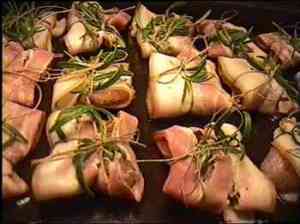
Ingredients: 600 g chicken breast, 16 slices of bacon, salt, pepper, rosemary thread

Instructions: Cut the bacon slices in half. Slice up and tenderize the chicken and put salt, pepper and rosemary on it, then cut it into 16 pieces.
Roll each piece into two slices of bacon and fix the whole thing with a piece of thread. Fix a piece of rosemary on each little bag. It will intensify the mouth watering smell of the dish. Place the bags on a baking sheet and bake them in the oven for about 40 minutes.

Hungarian lunch is not lunch without soup on the table.

Meat soup with matzo dumpling
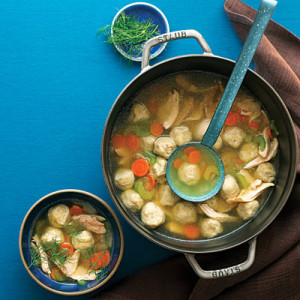
In Hungary, matzo dumplings are not so much made of mace flour, but there are those who make a mixture of coarsely crushed mace. Adding ginger and parsley is the secret to good matzo dumplings. Here is the recipe for mace.
Ingredients: 250 gr mace, 6 eggs,, 4 tbsp goose fat,, 2 bunches of chopped parsley, 2 heaped tsp. ginger powder, black pepper, salt and to make it more  a mocha spoon of soda bicarbonate as well and will be more lighter.
Cooking: eggs are mixed with the fat and the same amount of water is added to it as the amount of egg mixture in deciliters. Add the hand-crushed Passover, the finely chopped parsley, and then season with salt, freshly ground black pepper and lots of ginger. Once kneaded, place in the refrigerator for at least 60 mins. By hand form balls the size of a ping-pong ball out of it and cook it in hot goose soup or it can also cooked in the beef soup or chicken soup.

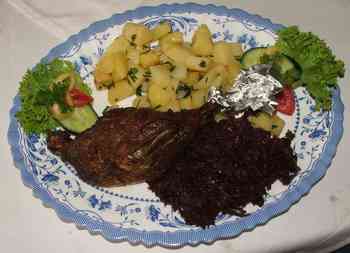
Stewed cabbage with smoked goose leg
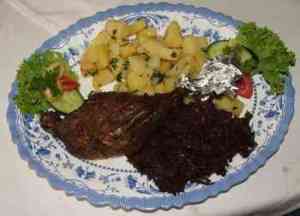
It is very popular … heavy meal … by the Hungarians, but rather cooked in the season of winter.

Ingredient: 2 smoked goose legs, 3 tablespoons goose fat, 40 dkg barrel cabbage.

Cooking: Wash goose legs thoroughly with warm water and soak for an hour or two. Melt the goose fat and heat it over your thighs. Then add the washed sauerkraut and the whole thing, stirring occasionally, just simmer until soft.

Can almost hear the “Q” … where is the famous Jewish cholent? Not missing!

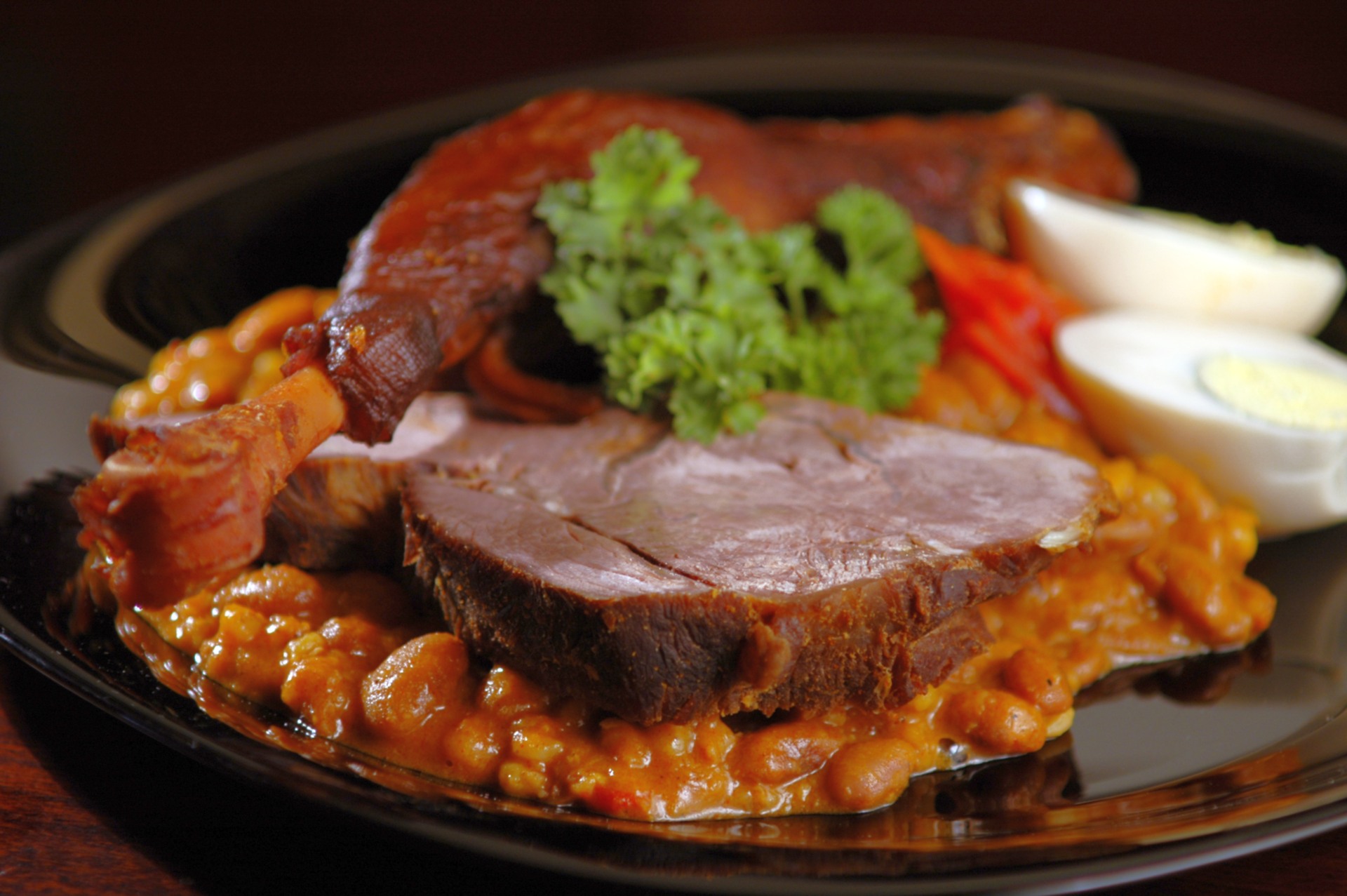
Goose leg and beef meat with boiled egg
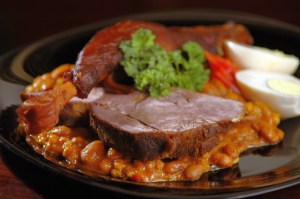
Most probably many people have had already tasted the real Jewish Cholent, but maybe only a few have not cooked it yet. So here is a Hungarian cholent guided tour:

Before the recept … First things First …

“Q” Where does the name Cholent come from?

“A”  The word of uncertain origin …  it is a Jewish Sabbath meal consisting of beans mixed with meat, peas, or a mixture of beans and rice, or pasta. The Jews are forbidden to cook on Saturdays, therefore this food is placed on the embers of the closed stove on Friday, where it is cooked until Saturday.

“Q” How to cook cholent
“A” In a ceramic pot, iron pot or enameled pot.

“Q” Making it on a stove or an electric hob?

“A” The point is to put the dish in the oven, it should be well closed to bare cooking for long hours , also to prevent evaporation.

Ingredients: 40 dkg brown beans 40 dkg beef (for soup), 2 goose thighs, 40 dkg of smoked meat (smoked goose leg or breast is best), 1 small head onion, 1 tsp red pepper, 3 tbs oil or 2 dkg goose fat, 1 tbs flour.
Preparation of brine:
Fry the chopped onion on the fat, sprinkle with the red pepper, add the beans and smoked meat soaked the night before and thaw for approx. With 2 liters of water .Add the meats and sprinkle on top of the flour we mix. Cover the whole thing and bake in the oven until the garnishes are completely softened. Usually in large pots it is good to prepare and make sure the water at the beginning covers all. You only need to salt if the smoked meat in it is not salty enough. Many people put gerslit in the brine, but it is excellent without it. During cooking the water is absorbed by the beans and meats, if so it is recommended to add a little water, but it should be served with short juice, it should be dense.

Life is sweet but better to make it really sweet non the other way than baking Flódni. It is also prepared for some famous event or celebration. Its essential ingredients are all symbols of abundance: poppy, walnuts, dense plum jam, wine and apples. the most famous cake of Hungarian Jewry.

Flódni
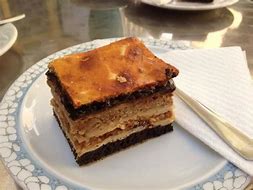
Ingredients: 1/2 kg of flour, 1/2 kg of sugar, 1/2 kg of walnuts, 1 kg of apples, 3  tsp of honey, 3 egg yolks, 1 dl of oil, 1 lemon grated peel.

Baking instruction: Knead the flour, oil, egg yolks and a spoonful of honey. Divide the dough into three and then roll each out to the size of a baking pan. Oil the baking sheet and put in the first sheet. Lubricate it with oil, water it with honey and sprinkle it with the nuts mixed with half the sugar.  Lay the second sheet on top, oil it, water it with honey and sprinkle with half the grated apple mixed with sugar. May bake with other ingredients as listed a/m. Put the last plate on it, water it with oil and honey, smear it on it, and then bake it ready in the oven. Baking time 50mins.

Hopfully, the Hungarian Jewish delicacies cuisine took you on a yummy tour.

©Aggie Reiter

“Incredible Construction” World’s Highest Railway Bridge – Connect @ Kashmir With the Rest of Incredible India

This slideshow requires JavaScript.

Kashmir has often been referred to as “Heaven on Earth.” The heart of the area is the fertile “Vale of Kashmir” (The Valley), which lies between the Himalayas and the Pir Panjal mountain range.

The world’s highest railway bridge in India over river Chenab in Jammu and Kashmir will be completed by December 2021, and will connect the Valley with the rest of India by rail for the first time.

The construction work of the bridge was accelerated in the last one year under the direct supervision of the top echelons of the central government. It is most challenging task in the 150-year-long history of the railways. 

As seen above the massive arch-shaped structure, being constructed in hostile terrain. Had been in use over 5,462 (18,379 ft) tonnes of steel  above sea level on the India side of Kashmir and will be 359 metres above the river’s bed level. The bridge has a central span of 467 metres. The height of Qutab Minar – Delhi 72 metres and that of the Eiffel Tower – Paris  324 metres.  The maximum designed wind speed for the bridge is 266km/h.

Designed to withstand wind speeds of up to 266 km/h, 1.315-km-long, by withstand Blast, Earthquake of Intensity 8. An incredible “Engineering Marvel”!

The Srinagar Leh power transmission line 220 KV Srinagar-Alusteng-Drass-Kargil–Leh power transmission system have also been completed. Ladakh now stands connected to the national grid. This has ensured grid connectivity and reliable quality power supply to the Ladakh region in winter and surplus power can be evacuated from there in summer, reducing reliance on diesel, boosting economy and protecting environment. The semi ring road in Jammu will be completed also by next year and all land acquisition and related hurdles have been removed. In this project, 30% of the work has already been completed. Major roads like Jammu–Akhnoor Road, Chenani-Sudhmahadev Road works has been accelerated and also has been earmarked for rebuilding of health institutions.

The Udhmapur-Katra (25 Km) section, Banihal-Quazigund (18 Km) section and Quazigund-Baramulla (118Km) section have already been commissioned. The last remaining section, the 111 km Katra-Banihal section is currently under execution. The 126 km out of 174 km of tunnels on this section has already been completed.

There has been a greater push in the last one year for implementation of various projects, practically every sector and provides for massive investments in basic infrastructure also  meant for strengthening socio-economic infrastructure and balanced regional development of Jammu and Kashmir.

The Chenani-Nashri Tunnel is the India’s longest road tunnel under construction in Udhampur district of Jammu and Kashmir. The 9.2 km long road tunnel is a major road tunnel project in Northern India and biggest of the country. Chenani-Nashri road tunnel is also known as Patnitop Tunnel also one of the longest tunnel in Asia. The Shivalik mountain range of the great Himalayas will host the India’s longest 2 way traffic road tunnel

Jammu and Kashmir, particularly the Kashmir witnessed the worst-ever floods in 2014 therefore a number of projects have been taken up to prevent floods. The Jhelum recovery project was a key one aimed at increasing the carrying capacity of the river Jhelum and the flood spill channel.

Further might be  of interest:

Tallest … Fastest … Longest Railway Tunnel … Under Sea Level  … High Speed Rail in India.

Tallest: Since 2019, the tallest building in India has been Lodha The Park 1 in Mumbai at 268 metres (879 feet). Multiple taller buildings are under construction as well as multiple taller buildings are on-hold. Mumbai has the highest concentration of high-rise buildings in India.

Fastest: The ambitious “bullet train” project between Ahmedabad and Mumbai is set to be a test of the credentials of the country’s infrastructure prowess. India’s first bullet train between Ahmedabad and Mumbai is likely to be completed by 2022, the year marking 75 years of India’s Independence. Also incated that the project would be completed by 2022, much before the earlier deadline of December 2023. The foundation stone of the project, which will get a soft loan of Rs 88,000 crore from Japan, will be laid on September 14 by Prime Minister Narendra Modi and his Japanese counterpart Shinzo Abe.

Longest: India is the fastest growing industry of mega structure of Civil work,whether its bridges, amazing cloverleaf or elevated freeway in Indian cities. Indian road and rail network are one of the largest transport network in the world and bridges,Tunnels play a major role to complete the connectivity across the country. There are many longer tunnels under construction in the Himalayas ranges as part of Indian railway. Most of the tunnel in India are located in Western Ghat and Himalayas ranges. Maliguda Tunnel is the highest broad-gauge railway tunnel in India and the second highest in the world.

Under Sea Tunnel for India’s bullet train project to be conclude by August, 2022.
Presently both Japanese and Indian professionals are working diligently on ensuring to build a tunnel inside
the creek near Thane/Mumbai.

The dfference between tall and high bridges can be explained in part because some of the highest bridges are built across deep valleys or gorges. For example, (as of 8 February 2020) the Duge Bridge is the highest bridge in the world, but only the tenth tallest. This bridge spans a deep river gorge. The bridge’s two towers, built on either rim of the gorge, are 269 m (883 ft) tall, but due to the depth of the river gorge,
the deck height of the Duge Bridge is 565 m (1,854 ft).

Longest Railway Tunnels of India: The 11.2 km long Banihal railway tunnel is India’s longest railway tunnel and and Asia’s 2nd longest railway tunnel. The great tunnel is located on the highest mountain pass on the eastern Pir Panjal range in middle of Himalayas. Indian Railways is closer to finish the work on India’s longest transportation railway tunnel. The longest tunnel of India is successfully pass its train trial run through Pir Panjal tunnel being the longest rail tunnel in India. The Karbude tunnel is 6.5 km long and one of the India’s biggest engineering marvels is located on the Konkan Railway route near Ratnagiri in Maharashtra. Karbude tunnel is known to be the longest rail tunnel on Konkan railway line situated between Ukshi and Bhoke station.

Last but not least … For many, when they hear the word KASHMIR, Kashmir shawls, women’s top garments and shoulder bags would slip through their mind. Many may know they are ancient Indian industry products in the Himalayan mountains, lower Kashmir province. Even today, many people know and are looking for these special products … and now @ Kashmir also to be known about the World’s Highest Railway Bridge.

© Aggie Reiter

“Q” & “A” Slovenian Culinary Heritage Into Hungarian Kitchen

Slovenian unique culinary journey on “Slavic Cooking” 

Most of Hungary’s food was formed and influenced many centuries ago by the cuisines of many different people kitchen … Turkish,  Italian, German, Bohemian-Moravian,  Polish, Croatian, Slovenian, Slovakian, Romanian,  during the Austrian Habsburg Empires expansion and also Jewish dishes just to mention a few.

It is no surprising foods migration to one and another  countries and becaming popular dishes kept boiling in today’s kitchens.  The Sloven foods are often simple and hearty. Many dishes are made with cream, such as mushroom soup, and pork sour soup. Horseradish with cream, a specialty of northeastern Slovenia, is often served with beef dishes.

In Slovenia also by experience realized “Cabbage” is a veggie which goes with many version in their gastronomy.

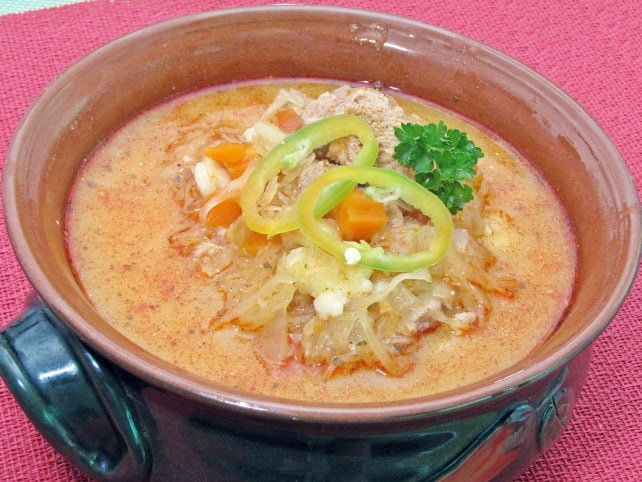
The Slovenian Cabbage Soup made its way to Hungary namely “Káposztaleves” which is a meaty cabbage soup that is often eaten on New Year’s Day. Káposztaleves is also thought to relieve the symptoms of a hangover, and this is probably the reason why this traditional Slovenian Soup became tradicional Hungarian soup is so popular on New Year’s Eve, but not to be confused with Korhelyleves or “Hangover Soup” which is known as one of the world’s greatest recipes with lots of paprika and 3 kinds of meat, topped off with a dollop of sour cream.

Hungarians call the soup (“Man-Catcher”) similar to the Sloven Cabbage Soup

Ingredients:  Ham hock, good size with lots of meat, 1 smoked sausage, ½  large head cabbage chopped or shredded, 8  cups of homemade chicken stock as a broth base or substitute or combined with water to make 4 quarts of liquid, 1  large onion chopped, 3 ribs celery chopped, 1 heaping tbs Hungarian paprika, 1 – 2  cups diced tomatoes, 1 or 2 Bay leaves. Add Sauerkraut (as much or little as you like), Salt & Pepper previously taste it. Sour cream to garnish.
Cooking Instructions. Saute onions and celery in bacon grease or lard, Toss in your cabbage, Add some S & P, Stir around until beginning to heat. Add your stock or water, ham hock, bay leaves and paprika. Bring to simmer. Allow to bubble on low for at least 2 hours. Taste and adjust seasonings as needed. Remove ham hock and dice the meat, placing it back into the broth.

Sloven Baked Mashrooms filled with Chesse

Ingredients: 12 whole fresh mushroom, 3/4 pound good quality of sliced Parmesan, mild Cheddar or Muenster cheese.

Cooking: Preheat oven to 300°F.  Wash the mushroom caps under running water, and remove the stems. Dry with paper towels. Cut the cheese into squares to fit between two mushroom caps. Make a “sandwich” of two mushroom caps with one square of sliced cheese between them. Secure with a toothpick, and place the mushrooms into greased pie plate or baking dish. Bake in the preheated oven for 20 to 30 mins until the mushrooms are tender, until bubbly and the cheese has turned golden brown.

Can be served up to 15 to 20 snacks, as an appetizer, but depending on the number of mushrooms can be a prepared for main meal as well with the same cooking as a/m.

The stuffed mashroom became one of the favorit yummy food in the Hungarian cuisine. It can be varied in many ways throughout all seasons. There is no limit in making stuffed mushrooms with all kinds of delicacies. Most of the work will run through… by the oven, and the result is very appetizing.

These stuffed mushrooms are full of flavour and a great way to start a dinner party. Serve warm or at room temperature.

Slovenia Potica Bread

“Q” What does Potica mean?

“A” A cake or bread filled with (ground) nuts, popular in Slovenia and in Croatia. (In particular, the Slovene variant of this pastry, in contrast to the Croatian variant, termed a povitica.

Slovenian nut roll is a celebratory bread baked for almost every important occasion and it is essential to the celebration of Palm Sunday and Easter. It resembles a jelly roll and is made of very thinly rolled yeast dough spread with a nut paste. The nut paste or filling may differ from region to region.
In Hungary namely different  … Chocolatey cocoa swirls, puffy dough and sprinkle of powdered sugar … this is the divine kakaós csiga (literally “cocoa snail”- cocoa rolls) and the dough can be include with chopped walnuts, pecans, poppy seeds, honey, butter, and dried fruits. There are around 75 sweet and savory traditional bread rolls around the world.

Ingredients:  3/4 cup of butter, 1 1/2 cup of sugar, 4 eggs, 3 cups sifted flour, 1 1/2 tsp. baking powder, 1 1/2 tsp. baking soda, 2 cups sour cream, 1 1/2 tsp. vanilla.

Prescription: Have butter at room temperature; cream with the sugar. Add eggs one at a time, beating well after each addition. Re-sift flour along with the baking powder, and baking soda. Add the dry ingredients alternately with sour cream and vanilla beginning and ending with flour mixture. Spread 1/3 of the butter in a greased bundt or 10 inch tube pan. Top cake mixture with 1/2 of the filling. Repeat; spread remaining butter over all.

Filling: 1 cup ground nuts, 1/2 cup brown sugar, 2 tbs. flour, 1 tbs. cinnamon. Mix together nuts, sugar, flour and cinnamon.

Bake at 350 °F  (175 °C) on lowest oven shelf for about 1 hour or until toothpick inserted in cake comes out clean. Make sure cake is cooled completely before taking out of pan. Before serving, dust with confectioners’ sugar.

© Aggie Reiter

HoneyLoveDay … World Bee Day August, 17. 2020.

There is only life on earth as long as there are bees. Take care of them!

 Indeed bees already have a World Day.

HoneyLoveDay is celebrated since  August, 17, 2019 as the National Honey Bee Day to honor the insect responsible for more than 1/3 of the food we eat from beekeepers, beekeeping clubs and associations, and honey bee enthusiasts from all across the country. Taking this opportunity to celebrate honey bees and recognize their contribution to our everyday lives as a means of protecting this critical species for future generations.

Who has not met the saying … “Sweet as Honey”… but manybe not too many known that the sweet taste of honey is determined by the non-crystallizing fructose, and its flavor  determined by the proportions of essential oils given by the nectars of the various flowers that the bees have collected.

Food for Bees and Food for Humans. It is a product of the nectar of flowers, plant juices transformed by bees. Man has collected honey since ancient times and used it first as a delicacy, later as an important food, and finally as a medicinal product.

It is known by many the consumption and the health effects of honey. Nowonder … honey is rich in vitamins and minerals and is an effective remedy when used both externally and internally. It helps with calcium absorption, increases hemoglobin, treats dietary anemia, in combination with apple cider vinegar has a beneficial effect on inflamed joints, cures all types of infections and respiratory diseases, speeds up the healing of stomach ulcers, and also helps in the healing of allergies. Heart disease (heart failure), gastritis, bronchitis, endocrine disorders (insufficiency), mucositis and immune weakness. The list would be long one, so just to mention a few more “miracals” honey provides instant energy without the harmful effects of sugar, a useful aid in case of insomnia, hay fever, insect bites and infected wounds … no cemicals … a real doctors recept!

In Hungary there are roughly 20,000 beekeepers and about 1.2 million bee families take care of honey production, which means 15-30 thousand tons of honey/year, depending on the weather. Domestic honey consumption averages 90 dkg per capita, while people in Germany consume 1.3 kg and in Greece 1.5 kg. Honey is a storehouse of extremely healthy food, natural antibiotics, vitamins and minerals, so the autumn honey campaign is definitely aimed at increasing domestic honey consumption.

There are several types of honey produced by beekeepers available in Hungary, one of the most popular is the Acacia honey, which is already considered Hungarian, in addition to lime honey and flower honey. Also Beet honey, Chestnut honey, Sunflower honey, Forest honey. Rare but existing Hungarian honeys include: Silkweed, Goldenrod, Wild Tobacco, Facelia, Lavender, Oil Radish, silver fir … Also less known  by the public the  Bee Bread (mixture of pollen and nectar), Bee venom (A special animal product similar to the Viper poison. It is used with great efficacy in medicine for rheumatism, polyarthritis, neuralgia, iris and retinitis. The exact composition of the poison is yet unknown.)

All the honey producers are truly reliable from the Hungarian beekeepers. It is not an easy  mission, their hard-working labor hands and their hearts is included!

Unfortunately, this year’s varied weather … rain, strong winds did not do any good either for pollination, neither for pollen collecting bees either… it is said there will be less out … BUT hope for the Best!

The world bee population is running low, and the lack of useful pollinators would doom strawberries, apples, almonds, tomatoes, peppers, coffee, cocoa, just to name a few Out of our 87 basic crops. Fact is Fact … 3 out of 4 crops depend on pollination. A single bee visits an average of 7,000 flowers a day, and in order for a colony (or man) to receive 1 kg of nutritious honey, one must collect pollen from 4 million flowers. Every year, 1.6 million tonnes of honey are produced only by Western honeybees and 20,000 species of wild bees are known worldwide.

The National Honey Bee Day program started with a simple concept. Bring together beekeepers, bee associations, as well as other interested groups to connect with the communities to advance beekeeping.

All the honey producers are truly reliable from the Hungarian beekeepers. It is not an easy mission, their hard-working labor hands and their hearts is included!

Unfortunately, this year’s varied weather intervened by dense stormy rain, strong winds which did not do any good either for pollination, neither for pollen collecting bees … it is said there will be less honey this year, but honey lovers hope for the Best!

Update Aggie Reiter

“Q” & “A” … Inherited Croatian food in Hungary

Popular Croatian Dishes that made home in the Hungarian kitchen

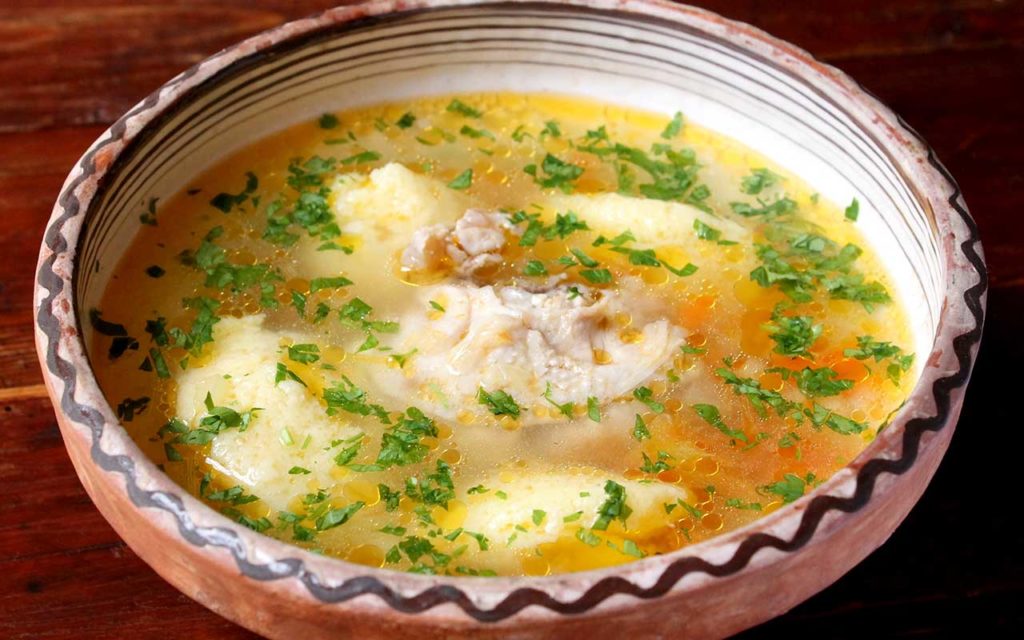
Ajngemahtec – Croatian Chicken Soup with Wheat Grits Dumplings

„Q” Where does the name „Ajngemahtec origin?

„A” The name comes from the German word eingemacht, which could be roughly translated as all in one, due to the fact this simple one-pot dish

„Q” Where did Ajngemahtec – Croatian chicken soup come from??

„A” The cuisine was strongly influenced by Croatia from the Austrian neighbors

Indeed it is nourishing soup with different veggies, containing chicken, heart dumplings and delicious with hearty dumplings. The soup usually served before Sunday lunch not only in Croatia, but Hungary as well as the home remedy to cure everything from flu to hangovers. In Croatia and Hungary it is common in adding to the chicken soup the VEGETA seasoning fulfills an extra flavor of veggies (but be careful with the salting later) Once you tried the mouthwatering soup you will love it. It is pretty simple to prepare it. Nice and comforting chicken soup, traditional (Sunday meal) both in Croatia and also delicious on the table in Hungary

Cooking time: 1h – Servings 4 – Ingredients: 4-6 pieces of chicken thighs bone in, 1 medium onion, 2 large carrots – 1 shredded and 1 finely sliced, 1 cup frozen peas, 1 small parley root (finely sliced), 1 chicken bullion cube, 6 cups of hot water, 2 tsp oil, 2 tsp chopped parsley leaves, 1 tsp VEGETA seasoning optional or any available veggie flavoring, salt and pepper

Dumplings: 2 medium eggs, 2 tsp oil vegetable or sunflower, about 2/3 cup semolina add more, for firmer dumplings.

Cooking instructions: In a large pot heat oil under medium heat, add chopped onion and cook about 2 minutes. Add shredded and sliced carrots and sliced parsley root, season with a pinch of salt and cook for 5 mins, stirring occasionally. Add chicken thighs, 1 -2 cups of water, bullion cube and cook on low heat for 25 mins, stirring occasionally and adding water if necessary. After 25 mins add frozen peas, pour remaining water and cook for 10-15 mins. Remove chicken from the soup and shred the meat of the bone. Put aside.

In a mean time in separate bowl beat eggs with 2 tsp of oil, slowly add semolina, stirring constantly until you get thick batter, making sure that no lumps remain. Warm tablespoon under hot water and with a tablespoon drop full spoons of batter into the soup and cook for additional 10 mins. Add the chicken back to the pot, add chopped parsley leaves, season with salt, pepper and 1 tsp VEGETA and cook for 1-2 mins. Serve warm.

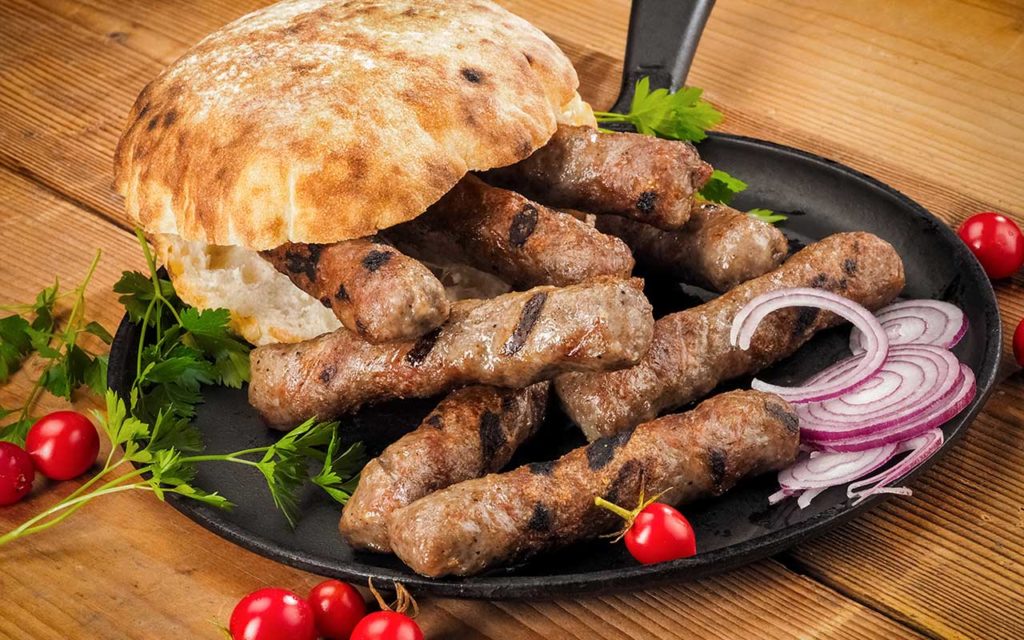
Ćevapi sausages

(In Hungary named: Csevap or Csevapcsicsa)

„Q” What are Ćevapi sausages?

„A” Bascially the Ćevapi are grilled, skinless finger-shaped sausages.

„Q” Where does the Ćevapi origin?

„A” The Ćevapi itself has a Turkish origin. Turkish influence in the similarity to the Turkish kofta kebab, which is a mixed-meat sausage that is molded onto skewers for easy grilling.

The recipe itself will not be complicated at all, in fact, it is extremely simple easy to make, the only possibility of mistakes is found only in the quality of the ingredients. That’s why it’s important to pick meats minced beef or pork, and spices. Ćevapi together with chopped onions, kajkmak, sour cream, minced red pepper, ajvar, and salt are incredibly tasty. For best flavor, let the sausages marinade in the refrigerator for at least 1 hour, up to an overnight.

Ćevapi has an incredibly unique taste and beside among Croatians at the Hungarian kitchen indeed appreciated. Delicious smoky flavor and are perfect for serving with flatbread and sliced onions.

Preperation time 20 mins, Cooking time: 10 mins.

Ingredients: 0.55 lb minced beef, 0.55 lb minced pork, 3 garlic cloves minced,1 ¼ tsp salt, 1 tsp ground black pepper,1 tsp paprika, ¾ tsp baking soda.

Cooking instructions: Take a large bowl mix together all ingredients.Using slightly over 1 tsp of meat mixture per sausage, shape the mixture into sausages the size and shape of a fat finger (roughly 3 inches long and ¾ of an inch in diameter).Place all the formed sausages in a single layer on a platter. Cover the platter and refrigerate for at least 1 hour (up to overnight). When you are ready to cook your sausages, preheat your grill to medium heat, 180⁰C -200⁰C (350-400⁰F) (You should be able to hold your hand a few inches from the cooking grate for 5-7 seconds.). To grill the sausages using a fine grate grill pan for 4-5 mins a side, until golden and springy. Serve the Ćevapi with sliced sweet onions and flatbread (like lepinja or pita). Mind you on the otherside of the Moon, @ Woolworths, Beef Chevaps are prepared ready just to roast Downunder.

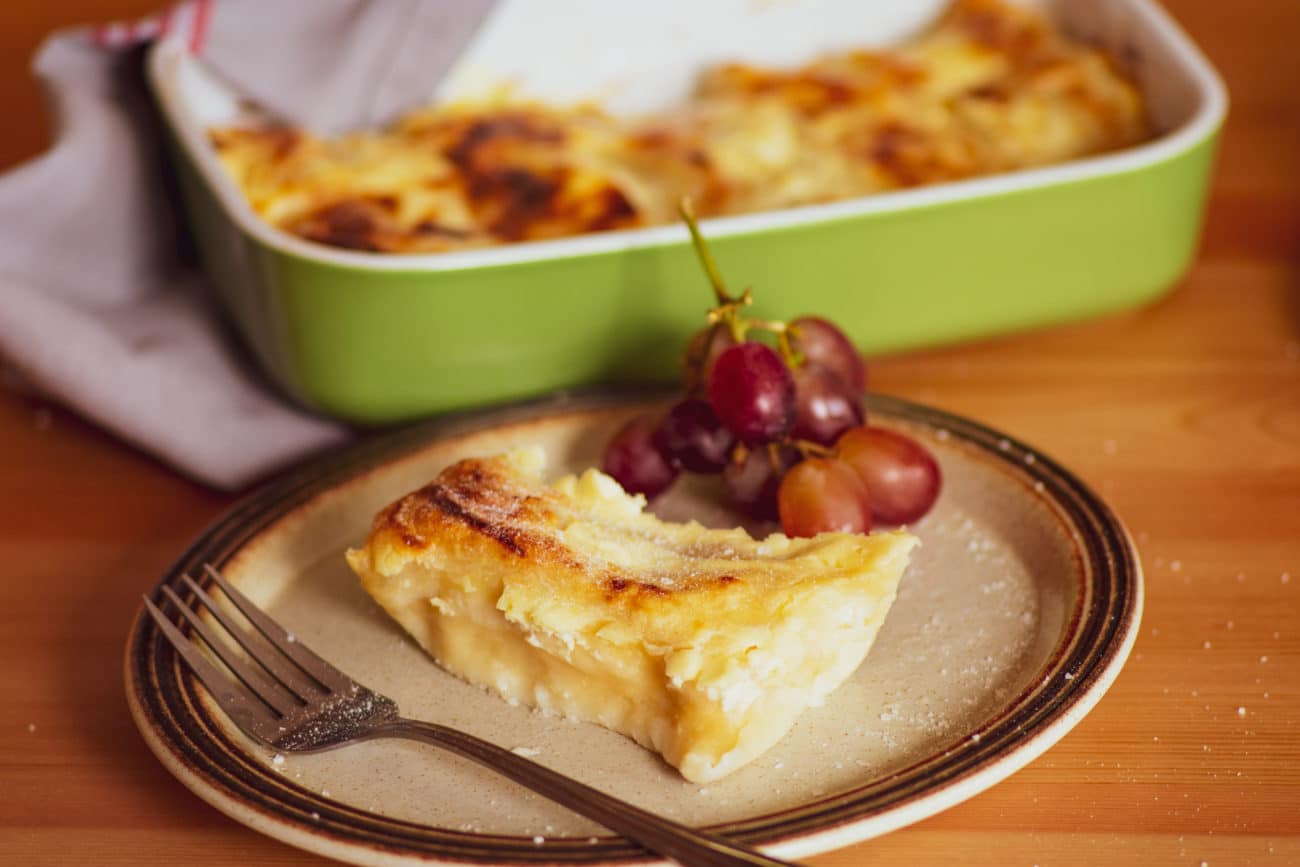
Štrukli from Croatia to Hungary

„Q” Where origin of Štrukli?

„A” The exact origin of štrukli remains unknown, but traced a staple for … pastry and a salty stuffing made from cow cottage cheese, cream and eggs long ago on the hills and forests, northern Croatia … some say the original dish also called Zagorje strukli, originates from the Zagorje region of Croatia)

„Q” What is the Štrukli?

„A” It is a rather simple „pulled pasta” dish, which, depending on the type of filling, can be either savory or sweet.

There are 2 types of Štrukli: boiled and baked. Ingredient is most important need the fresh cottage cheese …  it has a fresh, slightly acidic taste and a refined taste of milk that is only really began to ferment.

Dough ingredients: 0.90 lb, 1 egg, 1 tsp oil, salt.

Serve: 8 – Ingredients for the filling: 20 oz (600 g) fresh cottage cheese, 3.3 oz (100 g) butter, softened + 2 tsp,4 eggs, 0.4 cups (100 ml) sour cream

Preparation time: 30 minsMeanwhile preheat then oven if baked to 180⁰C (365⁰F).

Mix a firm dough of flour, 1 egg, oil and a little salt water. Stir until bubbles appear, then shape the dough into 2 loave ball and roll it  using the tablecloth , stretch the dough out a bit and coat it with oil so that it doesn’t dry out and cover with a warm towel. Leave the dough to rest for 1h. The dough is then stretched out, as usual, on a sheet smeared with oil or on a cloth sprinkled with flour. Mix the ingredients of the filling well, then place small piles on the dough with a spoon in a row, not too far apart. The dough is rolled up, the dough is squeezed between the piles with a wooden spoon and then separated using a plate. This is how to get the separate pieces filled with cottage cheese, which is cooked in flag salt water. Don’t have to cook for long when it comes to the top of the water, good. Place the cooked Štruklies next to each other in a fireproof bowl or baking tray, pour over the cream to cover them.

Stuffing mixture: mix the cow cheese with 4 eggs, melted butter and a little salt and mix until smooth.

Cooking time: 50 mins.  Knead a medium-soft strudel dough from the dough.Divide into 2 loaves, smear with oil, rest for 1h in a warm place. The dough is then stretched out, as usual, on a sheet smeared with oil or on a cloth sprinkled with flour. Mix the ingredients of the filling well, then place small piles on the dough with a spoon in a row, not too far apart. The dough is rolled up, the dough is squeezed between the piles with a wooden spoon and then separated using a plate. This is how we get the separate pieces filled with cottage cheese, which we cook in flag salt water. You don’t have to cook for long when it comes to the top of the water, good. Bake in the oven for about 50 mins at 180⁰C (365⁰F) until golden brown.

Excellent both either hot or cold. You can also put a little filling on the cooked Štrukli.

© Aggie Reiter