TOTO EUROPEAN TOUR – “PECSA” MUSIC GARDEN BUDAPEST AUGUST, 21. 2012

IF YOU AKS ME … I WISH TO BE AT THIS GRAND CONCERT AND HOLD THE LINE!

T O T O

ROCK WITH LEGENDARY HITS AND MUSICIANS

AUGUST, 21. 2012.

When:

8.30 P.M.

Where?

Budapest

PECSA (Petőfi Csarnok) Music Garden

District XIV. 14, Zichy Mihály Road – City Park (Nearby the Hereo Square)

The grand voices and rhythm behind the Super Hits of the ‘80s

Every heart sings a song an those who wish to sing, always find a song

Gosh, time has surely pulled on its running shoes. It’s already six years since the band was here in Budapest, giving a concert at the same place, the PECSA Music Garden.

I believe that where you felt and had a good time you wish to return to the same place. I guess the same goes here with the TOTO and not to mention the Hungarian TOTO lovers will surely be crowed at their one time concert, as mentioned already,

Tuesday, August 21. 2012.

6.30 p.m. on sharp!

Could it be this is one of the reason why TOTO is coming back to Budapest. This is a short European tour only a couple of cities were implemented into Europe and in the States run. Well, we are the lucky ones to be in that pack. A band on stage and their music in our ears are over more than three decades.

Next year will be a huge tour relating to their 35th anniversary with a superb, massive world tour with covering more-and-more cities. So “Hold the Line” you out there, they will be in your town and cities just you wait and see!

Many know, but for those young adults who weren’t as lucky to be around in the ‘80s here is a brief background of the TOTO! The band members met at their high-school. Later in the ‘70s played studio sessions. Soon they became one of the busiest session musicians and their music was like glue or should I say, like a magnet attracted the audience at home in the States and around the world. So the band Toto was formed in Los Angeles in 1978 and from then on they lay their fame in the history of music with their combination of the pop, rock, disco elements, hard rock, soul and jazz, you name it!

Toto released its self-titled debut album in October 1978, and it hit the Top Ten, sold two-million copies, and spawned the gold Top Ten single “Hold the Line.” The gold-selling Hydra (October 1979) and Turn Back (January 1981) were less successful, but Toto IV (April 1982) was a multi-platinum Top Ten hit, featuring the number-one hit “Africa” and the Top Tens “Rosanna” (about Lukather’s girlfriend, movie star Rosanna Arquette) and “I Won’t Hold You Back.” At the 1982 Grammys, “Rosanna” won awards for Record of the Year, Best Pop Vocal Performance, and Best Instrumental Arrangement With Vocal; and Toto IV won awards for Album of the Year, Best Engineered Recording, and Best Producer (the group).

From the list cannot be left out their presence when they had been included in the year 2009 in the Musicians Hall of Fame. They are owners of several Grammy Awards as well.

Bobby Kimball – Bobby’s voice was a distinguishing mark, a signature of TOTO’s 1st hit: “Hold the Line” and topped the hit list fast as shooting star. Need not have to fear the “Hold the Line” will not be missing because of the absence of Bobby, even though many-many who have memos of his awesome, unique, emotional voice will miss him.

All can judge for themselves by seeing, hearing how Steve Lukather ignites the stage not only by the way he brings the sound out of his guitar, it like him having two dozen fingers , but also by bringing back other great TOTO hits like: AFRICA and ROSANNA tunes.

You just cannot allowed yourself to miss it the chance to hear some of the ‘80s music’s biggest hits.

Many will be humming the songs as they leave at the end of the concert and not just that evening but in the coming days, weeks they will surely click the tunes in their head.

Mark the date 21st of August in your calendar!

Get your tickets of the spot at the box office or through the www.ticketexpress.hu

By phone: +36-1-848-0206

Hush … just listen to this quicky sound, if this doesn’t make our feet to follow the track to the PECSA Music Hall, afterwards you will be sorry you didn’t make it!

http://www.youtube.com/watch?v=Lssvr_OpbiE

(My fav. recorded in Japan, where they were beside Europe extremely popular!)

Update Aggie Reiter

146th ANNIVERSARY OF THE BUDAPEST ZOO


This slideshow requires JavaScript.


The Budapest’s Zoo is getting older but its external and internal appearance, also  its residents and the newcomers seems to enjoy their way of  living here in Budapest.

Even though the Budapest Zoo shares 365 days a year to go to the World of the adventures., this Saturday was a special day in the History of the Budapest Zoo by celebrating it’s 146thanniversary. On this occasion prof. Dr. Miklós Persányi, Zoo Director-General decided to add to this celebration as a small present to the little kids, youngsters., in other words, all those kids and youngsters whose height wasn’t over the 146 centimeters could go free of charge. Of course entering into the Zoo by crouching steps didn’t count.

Within the 146th year’s celebration, another highlight of the year was as  to open in the Great Rock the Magic Mountain’s „Varázshegy” Exhibition within a space of 3200 square meters. The exhibition shows the evolution of life in sixteen rooms through giant and molecular displays, fossils, adventurous games. Also a 3D cinema and a unique animal collection was to aim,  bring visitors closer to the land of „Mother Nature” The  Darwin’s Lab, yes, you can look in the microscopes and meet realities. Last but not least,  spend an amazing time by exploring the Ancient Sea, the Time Channel or the Hall of Giants.

As can be seen within the snaps the animals at the Zoo didn’t count on such a  heat wave, therefore they were pretty lazy. Even the lions didn’t sleep that night, . Were probably up all night and  slept during the day. The kangaroos had their “OUTBACK” day. The lizards were immobile, did not even have the strength to take one more step ahead. Even the Mr. Dragon got petrified. The hippo disappeared, probably cooling deep down in his pond.

Superb day for the kids and their family to have this trip to the Zoo and surely a wonderful thought of the Director offer free entrance to add to this celebration  for  (big – max. height 146cms.)  and small kids to visit the  Zoo on its 146th  Birthday.

Update and snap Aggie Reiter

“IRWIN” WAS WEIGHTED AT THE BUDAPEST ZOO

This slideshow requires JavaScript.

The press and media representatives were called to see the  measuring day for the Dragon, no, not because of entering a classy battle game. The dragonometria, is not only important for the scientific interests, nor for the fabled Knights of privilege. The operations are on schedule, “daily tasks”, carried out regularly both at the Budapest Zoo and the Botanical Garden. The Komodo dragon, also known as monitor lizards is measured annually by professionals so its thrive can be tracked. Irwin, the Komodo Dragon named after Steve Irwin  (who would have been 50 years old this year) is 225 centimeters long. This means that if it would be at London’s Olympia, it would hang down from the Olympic village’s bed, because the length of the beds are 197 cm. The Komodo dragon was placed on the Zoo’s scale recently.  Last year at this time Irwin was 191 cm in length, i.e. one year increased by 34 centimeters.

The Komodo monitor lizards “Varanus komodoensis”  is the beast of prey, often eating carrion, but eats almost everything that is on the menu list. Even the folks are not completely safe from him, as the monitor lizards grip by its  jaw can be fatal, and  its bite is also poisonous. The Komodo dragon’s mouth as part of a venom, produces glands and a  high concentration of  bacteria is in the animal’s saliva, which induce the prey’s blood caused by severe sepsis. Well that’s not the best news, but guess so these  horrible sepsis kept these species to survive the time in history. The main area where the dragons  live: Komodo, Rintja, Padar, Flores and of course one that lives in Hungary at the Budapest’s Zoo.

Irwin, popped out from its egg in January, 15. 2007 at the Chester Zoo. Irwin arrived to its new home at the Budapest Zoo in April, 2008. At the time being the Komodo dragon still didn’t reach its body length even to one meter.

Relatively late, only in 1912, Mr. Peter A. Ouvens director at the buitenzorgi (Java) botanical garden described scientifically the presence of the dragon. The reason why it was for so long on a  blank paper was of   the near by Komodo Island the  Sumbawa Island’s prison and the governor strictly gave instruction that the Island was in  private use. So, therefore that fact of dragons living in that territory remained as a secret.  The locals called these species the inland crocodiles.

Update and snaps Aggie Reiter

THE KOH KER PROJECT AND THE MUSEUM OF GOLD IN BUDAPEST

This slideshow requires JavaScript.

THE MAIN AIM WAS TO HOLD TO THE REPRESENTATIVES OF THE PRESS AND MEDIA AN UPDATE  CONCERNING THE PROJECT OF THE  KOH KER TERRITORIAL DELIMITATION.

The collector,  private owner of this fascinating South-East Asian Gold Museum is Mr. István Zelnik.

Director-general Róbert Kuszinger, Head Lidar-project, also director-general of the Museum of Gold, Dr. Zsuzsanna Renner, Director-General – Research institute in Southeast Asia

At the beginning was an update by giving to an overview of the ongoing Koh Ker Project.

Timetable of the project

Cultural heritage protection and archaeological program starts in Cambodia.

2009,  was the year when the research institution in Southeast Asia was established.

2011 roving excavations.

December, 2011 – Jayavarman the 7th, King of the Khmers “khmer” inscribed, gold-plated silver bowl donated to  Cambodia.

Then followed the contract that stood for an International co-operation between the University of Australia at/in   Sydney. The contract  all covered expertise within the co-operation with: Khmer, Chinese,  Australian and French experts. We we were also told the Hungarian party of the Koh Ker project has indeed a string and successful co-operation with Mr.Evans Damian, U. of Sydney, Sydney, Australia (see more at:

http://www.wennergren.org/grantees/evans-damian-harold.

Since April, 2012 the Lidar-program (Light Detection and Ranging)   place.

During the press gathering screened maps and updates of the “closed” territory was well illustrated. As it was pointed out  the works are pretty hard, since they could have  only manage to map the places that were free of mines, but was happy to say they have implemented an air vision method to be able to get shots of places, temples that cannot be reached by foot. Anyway the track signs have to be taken seriously, that is why they are there, so they are  safe to follow.  With the  Tourism,  it seems like it is getting geared up, more-and-more agencies deal with having tours to Koh Ker.

To not only have the frame but to see th picture inside the frame, here is  the background in-brief of  MrIstván Zelnik’s  Southeast Asian Gold Museum. Mr. István Zelnik, the founder and owner of the Museum of Gold aim was to established and maintaining a museum, a  library of art concerning Southeast Asia. The museum is operated by the Hungarian Indochina Co. Ltd.

Mr. Zelnik, who was also present at the press gathering added a couple of thoughts by saying: “Unfortunately had to realize that some co-workers considered a way to gain a trip and enjoy their time, while others were not able to deliver an international standard with providing appropriate documentation. On the other hand, the field work proved  the Krachap Prasat temple turned out to be a former village community center, and it was not only in the X.th century people lived there, but later on as well. The evidence lay out the proof of the 222 pieces of ceramics, 38 inscriptions found in the  in the temple”

In our world which is rapidly increasing pace of information. Here at the Andrassy Boulevard there is a peaceful island where you can rest in Budapest, and yet you feel as if we were in Southeast Asia.

The Aladár Sövény Teahouse is one of its kind, an unforgettable experience. The only unique tea with specialties you would find in Budapest. Especially, if you are a tea-lover. As the inside area,  the outside garden is a  gem of its kind by having around you conceal statues which if they could speak, they would probably tell fascinating tales of the long-long gone past and its culture. Being a tea-lover, one day have to go back to have a taste or two of those authentic Asian  teas.

Throughout the times of history many individuals said they have a dream and within these people Mr. István Zelnik’s dream to open a museum to share the sights and sound with the public came true in the middle of September, 2011. Was worthwhile to have that dream, cause his dream came true with the Museum of Gold and the surroundings.

On the 15th of September The István Zelnik Southeast Asian Gold Museum, where the collector is displaying over a thousand selected artefacts from his peerless collection, opened its gates for the very first time, to remain permanently open from the 23rd of September. Numerous treasures, unique in the world, await visitors to the villa building on District VI. on the Andrássy Boulevard, Budapest.

On the ‘Ides’ of September the historian, Prof. Claude Jacques, the world’s foremost expert on Cambodia, opened the István Zelnik Southeast Asian Gold Museum in a fully refurbished villa on Andrássy Boulevard.  The one thousand most significant objects selected from the several thousand in the Zelnik Collection are being revealed to the general public from the 22nd of September.

The exhibition presents masterpieces arching across several millennia in nine halls on two storeys. In each of the sections representations connected to Buddhism can be found, standing, sitting or walking Buddhas reflecting the multitudinous aspects of cultic objects. Beside the wall of  The Thousand Buddhas space has been given to stupa-shaped reliquaries, votive plates and ritual vessels. The Hindu representations of Shiva revealed to us are differentiated by ethnic groups and kingdoms. And among the gemstones of the Maritime Silk Road quantities of agate, mountain crystal, amber and jade are enumerated alongside carved ivory and precious metal dress ornaments. Through gold artefacts in particular, the exhibition represents the range of the high smiths’ art from the mainland and the archipelago, royal and tribal cultures of the Cham, the Khmer and the Javanese. Never before seen rarities can be witnessed among the tribal objects, among them human-shaped ritual objects and masks presumably connected to death and ancestor cults, the golden drum from the Bronze-Age Dong Son Culture and a series of pectorals from Tanimbar. It is, however, not only the display cabinets that conceal extraordinary treasures at the Gold Museum. The Shop, too, offers a range of genuine Southeast Asian antiques alongside its souvenirs.

At the end of the press gathering, we  got an overall picture in the light of the latest researches and learnt that Koh Ker is once again among the centers of the Khmer civilization and promising the exciting discoveries of the past hidden Angkor Empire.

If this update was not enough and someone wish to get deeper-and-deeper here you go:

http://www.zelnik-collection.hu/home

Update and snaps Aggie Reiter

BEIJING IN BUDAPEST – FINE AND CONTEMPORARY CHINESE ART MUSEUM AT THE FINE ARTS MUSEUM, BUDAPEST

This slideshow requires JavaScript.

Let me start with my Herald news by saying the following: Last year during the Springtime here in Budapest the  Museum of Fine Arts welcomed the awesome exhibition of the Mummies Uncovered. Last month ended that superb exhibition and as the Mummies left came another extremely well introduced  land of arts by bringing  from Beijing  exhibition of  “Openness and Integration” collected from the Chinese Museum of  Fine and Contemporary Art. The exhibition introduce the past three decades by showing the collection of 120 piece of extraordinary ArtWorld of Chine.

The press and media representatives were called to meet the representatives from the Museum of Arts from Beijing and also  had a guided tour by the curator at the Museum of Fine Arts. The exhibition triggered deeply the interest of China’s Fine and contemporary ArtWorld of the 21st century.

The Chinese Museum of Fine and Contemporary  is  brought to Budapest in the frame of the exchange visit by the Fine Art Museum of Budapest visit of last year in Beijing. This year Budapest invited the  representatives of the Museum of Fine and contemporary Art from Chine to hold an exhibition here in Budapest.

Now what the main point to stress out this Herald News here!

The exhibition is only a one time show. At the end of the exhibition September, 09. 2012 all the art works will be heading back to Chine! No other European countries will be able to see these pieces of art, unless they come during the following one month to Budapest.

So, minding all who are  interested in this marvelous collection of Chinese Art, must take their walking shoes and go to see them at the Fine Arts Museum – Budapest.

August, 10 until September, 9. 2012.

The recommended time for a comfy  and enjoyable visit, take yourself 2 hours.

Opening hours: Tuesday – Sunday: 10 a.m. – 6 p.m.

Address:  District XIV. 41 Dózsa György Road – Budapest

Now get ready,here we go on a little art tour to the Far-East without having to sit-fly for hours for the arrival to Beijing!

A wonderful collection of the Chinese  Museum of Arts from the East and West – Old and New.

The title of the exhibition:

“Openness and Integration”

Hosted by the Museum of Fine Arts. The National Art Museum of China selected over 100 oil paintings, traditional Chinese ink-and-wash paintings,drawings, prints and sculptures with the aim of providing a cross-section of the artistic trends of the recent past, the complex techniques applied by artists as well as with the diversity and wealth of Chinese art. The exhibition showcasing the art of the period from 1978 to the present day covers a floor space of almost two thousand square meters and approaches this colourful world of art from three perspectives. The works displayed in the section The Adversities of Time reflect the social developments of the reform period in China, The Poetry of Nature illustrates how Chinese landscape painting with its tradition of over one thousand years continues even today, while The Delights of Diversity shows the various trends that co-exist side by side. The flourishing of contemporary Chinese art has taken place in tandem with economic growth. The art of the last three decades in a country that has embraced the challenges of globalisation is intricately interwoven with China’s social reality, which since the declaration of the People’s Republic of China in 1949 has been in a state of continuous change. The trends that came from Europe and North America exerted a meaningfully significant impact upon contemporary Chinese art (beginning with Expressionism through Pop Art right up to Action Art).  The search for different ways of seeing things and new tools of expression resulted in the kind of processes that have lasted to the present day and which themselves integrate the new but nevertheless maintain links with traditions, albeit at varying levels of intensity. The experiments of the artists seeking to develop a novel visual language have brought forth works created with the most diverse medium sand techniques: beyond ink-and-wash and oil paintings, drawings and woodcuts, photography and video art have also attained accentuated significance in the Chinese art of recent decades.  

Directly after 1949 art traditionally served as a vehicle for representing ideals rather than a means of accurate representation of reality, while in many cases artists were forced to work in isolation, secluded from the world. The classic monochrome ink-and-wash pictures depicting birds, flowers and landscapes proclaimed the philosophy of the unity of man and nature through the use of visual tools; however, they slowly became obsolete since they were no longer suitable for the realistic representation of tangible reality. In the meantime, the oil painting technique adopted from Europe became the government’s most favoured tool enabling it to super  events and figures. Moreover, during the “culturalrevolution” between 1966 and 1976 the art scene virtually ceased to exist with artists being vilified and exiled to the provinces.    

From 1978, under the leadership of Deng Xiaoping, ideological trends of a new kind began to define the development of Chinese art. The contemporary trends that came from the West questioned the purely realistic artistic approach and prompted artists to experiment with modern tools of expressive while at the same time encouraged them to rethink traditional artistic forms. By fusing the artistic tools of abstraction and expressionism with the spirituality of traditional Chinese painting a new style emerged in this period. Further new trends appeared in the 80’s and 90’s, including “rural realism”, which depicted themes taken from the countryside,“classicism” with its roots in Europe, as well as Avantgarde trends borrowed from Western art, such as Expressionism (which appealed to Chinese artists because of its highly subjective symbolic content), Surrealism and Hyper-realism. In addition to Avantgarde trends the old genres also gained impetus in Chinese art, albeit with a significantly renewed content. Pictures made with the traditional ink-and-wash technique and woodblock printing preserving classical Chinese aesthetics and symbols are still present today,although they now reflect an image of modern society.       

Following the spirit of “reform and openness” the institutional system also underwent a restructuring with restrictions lifted and freedom granted for artistic experimentation. The Chinese art of the last three decades can be characterised by unprecedented change and along with this process the international recognition of Chinese artists has grown. Contemporary Chinese artists are now regular participants at international exhibitions. Moreover, in 2011 five of the ten artists generating the highest earnings at international auctions were Chinese with 212 million USD being paid for the art of Wu Guanzhong, some of whose works will be showcased at the Budapest exhibition.

The exhibition  displays the fine art of China throughout in three chapters:

The Adversities of Time

The works in this section are not merely works of art but also documents of a turbulent era.

After the 1978 policy of “reform and openness” was declared the artists that had been exiled were allowed to return to their profession and the training of new generations of artists also began.Artists strove to detach themselves from the standard depiction of social realism and a wealth of new trends emerged. The initial years saw the development of the art of “scars”, which was an attempt to come to terms with the tribulations of the preceding decades. In the framework of the forming ideological vacuum artists tried to find resolution to issues defining the life of the nation and along with this sought to discover their own identities. In addition to depicting historical-political themes Chinese artists strove to accurately capture the rapidly changing Chinese reality that surrounded them and they depicted real people and lives in their pictures instead of the idealised workers and peasants of the previous era. New themes were provided by urbanisation, globalization as well as the relentless progress of the market economy and fundamental changes in society. Rapid growth has brought along with it new opportunities and a deep sense of optimism but at the same time new problems were continually coming to the surface.    

The Poetry of Nature

The approach of Chinese landscape painting, which stretches back over one thousand years, fundamentally differs from its western counterpart, its objective is not to depict a given landscape but instead to capture the relationship between man and nature and to represent an ideal spiritual home. Chinese landscape pictures do not depict actual and scape but rather the internal world of the painter. A break took place with ancient traditions between the 1950s and 1970s, in which time man became the conqueror of nature instead being a part of it. However, from the 1970s onwards the notion of the unity of man and nature was revived and Chinese landscape depiction returned to its roots. At the same time, the genre was renewed to a major extent. Artists in China have now broken out of the constraints of traditional ink-and-wash painting with some landscapes being made with western oil painting and modern graphic techniques, and traditional ideals are embraced by using the most diverse of materials, approaches and styles.Some artists aim for a spatial depiction of the landscape but now the rules that used to govern the kinds of landscapes that could be depicted are no more.       

The Delights of Diversity

In the new era Chinese artists are free to choose their themes and techniques, and can bravely experiment and seek their own artistic modes of expression. The world has opened up before them and they are able to blend the old with the new, and Chinese with foreign art, thus creating their own unique idiom. The many and diverse styles and techniques have made the Chinese fine arts of today extraordinarily colourful, varied and dynamic: traditional ink-and-wash painters and postmodern media artists work side by side with the representatives of realistic oil painting and abstract experimentation, influencing each other. Both traditional genres and contemporary trends are experiencing a golden age. The boundaries between the various branches of art have become indistinct and traditional categories are no longer applicable in China either. The Chinese art scene has become international.  Chinese artists now form part of and indeed shape global trends,while striving to preserve their own national characteristics.

There were pieces that surely made favours, mention just one of them that caught my eyes. I could have spent hours just going strolling through the sights on the huge wall painting, showing the different lifestyles throughout the VILLAGES painted by  LIN SEN.  See in the collection of snaps.

Update and snaps Aggie Reiter

“PUCCINI – TURANDOT” IN BUDAPEST AT THE OPEN-AIR THEATER ON THE MARGARET ISLAND


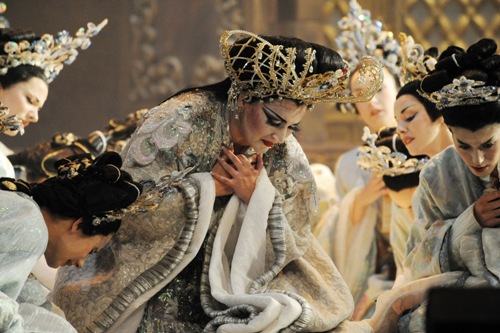
 Ms. Gyöngyi Lukács in her title role of  Turandot at the Barcelona Opera House July, 2009. Photo by A. Bofill

NOT TOO MANY WEEKS ARE AHEAD OF US OF THIS YEAR’S SUMMERTIME, BUT STILL TO COME TWO SOPHISTICATED PERFORMANCES WILL BE ON STAGE AT THE MARGARET ISLAND’S OPEN-AIR THEATER

2012

Puccini: Turandot

Spectacular Opera

Friday, August 10 and Sunday August 12.


Puccini’s opera Turandot is one of its kind, interesting feature and despite the author’s authentic Chinese music which was motifs used in his work, the performance was banned in China for more than seventy years.

The role of Turandot will be performed by Ms. Gyöngyi Lukács, the world-class dramatic soprano singer, who beside the Hungarian State Opera house has been in the title role of Puccini’s opera at  several Opera Houses like: Palermo, Los Angeles, Barcelona (see photo above taken in 2004).

Mr. Rubes Pelizzari, Italian tenor playing in the role of Kalaf  will be first seen in Hungary.  After his debut in Budapest, he will be leaving for Japan to sing, play in the same role. The conductor will be Mr. Zubin Mehta who already conducted the opera in Beijing in the year 1998.

On this premiere  of Turandot  at the Margaret Island Open Air Theater  the  Chinese Youth Orchestra will be welcoming  at both performance upon the  arrival of the  guests. As it shows from their name the Chinese Youth Orchestra  are all youngsters from Guangdong Symphony Orchestra. They have had been winning several competitions. currently, they are on their European tour. The orchestra is  coming to Budapest from Vienna  to see the concert-opera style version of Puccini’s Turandot.

Puccini’s three act opera show will be presented in two parts. The background story may be well-known by many. Just a reminder:  More than five hundred years the place called the Forbidden City,  served as the residence of Chinese emperors.

The Turandot was the last written opera by Puccini. It was an unfinished opera because of his sudden death. Luckey from his manuscripts and notes it was possible to complete the whole opera. The premiere is dated back  to April, 25. 1926. whereas at the La Scala in Milan, Mr.Arturo Toscanini conducted the opera.

As many who have attended to any of the previous Budapest Summer Festival events surely know by now that there is a boat service on duty between the Vigadó Square (there are several other station stops, but this is the most convenient for tourist and also for the temporary foreigners staying in Budapest) to the  Margaret Island Open-Air Theater  back-and-forth. This boat service is operated by the MAHART (Hungarian Shipping Co.). Fair tickets are available at the boat station’s cashier box heading to the Margaret Island’s Open-Air Theater. Back-and-forth tickets can be purchased in advance.

Hopefully, all will be lucky enough to still get their tickets before the grand events, if not in advance then on the spot at the ticket box. Tickets are also available  through online service at   www.szabadter.hu or simply dial  through: +36 30 584 1043.

Update Aggie Reiter

2012 – MAN OF LA MANCHA “GALLOPING” TO THE CIRCUS RING UNDER A TENT AT THE SZIGET FESTIVAL

This slideshow requires JavaScript.

A COMBINATION OF REALITY AND DREAM

MAN OF LA MANCHA

TUESDAY – AUGUST, 7. 2012.

The production started  6.30 p.m. on sharp along with an accompanied live music group.

In the previous years the SZIGET audience could have had insight of dance, circus, visual arts, classical music productions. This year was the first time after 19 years the SZIGET festival designed the presence of a circus tent to be able to introduce productions to the theater lovers.

This year’s on the 20th anniversary of the SZIGET Festival was enriched by a new initiative with  a circus ring under a tent. The famous Wasserman, Leigh and Darion musical, the Man of La Mancha  production was performed by the  JÓKAI Theater from the City of Békéscsaba on the Day-Zero.  The play has a switch knob compared to the original story. The director Mr. Pál Fekete, placed a part of  the act scene back to the ’50s Hungary, when people just being ordinary people were feared by the communism of being collected and moved into different kind of camps.  Then here comes the poet, Cervantes, who has stories for them of  trying to give faith back to the prisoners. This was the director’s interesting  combination connected to the ’50s past era in Hungary and the Man of the La Mancha (Don Quijote). Those foreigners from the West had some “blackouts”  at  the scene when the “Pobeda” made, black color vehicle rolls into the rig.  Most probably thought how on the earth comes this scene to the original play. The youngsters may have had no idea of what the car has to do in the play, which symbolized the fear during the communism.  At the end as I talked to some, they put the pieces of puzzles together.

The JÓKAI Theater and the SZIGET brought something that caught many attention, not only locals, but foreigners to go-sit-watch the well-known story of the MAN OF LA MANCHA  instead of sitting at one of the outside pubs and drinking a cool beer.

By the beginning of the musical, inside the tent it was completely full, no seats available, but many just stood at the entrance and exit pathways, even sat on the floor. In front of me sat a young couple and saw they were  absolutely present by watching with  all their senses. At the end following one-by-one, folks stood up, cheered and constantlywere clapping. Asked the young couple, how did they go on by following the play. They told me, even though they don’t understand a word of Hungarian, they were able to follow the musical, only had some trouble to follow what and why  the black color car collected people, but indeed enjoyed dropping by the tent theater to see this musical. Also told me they are from Germany and beside going to other European gigs, this is their 4th year coming to the SZIGET Festival and enjoyed the culture being brought to the festival. Not only them, but almost everyone was loose in cloths and flipped around in flip-flops. Haa, to enjoy culture events doesn’t always need to be dressed in smoking to be able to enjoy a good production. Guess, now-a-days  it’s not the dress that makes someone enjoy a good production.

The original musical’s length of time is two hours, here at the SZIGET the production was brought to a shorten version.

The five-time winning play was on stage by the following Jokai Theater’s actors and actresses:  Mr. Antal Cerna, Mr. György Szomor, Mr. Lajos Csomós, Ms. Erika Lapis, Mr. Ferenc Jancsik, Mr. Ferenc Katkó, Ms. Orsolya Ceselényi, Mr. Lajos Szabó, Mr. Attila Gulyás, Ms. Erika  Nagy, Ms. Erika Steinkohl, Ms. Anett Komaromi, Ms. Adrienn Cseh,  Gábor Vadász, Mr. Róbert Nagy, by Mr Arpad  Burány, Mr. Péter Mlinár, Mr. Norbert Szőke. Mr. S. Albert Gabor.

Director Mr. Péter Fekete.

The Act does not stand of just platitudes, the sentences are eternal truths, which cannot be repeated enough times.

At the porondin the artists, I mean the actors and actresses surely have made an unforgettable evening of  Day-Zero at the SZIGET Festival 2012.

AND …

Last but not least …  for those who would like to hum along and refresh their memos by seeing/hearing the unforgettable  Mr.Peter O’Toole performance:

Update and snaps: Aggie Reiter

DAY3 – AUGUST, 5. 2012. – APLEC INTERNATIONAL CATALAN CULTURE DAY – IN BUDAPEST


This slideshow requires JavaScript.

This Sunday was hot … not only the weather was quite unbearable with the 36-38C  but the Catalans heated the air with their continues shows. Only a 20 minute of  “tropical rain” cut off the show but afterwards it continued as nothing has happened with performances of  the grand Minyons de Terrassa – Human tower, Musica tradicional – Traditional Catalan Folk music, Havaneres – Habanero, Gigants, Falcons, The Esbarts, Castells, Dracs – Dragons, Diables – Devils, Cobla – Catalan folk dancing,   BigHeads, Bestiari festiu – Bestiary festive, Ball de bastons – Stick dancing,  last but not least  the 70 years old giant puppets often strolled along the audience.

The Catalan unique visual world debuted at its best with their  ARTFOLK  production in Budapest.Let alone, it was a short  three days visit, but  from early morning  up till late night the Liberty “Szabadság” Square was overcrowed by locals and tourist from the States, Canada, Sweden, Austria, UK, Mexico  at least I dumped into these tourist interested in the show performances. The Catalans surely have the key to open ears and eyes to take many on an entertainment ride.

One of the grand attraction was the  Catalonian  made  “Rom Pujol” rum on fire, then after the public could have the tastings. It did not cause any dizziness, cause the main part of the alcohol burned, it remained a nice sweety flavor.

As it got darker-and-darker and closely reaching the culminating in performances, the audience had a chance to see a superb show that couldn’t have had been arranged better at the circus: The flying mythical Turul bird, the huge fireworks, air acrobats, fire-breathing dragon, devil figures, dancing with the “bear” filled the Szabadság Square.

At the  official closing  ceremony  Ms. Zsófia Vitézy, Head of the Budapest Festival Center, thanked in the name of  the Metropolitan Municipality all the members of the Catalan for giving us, the Hungarians an enjoyable 3 days of the Catalans feeling with the shows of the awesome artists.  The  ten-stories tower performed  by the acrobatics was a  real breathtaking  act. This show for the Catalans holds a symbolic message of Courage, Togetherness and the attention to each other. This also is a lesson for us Hungarians.  We should all learn this from the Catalans, as we very much need in our everyday here in Hungary,  closed her talk.

It was announced by the president of the ADIFOLK  Mr. Antoni Vinas representing Catalan autonomous government the next year’s, Aplec International Catalan Culture Days to be held  in  Marseille. That will be the Aplec’s 26th Birthday.

Before the lights went out the whole audience at the  Liberty “Szabadság” Square sang as one, waved back-and-forth to eachother, smiles were big and wide and some huged and kissed each other as old friend do in Catalan stlye by saying good-bye. The Catalans said good-bye and most probably will leave with making great friendships here in Budapest.

Who were out on all the 3 days surely had a little culture, folk, amusement visit in Catalan. Great Spanish yummies prepared by the Zöld Pardon and Hungarian fried bread “lángos” specialities and the wines and pálinka could not be missed on the spot.

Update and snaps Aggie Reiter

DAY-ZERO – LOOK FOR THE HUNGARIAN THEATER TENT AT THE SZIGET FESTIVAL 2012.

This slideshow requires JavaScript.

Throughout August, 6 till 13, at the Óbuda Island the “SZIGET” = ISLAND will hold its 20th anniversary.

Just two days left before the “locks fall off” the gates.

The “Jokai”  theater from the City of Békéscsaba presence at the “SZIGET FESTIVAL”at the circus ring theater tent.

Sunday – 6.30 p.m. – August, 12.2012

MAN OF LA MANCHA

A Music and Drama in a slightly different way!

In brief … a musical concerning hope, faith and never giving up under the time of communism!

The Broadway hit musical puts Cervantes’ novel into an inquisition prison, whereas it is adapted into a circus tent by Director Péter Fekete in 2012.

Why is a great black POBEDA, i.e. the great dreadful car of communism in the middle of the tent? Who are the people driven behind the barbed wire and sitting on their suitcases waiting for? Relocation? Holocaust? Concentration camp? People are waiting with empty looks, they are uncertain and have lost everything. They are distrustful toward the external world and to one another as well! Then somebody comes who tells tales, fights like Don Quixote, plays and gives hope. And also gives faith in the power of community and never giving up.
It is a unique theatre performance, a real team work: acrobats, musicians, artists, dancers are on the same stage, circus and theatre spaces give a combination of reality and dream. Monumental pictures that burn into memory, live music: a bunch of miracles.
It is a musical in a different way, without political hints but with a powerful thought message, and spectacular scenes never seen before.

Text Book: Dale Wasserman
Music: Mitch Leigh
Lyrics: Joe Dario
Translated by Tamás Blum

Cervantes (Don Quixote) – Anthony Cerna
Sancho –  Lajos Csomós
Aldonza – Erika Lapis
Governor (Innkeeper) – Ferenc  Jancsik
Innkeeper –  Ferenc Kató
Prince (Dr. Carrasco) – György  Szomor
Captain – Orsolya Veselényi / Lajos Szabo
Padre – Attila Gulyás
Housekeeper – Erika Nagy
Antonia – Erika Steinkohl
Maria, (hostess) –  Anett Komaromi
Fermina, (cook) – Adrienn Czech
Pedro, (a master muleteer) – Gábor Vadász
Anselmo, (Barber) – Róbert Nagy
Carlos –  Árpád Burány
Juan – Peter Mlinár
Tenorio –  Norbert Szőke
Jose – S. Albert Gabor

Set Decorator – Howard Lloyd
Director – Péter Fekete

The play in Hungary is presented through the Agency of the Theatrum MUNDI Theater.

“-“

TO GET INTO THE GROVE AT THE “SZIGET” …  SEE … BE … ENJOY … THIS SUPERB GATHERING:

 http://www.sziget.hu/festival_english/programs/

MOST PROBABLY FROM EACH-AND-EVERY CORNER OF THE COUNTRY, JUST LIKE MANY HAVE DONE IT THE PAST 20 YEARS WILL BE SHAKING ALL OVER AND ALSO THE NEW AND REGULAR VISITORS FROM ABROAD WILL HAVE  WHAT THEY HAVE BEEN AWAITING FOR  THROUGHOUT OF THE WHOLE  YEAR.

Update Aggie Reiter

CATALAN – BUDAPEST – GIFTS PRESENTED BY BOTH SIDES

This slideshow requires JavaScript.


During the late morning hours on Saturday, the representatives of press and media gathered at the scene of the hall at the New City Hall, whereas  the Catalan artists, performers gathered  and were welcomed by as Mr. Miklós Csomós, deputy major of  the Metropolitan Municipality and Ms. Zsofia Vitézy, Head of the Budapest Festival Center.

Also the president of the ADIFOLK Mr. Antoni Vinas, Catalan autonomous government representative was present.

After the artists were welcome, each-and-every Catalan group, performers, dancers, human tower representative all one-by-one came to greet   the Major of the Metropolitan Municipality  by handing over gift from and  concering their activities.  Mr. Miklós Csomós, deputy major,  also  handed over a token to remember their stay in Budapest celebrating their 25 th anniversary

This time fewer words are the best, cause  the snaps speak for themselves.


Update and snaps Aggie Reiter