Archive for the ‘New Theme on its way – “Q” & “A”’ Category

Day-By-Day – Travel in Traditional Hungarian Foodies #4

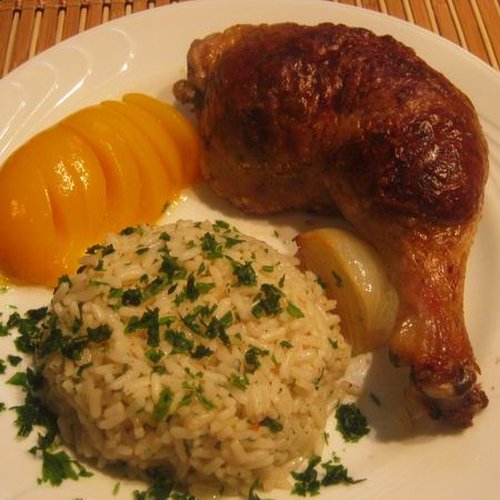
“Gödöllő” Style Stuffed Chicken –  Gödöllői  Töltött Csirke

To increase the taste buds pleasures we can add canned peaches

The name Gödöllő stand for a small city, a suburb area of Budapest. It was the summer resort of Queen Sissy – wife of Franz Joseph 1.

A peck into the background of the small city Gödöllő … The recipe for stuffed chicken breast from Gödöllő is an imprint of the former Baroque abundance. This dish has an upscale name, the name of an upscale place with a rich history. The stuffed chicken breast from Gödöllő and the honey kiss from Gödöllő preserve the memory of the former greatness of the eponymous city. Gödöllő was built in the XIV. century. It was founded in the 16th century, and although it became almost completely unpopular during the Turkish occupation, it was later repopulated in the XVIII century. In the 16th century, Antal Grassalkovich was the landlord of this, thanks to him, today, the defining structure of the town, the castle. Since then, Gödöllő and Gödöllő Castle have been direct witnesses to many turning points in Hungarian history, and the accommodation of countless famous figures.

Chicken breast is a good food in itself, but from now on it can be varied and it bears well if it is supplemented with all kinds of delicacies. In this way, mushrooms, liver and green peas can be included in the spirit of the Gödöllő filling. The stuffing could be a rich food in its own right, but along with the meat and the garnish it offers, it’s a truly fabulous feast.

The recipe  the most stuffed chicken legs, shows the love of hiding food in other food… Try with bigger parts in the beginning, it will be easier doing the fillings.

Ingredients for 4 persons – Preparing time cca 60-80 mins.

4 whole chicken legs with their skin  left on, or if taste may have chicken breast meat, 151-200 g chicken liver, 2 rolls of soft bread, 100-150 g green peas,100-150 g mushroom, 100-150 g bacon, 2 eggs, 50 ml milk,1 handful of chopped parsley, 1 tbs of lard or butter,salt, pepper to taste, 3 tbs breadcrumbs.

Chop the bread roll, mashroom, liver and the bacon.Star frying the bacon in a  cooking vessel. Remove the bacon, saute the liver and the mashroom in the grease of the bacon, then mash the liver when cooked. Add the peas, cook for a while, thenafter mnix parsley together. Season with salt and pepper. This will take only 10-15 mins. Poor milk on the bread rolls, mix it together with the liver, eggs and mash. Add some breadcrumbs to it and there you go the filling is ready. Now come the chicken legs. Use your fingers to loosen the skin of the chicken legs and take a small spoon to stuff the mixture under the skin. Put  a little grease into the roast pan or tray. Place the chicken legs in it, add some grease on top of the chickens. Bake them in the oven until the get a golden color. Upon the baking time grease them to avoid the skin to open while baking and skin won’t open with the stuffing.  The heat has to be 140-150 celsius that will bake the chicken and will not burn. Do the baking cca. 20 mins. Good to know … When working with chicken skin, make sure no feathers are left on it. Can easily burn over the fire.

May read more about other traditional  Hungarian dishes by visiting previous recipe @ “Q” & “A” Culinary Heritage Into Hungarian Kitchen. 

© by Aggie Reiter

Day-By-Day – Travel in Traditional Hungarian Foodies #3

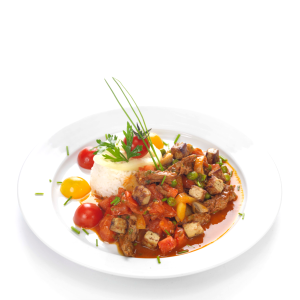
Beef Style “Budapest˝  – Budapest Bélszín

“Q” What kind of  beef meat is to buy, to suit to cook ˝Budapest˝ Sirloin?

“A” The fillet beef is an expensive cut of beef but make sure to get the middle section and not the tail ends – the plumper the better – also make sure the butcher does not fold or roll up the fillet to make it look rounder. It needs to be the middle cut of the fillet.

The ˝Budapest˝ Sirloin is a beef roast dish with mashroom, goose liver and green pea ragout. It can also be easily prepared at home and is something typically found in restaurnts as well.  Can be served having rice or patatoes, but yet some like it with French fries.

Ingredients for 4 persons – Preparing time: 45mins

One large onion, salt, 1/2 tsp pepper sweet red paprika powder, 200 goose liver, 100 g smoked ham or bacon, 1 Hungarian sweet yellow pepper, 200 g mashrooms, 1 large tomatoe, 150g green peas, 600 g fillet of beef, 1/2 handful of parsley, oil for the stew and for the grill.

Cooking: Cut the smoked ham and the veggies into pieces. Dice the onion finely. Heat the oil in a saucepan and sweat the onion in it until translucent. Add the ham into the pan and fry until crisp. Deglaze the pan with some stock then add the sliced pepper, tomatoes, mushrooms and paprika powder. Cook over high heat, stirring lightly continuously til the veggies are browned. Add then the peas and continue cooking on lower heat until they are tender. Seasoning with salt, pepper and parsley. Now cut the beef and the the liver into slices, flatter a little with the palm of your hand. Heat the oil in a skillet and grill the for around 5 mins on both each side until the center is medium rare and in the same skillet grill the liver for about 1to 2 mins. (keep in mind only grill the goose liver when all is to be served cause it cools down quicky.) The place half of the ragout on a serving dish and on the  fillets and the liver on the top. Place the rest of the ragout on each of the fillets and on top the goose liver. For side dish can have rice, potatoes or French fries.

There are other beef styles in Hungarian which are popular, just as forexample the Beef Stroganoff Style with mushroom, gherkins and shallot in creamy sause (see here @ previous recipe: https://rollinginbudapest.com/2020/06/08/part2-continue-gastronomy-inherited-over-50-years-of-russian-rule-hungary/

© by Aggie Reiter

Day-By-Day – Travel in Traditional Hungarian Foodies #2

Here comes another favorit foodie #2 by Hungarians, and now may be on your tables as well. Check it out!

While it’s easy to get lost in the country’s food, the promise of “typical local cuisine’ doesn’t always provide the truly authentic experiences that locals have at home. Hungary is no different and, while goulash is certainly a familiar national dish, the cuisine that most people enjoy is often simpler and easier to prepare. Here see & cook yourselves to explore the meals that Hungarians actually eat.

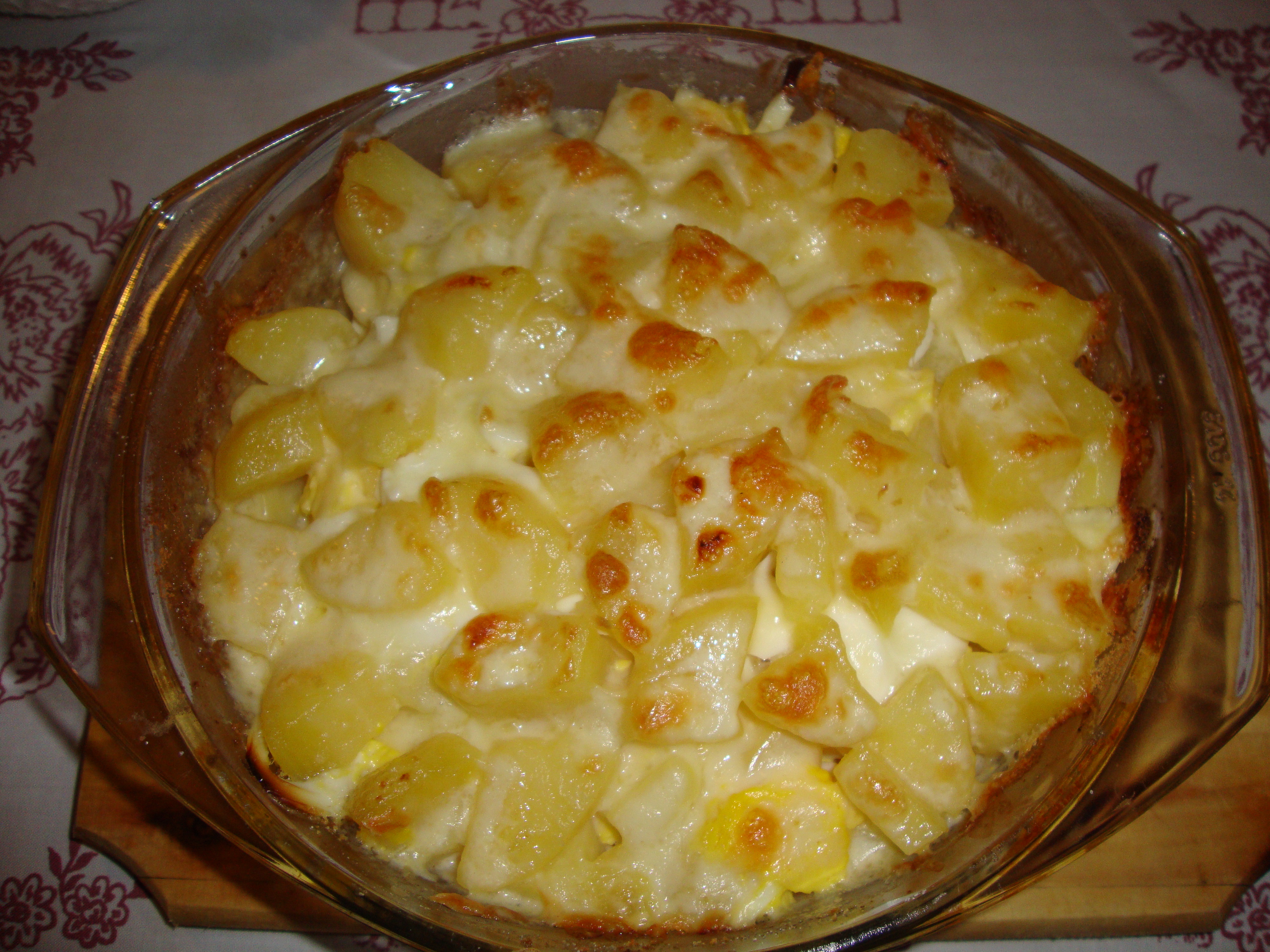
Cheesy, sour cream, eggs layered potatoe” & a.k.a. Casserole potatoes 

Sajtos, tejfölös, tojásos rakott krumpli

A pure comfort food –  baked until bubbly and golden.

Literally meaning ‘layered potato’, rakott krumpli may not appeal to the uninitiated, but it is one of the most popular comfort foods in Hungry. Layered potatoes are made in more than 30 different ways in the regions of  Hungary. What makes it even more unique is that each family has its own subtle twist on the basic recipe. It is often on the table in most Hungarian families, even the children love it, and the head of the family is full of it.

For the real  gourments the traditional  Hungarian layered potatoes is a “must” with Hungarian smoked sausage “füstölt kolbász”.  Can’t find it on your end, may obtain other smoked sausages … or possibly bacon will do in the meantime (without sausage will not be tough to stomach but worthwhile once to have a try).

There’s a whole family of layered dishes as well, though each recipe comes with its own unique twist. For example layered cauliflower – rakott karfiol, involves pouring a creamy cauliflower sauce a top a minced meat and rice mixture. As well layered cabbage – rakott káposzta uses cabbage leaves for a similar effect.

“Q” From where did the layered potatoes come to Hungarian cuisine?

“A” The layered potatoes are derived directly from the French, they call it Tartiflette.

Q” What is the difference between the French Tartiflette and the Hungarian Layaered Potatoes?

“A” Tartiflette contains camembert-like cheese, bacon, onions and fries, fooled by a little white wine. However the Hungarian version contains eggs and smoked Hungarian sausage – “füstölt kolbász”  which are missing from the French version,  so needn’t to say after tasting the traditional Hungarian layered potatoe dish will make your tasting bubs want more-and-more. It is more than a fully main meal with mixted flavors.

“Q” When did appeared as a Hungarian meal for the first time?

“A” First mention of it in Hungary was made in the 1840 edition of István Czifray’s Hungarian national cookbook.

Recipe:  Serves for 4 – Preperaing time: 1h40′
Ingredients: 500g potatoes,  50g butter or sprinkle of oil  70g grated cheese, sliced smoked sausage or bacon, 4-5 hard-boiled eggs, salt and black pepper to taste, 500ml sour cream May double the amount to serve for 6-8.

Preparation time cooking the potatoes: 30-40 mins –  Bake 1h at preheat oven to 150C
Cook previously the potatoes in a bowl with cold water. With a fork see if it is cooked wait until it cools down. Strain the water. Place peeled sliced potatoes into a glass bowl that stands the heat or in the right size baking tray. Use 1/3 oil to grease a dish. Layer 1/2 of the potatoes on the bottom of the dish and sprinkle with salt and a little black pepper to taste and place around the sliced smoked sausage or bacon Thenafter again a layer of sliced potatoes and grated cheese then the sliced eggs. Place the rest of the potatoes on top. Pour over sour cream “telföl”  on top and with the rest sprinkle with grated cheese. At the end dot with a little oil

May read more about other traditional  Hungarian dishes by visiting previous receipt @ “Q” & “A” Culinary Heritage Into Hungarian Kitchen.

© by Aggie Reiter

Day-By-Day – Travel in Traditional Hungarian Foodies #1

It was and is nice to have you around. Don’t know how many of you have tried to make your own mouthwatering “Cook Show” with the soups during last week post. Whether your tummy was full of the results of your wonderful taste … will not stop here, cause the traditional Hungarian main foodies yet to come.

As the situation around the world by coronavirus (COVID-19) the numbers of infections are high and low, it is a great preoccupation to enloose your mind by occuping yourselves a little and enjoying the pleasure of cooking and deservedly eat the delicous soups made unsubstituted.

Now lets talk about Hungarian food that local and foreigners are fond of without mentioning Goulash which already is a crusine landmark in-and-out of Hungary. A couple of soups, meat dishes, veggies, sweeties have had already wrote about at the previous: “New Theme on its way – “Q” & “A”.

This week starting with 

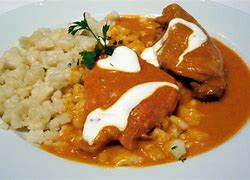
Chicken Paprikash with Nokedli – Hungarian egg noddle-dumplings – Nokedlis Paprikás Csirke

Chicken in sour cream, which is not only by locals but as well touched by the flavor of foreigners after the most favorit the Hungarian Goulash soup.

“Q” Is it a stew?

“A”  Not exactly … the chicken cooked in cream and paprika along with olive oil and bell peppers.

“Q” What is the role of the paprika?

“A” Most of the Hungaian stews do not rely on flour or roux for thickening. Paprika takes over the power in thickening. Also is in use in many kitchen to add color, flavor to the dish.

“Q”  What does it taste like?

“A” The paprika as the main ingredient gives it a piquant hotness. If you’re not into chilies, be careful with this!

Good to know … The first use of the word “paprika” in English is from 1896. It came from the Hungarian word “paprika” which was a diminutive of the Serbo-Croatian word “papar” meaning pepper. Hungary is a major source of paprika and it is more commonly used.

Paprika is likely Hungary’s most popular spice, and these are a series of dishes in which it’s the star ingredient.
Paprikash is composed of a creamy, paprika-rich sauce added to a number of different options: chicken, catfish, or
mushrooms are the most common variations. Garnish Nokedli (Hungarian egg noodle-dumplings), and the meal is complete. This is comfort food at its finest, very easy, flavorful meal … but caution … should not have read this with an empty stomach.

Ingredients for 4 person, preparing time: 60-90 mins.

4 pieces of chicken legs, 2 small onions, 1 and a half tbs sweet red papreika powder, 1-2 tomatoes, 1-2 Hungarian sweet yellow paprika. 200 ml sour cream, 2 tbs flour, 2 tbs oil or lard. For the Noodles – Nokedli: 2 eggs, 411 flour, salt 300-350 ml water for the batter, 1 tbs oil and a pan for water  for cooking them.

Cooking: Sauté the finely chopped onions in a little oil until “glossy”, remove from the heat and stir in the paprika powder, watch out not to get it burned. Season it with salt and pepper. Mix well and add a touch of water and simmer. Add some water if it is getting too thick, not too much only not to burn  chicken. Add the cut chicken pieces and return the pan to the stove, leave the skin on c aíuse  by this it will not fall apart by cooking and the end may peel it off, if not prefer to eat it.  Now add pepper and tomatoe. Place the lid on, reduce the heat and simmer chicken until tender. Next, using a bowl, mix into the sour cream. Stir until smooth. Take some of the gravy mix it to the sour cream mixture and repeat it two times until homogeneous.  Before puring the  sour cream into the the pan, remove the chickens. Add the sour cream mixture  to the sauce. Mix it well then put the chicken back and simmer for ccya 4-5 mins. … Now this ain’t too complicated receipt… right 🙂

Now come the most loved by Hungarian and foreigners the cooking of Nokedli Hungarian egg noodle-dumplings.

In a deep bowl mix flour, salt, eggs and  water. Bring 4-5 liters of water to boil point in a large pot for cooking the Nokedli – dumplings.

Mix 1 tbs oil in it so that you get a batter that is easy to stir but not to be sticky and careful not to make it too loose. This will be perfect by experience. Form little dumplings  from the batter and cook them in the salted boiling water. The Nokedli will rise to the top cca. 2-3 mins as boiling, drain and rinse with cold water. Add cca. 1 tbs of oil and mix well. toform the Nokedli place alittle pasta on a cutting board and with a dipped knife cut a little one-by-one put in hot water.

May also achieve a further increase in taste by adding on top of the ready chicken a spoonful sour cream, as you please. Have a great experience cooking!

© by Aggie Reiter

Day-By-Day #7 … Hungarian Cuisine – Cold Sour Cherry Soup – Meggyleves

Cold Sour Cherry Soup – Hideg Meggyleves

You haven’t ate nothing yet if not to taste the traditional Hungarian sour cherry soup. The taste buds cannot resist this delicious soup.


“Q” What is that fruit soup?

“A” Yes … they are very common in Hungary.  A traditional homemade soup and served mostly as an appetizer and only sometimes as a dessert. This cold sour cherry soup is a bit more tart, making it a great starter dish.

The fruit soups are very popular all over the country and made from a wide variety of fresh fruits, such as … apple, sour cherry, elderflower, strawberry, red currant and gooseberry … soforth. It is a quintessential Hungarian summer soup!

The wild cherries stretches back through prehistory, the cultivation of cherries is believed to date to about 300 BC. The word cherry comes from the Turkish town of Cerasus, which reflects the western Asian origin of cherry cultivation and can also be seen unchanged in the name of one species of cherry.  The nearest linguistic ancestor of the English word – cherise – sounded too much like it was plural, and by time became cherry.

Cherries wonderfully flavorful in a wide range … from jams to pies, This soup is enjoyed through the summer months, because sour cherries are the earliest of the spring fruits, this soup is often associated with spring festivals and, among Hungary’s Jewish community, is a favorite for Shavuot. This soup has a wonderful, sweet-tart flavor.  Yummy served chilled, it makes a refreshing first course but also by the end of the meal as a desert will fit on a warm day.

Sour cherry soup is made with sour cream, sugar and whole fresh sour cherries. The soup is a good example of Hungarian fusion of  Eatern/Asian influences and traditional Continental European cuisine.   The sour cherry also called tart cherry or wild cherry. The fresh of the fruit being softer and is more acidic – so it is better for cooking and pastry.

In Hungary sour cream is called “tejföl”. It is a dairy product that is produced by souring heavy cream. Whether nott to trace at your area for this receipe any cooking cream will do.

Receipt for 4 person – preparation 30 mins. + cooling time.

Ingredients:  350 g ripe sour cherries (or one jar of bottled cherries), 1 lemon (fresh or juice), pinch of salt, 4 whole cloves, 1-2 cinnamon sticks, 100 g sugar,  100 ml red wine, 200 ml sour cream, 1 tbs flour … A small amount of sweet white or dry red wine is also sometimes added before serving.

Cooking: Wash the cherries … if needed remove pits … and place them in a pot. If using bottle cherries, add the juice as well. Add water which should always be double the cherries. Add a pinch of salt, the cinnamon, cloves and sugar to taste the flavor with the lemon juice and the lemon peal.  Simmer over low to medium heat for cca. 10-15 mins. Time depends whether having fresh or botled cherries. Add the red wine … will bring more the body flavor, but if not prefer to have alcohol then leave it out, it will be delicous anyway. While cherries are cooking mix flour and cream or sour cream and a touch of salt in a small bowl. Remore soup from the fire, take out some of the liquid and mix into the cream and flour mixture. Carefully pour it back,  constantly  …  make sure to split the temp. correctly, so the creram does not curdle, but if needed use a strainer. Return to the heat and cook for 5 mins. more stiring occasionlly.

Just a tip … Put spices in a small gauze pad, tie it with thread, and by the end of cooking just take it out of the soup. That’s it, don’t have to look for them one by one. When cool, refrigerate go to the finished soup

Serving the soup may add … to taste … on the already chilled soup whipped cream it will be not only pleasing to the eye but also the taste buds.

This Hungarian dish has been adopted by the Austrians, Poles, Slovaks, and Germans and Hungarian-Americans and Hungarian-Canadians brought the soup to North America.

To read more about traditional Hungarian soups, visit previous receipt @ “Q” & “A” Culinary Heritage Into Hungarian Kitchen.

© Aggie Reiter

Day-By-Day #6 … Hungarian Cruisine – Chicken Ragout Soup with Tarragon

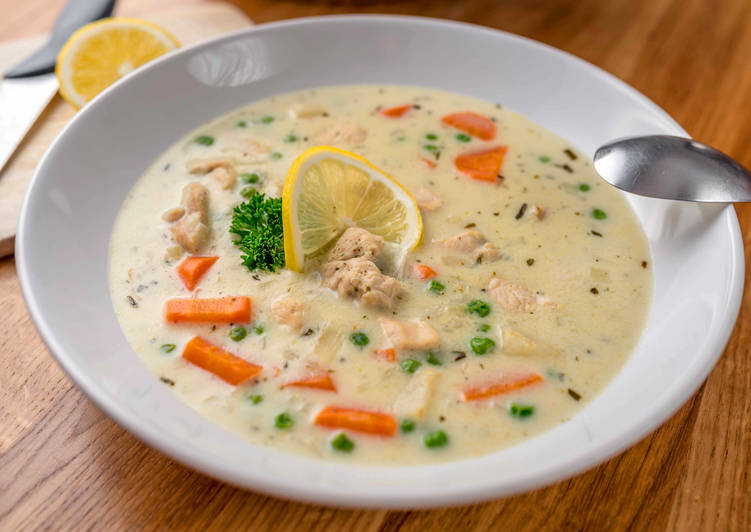
Chicken Ragout Soup with Tarragon – Tárkonyos Csirkeragú

This is a well-known traditional Hungarian fragrant creamy chicken soup with tarragon can be made with pork or chicken, choice depends on preference as at each region in Hungary everyone has their own recipe for it. Some people make it with chicken breast which is also fine and also may in using thighs because they give more flavor to the soup.

Easy to make this soup any day of the week. This healthy vegetable soup made with the twist of using tarragon and lemon juice.

Receipt for 4 persons – preparation time: 40-90 mins.

Ingredients: 2 chicken breast fillets, 1 head onion, 3 cloves garlic, 3 carrots, 2 white beets, 1 medium size kurnips, 1 medium size celery, 25 dkg mushrooms, 20 dkg green or yellow peas, 4 tbs oil, salt, pepper, tarragon, 4 veggie soup cubes, 2 dl cooking cream, 1 tbs flour, 1 tbs parsley, half a lemon.

Cooking: Cut the chicken breast fillet into small cubes. Chop the onion and garlic. The vegetables are cleaned and diced except for the green or yellow peas.

Heat the oil in a large saucepan and saute the onions over it. Add the meat and fry until white. Add the two types of beets, turnips and celery and sauté for 5 minutes. Season with salt, pepper, tarragon and chopped garlic. Then add to it as much water (cca 2 liters) as you want to make the soup… less water to make the soup thicker. Add the veggie soup cubes, bring to a boil, then add the peas and mushrooms. Cook until all ingredients are soft (about 10 mins).

Pour the cream into a small bowl, sprinkle with flour and mix. Add 3-4 tbs of less hot soup, stir until smooth, then add to the boiling soup. Bring to boil on it and finally add the chopped fresh parsley and freshly squeezed lemon juice (it is recommended to taste, rather add less lemon, which can be replaced to taste when served).

To read more about traditional Hungarian soups, visit previous receipt @ “Q” & “A” Culinary Heritage Into Hungarian Kitchen.

© Aggie Reiter

Day-By-Day #5 … Hungarian Cruisine – Palóc Style Soup

Palóc Style Soup – Palóc leves

The Palóc were a tribe of people of Slovak origin who settled in North-Eastern Hungary from where this soup originates.

The writer and MP, Kálmán Mikszáth, who is often referred to as the Great Palóc, asked János Gundel, the founder of the most famous dynasty in Hungarian gastronomy, to make him a dish that would be characteristic of the region where the Palóc folks live and with their cuisine. The most widely known village of the Palóc region is Hollókő – Hungary. The village is declared a world heritage site by UNESCO in 1987. The landscape of the village perfectly fits into fairy tale. The venue comprises 58 heritage buildings that are representative of 17th century village architecture.

The origin recept calls for mutton or lamb, yet if  prefer can also subsitute for pork or beef. Keep in mind, different meat pieces cook shorter and/or longer. Many people add some fresh dill or some drops of vinegar to it  depending on theindividuals taste.

Receipt for 4 people – preparation time 40 to 90 mins.

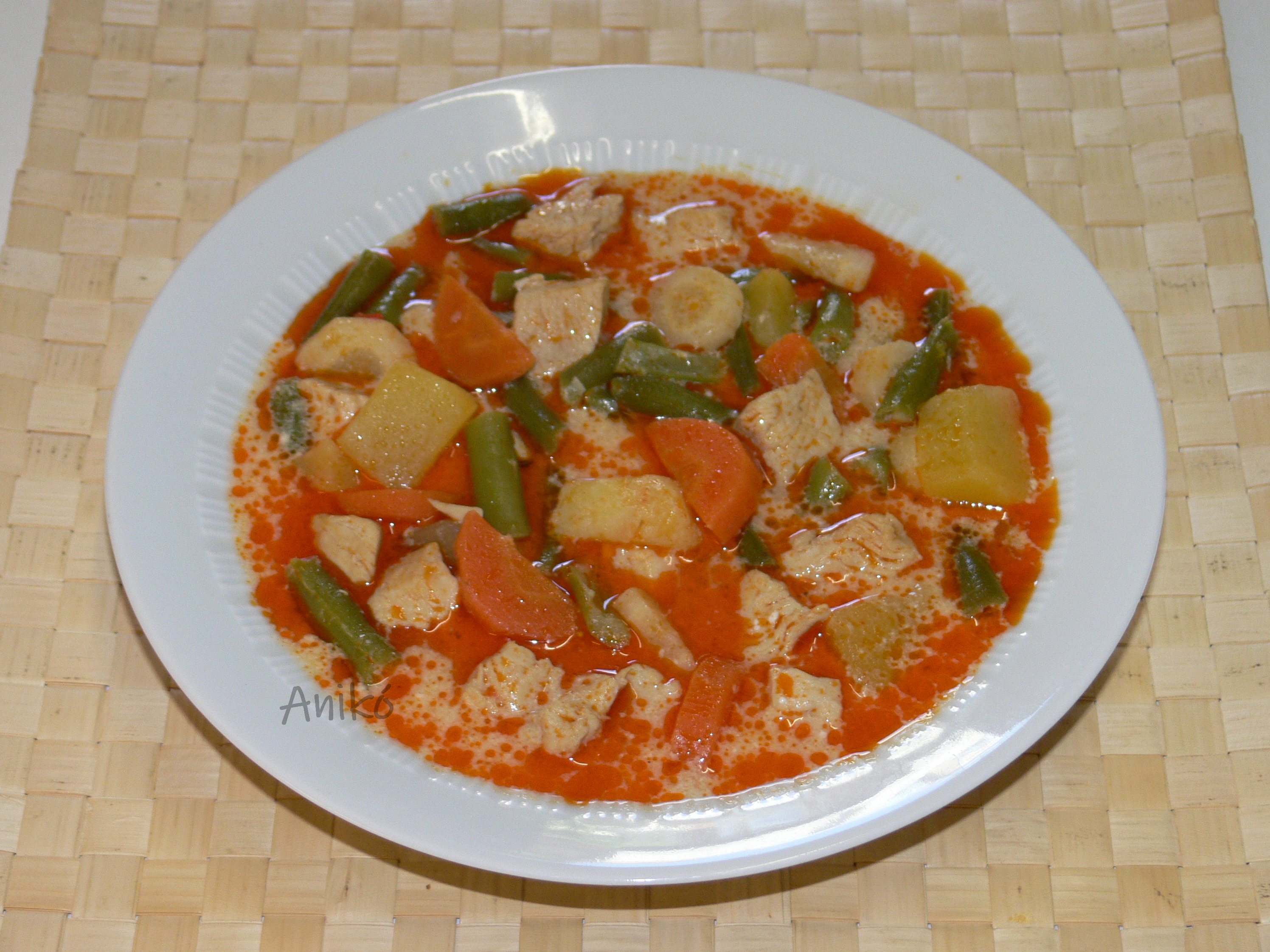
Ingredients: 900 g pork, beef or mutton, 1 big onion, 250 ml sour cream, 1 handful green fresh or fozen beans … In Hungary green and yellow beans are available. Growing in the season having fresh and if out of it the frozen one are cooked. Two médium size potatoes, 4-5 Bay leaves, sweet red paprika powder, dalt, ground caraway, ground pepper to taste and 1/2 tbs flour. A hint … add as many or as a few potatoes and beans as prefer, but roughly cca 1 medium potatoe and about 150 g beans/person to serve.

Cooking: Chop and fry the onions and season with bay leaf and caraway. Cut the meat in cubes, Wash and place them into a saucepan with the fried onions. Season with red paprika powder and some ground black pepper and stew slowly until about the meat is half tender. Add potatoes, cook and sauté them a little bit longer. Pouring water on it if needed and boil. Add the green or yellow beans and cook on for 10-15 mins more and look afterwards that all parts are cooked well. When the soup is ready, set aside to cool down a bit.

Next to thicken with the sour cream first take a seperate bowl in which add a little flour and mix together. Be careful when addig sour cream. Make sure to have non boiling temperature. Might wish to use a strainer, but addig the sour cream to the less hot soup it will be easy to mix the two.

To read more about traditional Hungarian soups, visit previous receipt @ “Q” & “A” Culinary Heritage Into Hungarian Kitchen.

© Aggie Reiter

Day-By-Day #4 … Hungarian Cruisine – Bean Soup á la Jókai

Bean Soup á la Jókai

(Jókai Bableves)

The soup is named after Jókai Mór who was a famous Hungarian novelist of the 19th century and this soup was his favorit. The bean soup is an exceptionally luscious dish. The flavor of the delicious vegyies mix with knuckle, sausage. At the end  may serve with 1-2 tbs of sour cream it brings the taste you cannot let go, simply marvelous  …  and nowonder just as the novalist you will love this bean soup. It is really a mouthwatering soup with the scrumptious smoky meat  that brings a perfect harmony of taste.

In Hungary the dried beans are grouped according to hardness, most Hungarian sorts have to be soaked well. By soaking the beans will grow and allow a shorter in time for cooking. The soup also preserves the most nutrients, and get the benefits of all proteins, vitamins and minerals.

Good to Know … It is common knowledge that beans are difficult to digest, but if at first only cook the beans in in cold water and after boiling  pour the  hot water off  twice, thenafter in fresh water cook with smoked meat, we get a much lighter soup and less harm to digest.

Receipt for 4 persons  – preparing time: cca 90-120 mins.

Ingredients:  300 g dried beans (soaked overnight), 300 g smoked pork sausage and ham shank, 1 celeriac root, peeled and diced, 3- 4  medium size carrots, 1 parsnip, 2-3 bay leaves, 2 tbs oil, 2 tbs flour 1/2 tbs sweet red paprika powder (but if prefer hot then use stronger one), 2 garlic cloves crushed, salt, peppercorn, vinegar to taste, hot chilli paprika on the top to feel the heat of the soup,  2-4 tbs sour cream, 2-3 tbs tinny rolyale (levesbetét).

Cooking: Soak the beans and the smoked ham overnight seperatly. Discard some of the water if too salty (it depends how smoked it was previously), pour some fresh water in the pot. Put them with bay leaves, peppercorns and sausage in a casserole and bring it boil over low heat. The same pot can be in use as soaking and cooking. Peal and cut the carrots, parsnip and celeriac. After 30-40 mins or when the beans and ham are already tender may add the vegyies to the casserole. Heat the oil in a small frying pan, add flour, keep stirring and heat it until it turns light brown. Take it off the heat, then add papirka powder and  sliced garlic. Take alittle out of the soup and add it to the roux, quickly mix well to get a liquid gravy. Stir th eroux into the soup, so it will thicken and bring it to boil. Add the tiny dry royale into the soup. Within that it will require 10 mins further cooking, best to know when ready seeing the royale slowly floating up to the top of the soup, then cca 3-4 mins and served.

To read more about traditional Hungarian soups, visit previous receipt @ “Q” & “A” Culinary Heritage Into Hungarian Kitchen.

© Aggie Reiter

Day-By-Day #2 … Hungarian Cruisine – Green Pea Soup

Gastronomy, cooking and food have always been quintessential elements of Hungarian culture and consequently Hungarian cuisine boasts a wide array of diverse and unique characteristic flavors. The Hungarian cuisine is an evalution of a 1000 year long history based on Hungary’s favorable geographical conditions as well as the heritage of traditional farming, small scale food and crop production. By-the-way … Pea soup has been eaten since antiquity … it is mentioned in Aristophanes’ The Birds, and according to one source “the Greeks and Romans were cultivating this legume about 500 to 400 BC. During that era, vendors in the streets of Athens were selling hot pea soup.

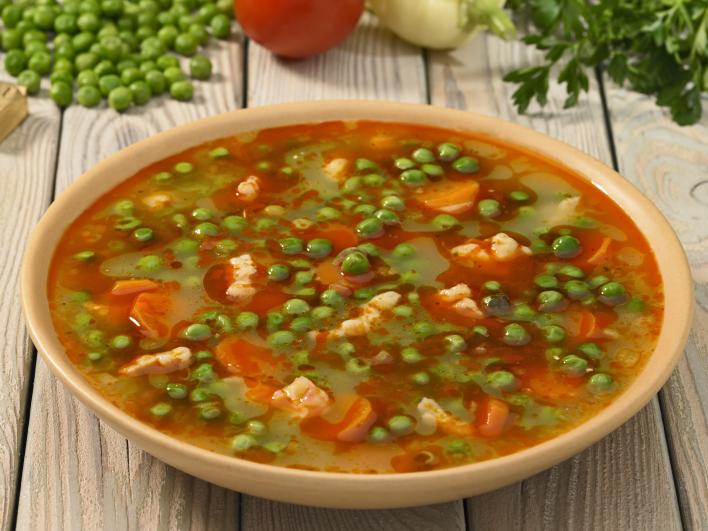
Green Pea Soup

(Zöldborsó leves)

This is a very easy to prepare this delicous soup, especially during the season when fresh peas are out to purchase. A fast and light soup, wonderful on hot summer days. Can use fesh, frozen or canned peas. If using canned peas, rinse them well.

The Hungarian veggie soups can be light soups and thick soups. To make the soup thicker make it with light roux. Depending on the season … green pea, cauliflower, green beans are almost regular soups for the Hungarians.

For 4 person – Preparing time 30 mins.

Ingredients: 500g green peas, 1-2 medium size carrot, 1 parsnip, 1 small chunk celleriac root, 1 small onion, 1 bunch of parsley, 3 tbs. oil, 1 tbs flour, 1 tbs. sweet red paprika powder, salt, black pepper as preferred.

Cooking: Heat the oil in the pot, sauté onion until glistening on medium heat for cca. 5 mins. Adding the cut up vegyies and sauté up 3mins. Scatter flour on top,  stir (practical with wooden soup) for a minute. Removing the pot from the heat add the red paprika. Add cca. 1 liter cold water, let it start to boil. Add the green peas.  When the veggies is done ad the dumplings, cook for 3-4 mins.  until the dumplings and veggies are tender.

Dumplings: 200 g wheat flour (1 cup), 1 egg, pinch of salt, 1 dl, cca 1/2 cup cold water (it should be smooth not hard)

Just a hint … with fresh peas is the best. Can be easily in use of frozen peas, cause peas freeze pretty good. May add alittle sugar, it will not sweeten the soup but the peas will taste yummy.

To read more about traditional  Hungarian soups, visit previous receipt @ “Q” & “A” Culinary Heritage Into Hungarian Kitchen.

© Aggie Reiter

“Q”&”A” Jewish Delicious Food – @ Hungarian Cuisines – Journey Through the Taste Buds

The Hungarian Jewish cooking may be rooted in the past, but its recipes aren’t staying there!

Don’t have to be Jewish to love the Jewish cuisine, it is enough to be a gourmet.


There is hardly a culture in which Jewish food and its preparation are not known in the world.

Just a little insight into the countless inherited and localized Jewish food at Hungary

The first Jewish cookbook was published in Hungarian in the 1880s, followed by several other, practical, kosher recipe collections. Due to the dispersion of Judaism, as many communities, as to many food choices and tastes.

Of course, Hungarian Jewry cannot be an exception. The borders of East and West, the typical Hungarian countryside, or even Budapest’s Jewish circles distinct types of food have become popular with a variety of ages.

The Old Jewish Food, was first published in 1984 and presented traditional Eastern European Jewish food, with the aim of preserving Hungarian Jewish dishes from the turn of the 19th and 20th centuries and the first half of the twentieth century. The food descriptions are a bit concise compared to the recipes, the author entrusts the method of preparation partly to the imagination of the chef or cook.

The Hungarians make many spice mixes at home, most of which include cumin, a few cloves, cinnamon, ginger, coriander, seeds, leaves, mint and, of course, salt, pepper, and the essential peppers, but of course the climate in Hungary is not favorable for all of them. cultivation.

From this abundant gastronomic offer here is one of a good … but  heavy crunchy-munchy

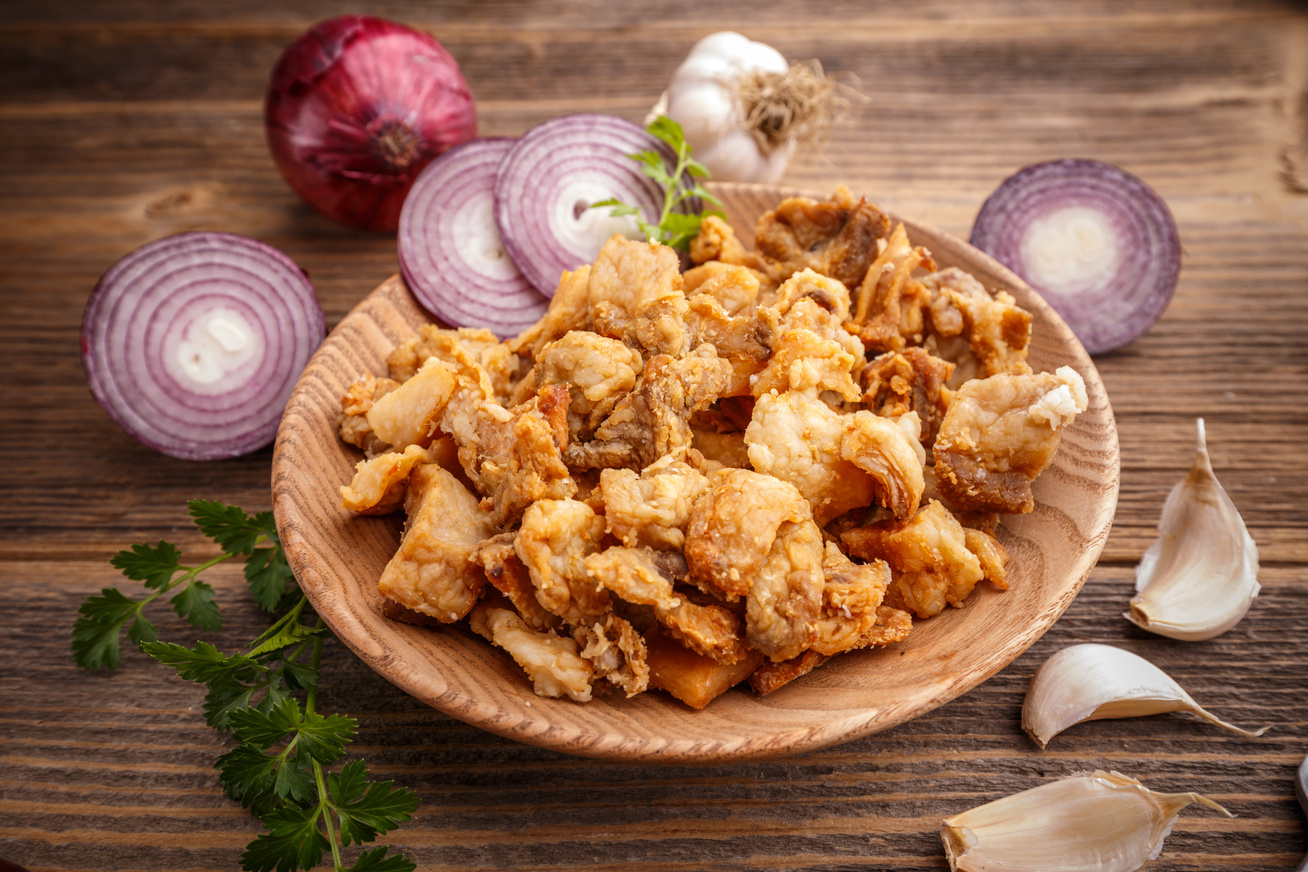
Goose bump with red onion
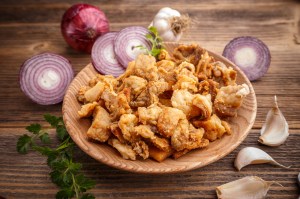
Goose bump It can also be considered akind appetizer. The Hungarians eat it with alot or without red onion.

(Good to know to avoid smelly onion in the breath, eat a tsp of fresh parsley, also when having garlic and its gone.)

Ingredients: cca 1/2 kg of goose skin, little water.
Cooking: The goose skin is carefully peeled off the meat (usually from the breast and back) … usually Hungarians buy at the market goose  bump …  cut into 2 x 2 cm cubes and then placed in a pot. Add enough water to cover it and cook it on a moderate fire, stirring sometimes. By the time the water evaporates, the crumb will turn nice yellow. Bake for a few more minutes, then pour a cca. 2 tbs of water into the fat and squeeze the lid of the pot. This will make the crackling crispy. Filter and pour the goose fat into a jar  and let it cool, later place it in the fridge and can be in use for cooking ie meat soup  by adding 1 tsp to richer the flavor.
Carefully pour the water into the flag fat, it is advisable to pull away from the oven.


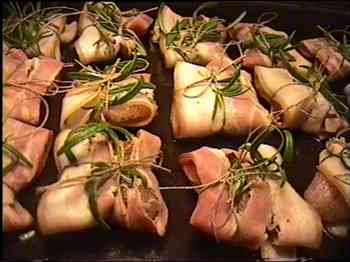
Another yummy appetizing … Chicken Breast Bags with Rosemary
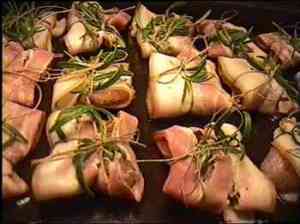
Ingredients: 600 g chicken breast, 16 slices of bacon, salt, pepper, rosemary thread

Instructions: Cut the bacon slices in half. Slice up and tenderize the chicken and put salt, pepper and rosemary on it, then cut it into 16 pieces.
Roll each piece into two slices of bacon and fix the whole thing with a piece of thread. Fix a piece of rosemary on each little bag. It will intensify the mouth watering smell of the dish. Place the bags on a baking sheet and bake them in the oven for about 40 minutes.

Hungarian lunch is not lunch without soup on the table.

Meat soup with matzo dumpling
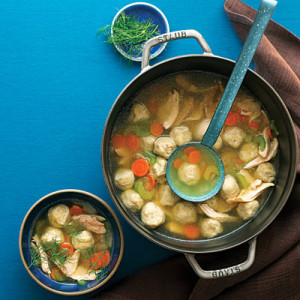
In Hungary, matzo dumplings are not so much made of mace flour, but there are those who make a mixture of coarsely crushed mace. Adding ginger and parsley is the secret to good matzo dumplings. Here is the recipe for mace.
Ingredients: 250 gr mace, 6 eggs,, 4 tbsp goose fat,, 2 bunches of chopped parsley, 2 heaped tsp. ginger powder, black pepper, salt and to make it more  a mocha spoon of soda bicarbonate as well and will be more lighter.
Cooking: eggs are mixed with the fat and the same amount of water is added to it as the amount of egg mixture in deciliters. Add the hand-crushed Passover, the finely chopped parsley, and then season with salt, freshly ground black pepper and lots of ginger. Once kneaded, place in the refrigerator for at least 60 mins. By hand form balls the size of a ping-pong ball out of it and cook it in hot goose soup or it can also cooked in the beef soup or chicken soup.

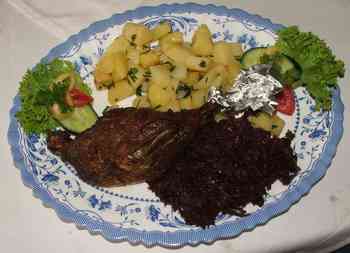
Stewed cabbage with smoked goose leg
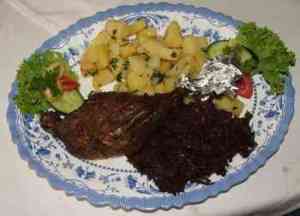
It is very popular … heavy meal … by the Hungarians, but rather cooked in the season of winter.

Ingredient: 2 smoked goose legs, 3 tablespoons goose fat, 40 dkg barrel cabbage.

Cooking: Wash goose legs thoroughly with warm water and soak for an hour or two. Melt the goose fat and heat it over your thighs. Then add the washed sauerkraut and the whole thing, stirring occasionally, just simmer until soft.

Can almost hear the “Q” … where is the famous Jewish cholent? Not missing!

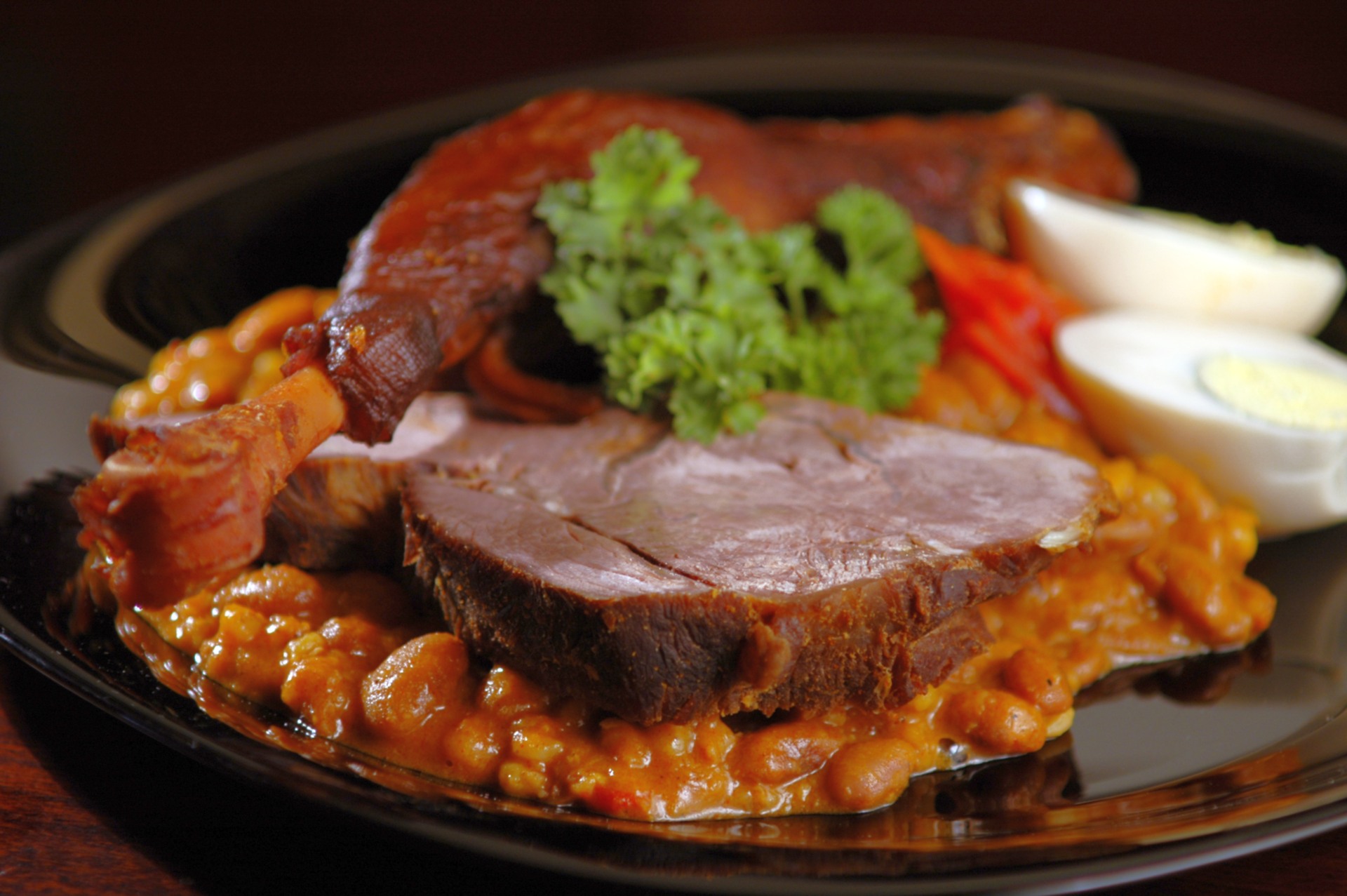
Goose leg and beef meat with boiled egg
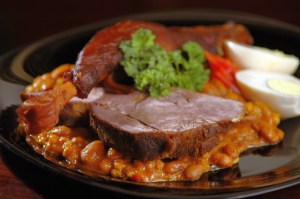
Most probably many people have had already tasted the real Jewish Cholent, but maybe only a few have not cooked it yet. So here is a Hungarian cholent guided tour:

Before the recept … First things First …

“Q” Where does the name Cholent come from?

“A”  The word of uncertain origin …  it is a Jewish Sabbath meal consisting of beans mixed with meat, peas, or a mixture of beans and rice, or pasta. The Jews are forbidden to cook on Saturdays, therefore this food is placed on the embers of the closed stove on Friday, where it is cooked until Saturday.

“Q” How to cook cholent
“A” In a ceramic pot, iron pot or enameled pot.

“Q” Making it on a stove or an electric hob?

“A” The point is to put the dish in the oven, it should be well closed to bare cooking for long hours , also to prevent evaporation.

Ingredients: 40 dkg brown beans 40 dkg beef (for soup), 2 goose thighs, 40 dkg of smoked meat (smoked goose leg or breast is best), 1 small head onion, 1 tsp red pepper, 3 tbs oil or 2 dkg goose fat, 1 tbs flour.
Preparation of brine:
Fry the chopped onion on the fat, sprinkle with the red pepper, add the beans and smoked meat soaked the night before and thaw for approx. With 2 liters of water .Add the meats and sprinkle on top of the flour we mix. Cover the whole thing and bake in the oven until the garnishes are completely softened. Usually in large pots it is good to prepare and make sure the water at the beginning covers all. You only need to salt if the smoked meat in it is not salty enough. Many people put gerslit in the brine, but it is excellent without it. During cooking the water is absorbed by the beans and meats, if so it is recommended to add a little water, but it should be served with short juice, it should be dense.

Life is sweet but better to make it really sweet non the other way than baking Flódni. It is also prepared for some famous event or celebration. Its essential ingredients are all symbols of abundance: poppy, walnuts, dense plum jam, wine and apples. the most famous cake of Hungarian Jewry.

Flódni
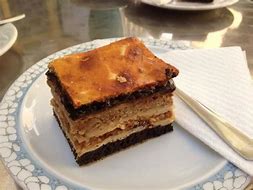
Ingredients: 1/2 kg of flour, 1/2 kg of sugar, 1/2 kg of walnuts, 1 kg of apples, 3  tsp of honey, 3 egg yolks, 1 dl of oil, 1 lemon grated peel.

Baking instruction: Knead the flour, oil, egg yolks and a spoonful of honey. Divide the dough into three and then roll each out to the size of a baking pan. Oil the baking sheet and put in the first sheet. Lubricate it with oil, water it with honey and sprinkle it with the nuts mixed with half the sugar.  Lay the second sheet on top, oil it, water it with honey and sprinkle with half the grated apple mixed with sugar. May bake with other ingredients as listed a/m. Put the last plate on it, water it with oil and honey, smear it on it, and then bake it ready in the oven. Baking time 50mins.

Hopfully, the Hungarian Jewish delicacies cuisine took you on a yummy tour.

©Aggie Reiter