DAY2 ROLLING IN MOHÁCS – PART1

This slideshow requires JavaScript.

Our day started with a fine brekky at the Hotel Szent János (Saint John), then off we went  for just a 10 mins. walk to a local black pottery artist’s workshop. On our way we saw the city is going through reconstructions and pulling up new buildings. We finally arrived to the Serbian quarter in Mohács whereas, the world of black ceramics welcomed us.

Mr. László Lakatos’s pottery craft  workshop. He learnt  this professional from his father, Senoir László Lakatos.

Upon our arrival Mr. Lakatos welcomed  to his land of ceramics and showed us on his winding table how he sets a traditional Mohács style ceramic plate.

Mr. Lakatos spoke about the  this special pottery’s ingredients and the knowhow of how the famous Mohács black ceramics are made saying:  “The black color derives from a special firing process in which the kiln is deprived of oxygen, causing the clay to carbonize, simple as that! All he pieces are separately hand-thrown and individually decorated. There are no two same pieces.  In the past centuries these ceramics were use as cooking tools and kitchen wear. To-day they more likely decorate the homes, by hanging on the walls the plates and using the jugs and vase for decoration”.

Leaving the land of ceramics, went to see the museum of masks, tools and outfits of the Busós.The Busós traditional is one its landmarks of the Mohács. The so-called Walking Busó’s “Búsójárás” has grown over the years to its major tourist attraction of Mohács.

The Walking Busó’s  “Busójárás” Street Carnival is the one-and-only unique attraction  in the World.

At the end-of-winter the  Walking Busó „Busójárás” festivities attract many tourists to come along  and see this splendid parade. The  Walking Busó Festivities of Mohács, is a spectacular farewell-to-winter and welcome-to-spring parade. Local Hungarians, temporary foreigners living in Hungary and folks from across the border joins this parade. This 3 days festive is an ongoing street carnival with people wearing scary wooden masks. Those that can make it will have a chance to see something that they wouldn’t have the experience to see anywhere else in the World. By-the-way the word Busó, as I was told at the Museum of Busó comes from way back  2500 years , when at this territory the so-called “bushmen” lived. At least the guide of the Museum said so and for me seemed pretty new tale in my information. Having to take a look at the snaps, you can get the image of this festival.

In 2009 the Walking Busó’s (Busójárás) Festival  made its way to the Representative List of Intangible Cultural Heritage of Humanity UNESCO – the United Nations Educational, Scientific and Cultural Organization.

ROLL-UP, ROLL-UP FOR THE MAGICAL MYSTERY TOUR – ROLLING IN SIKLÓS

This slideshow requires JavaScript.

http://www.youtube.com/watch?v=99aL0NkcQDw

I was invited for a two days “magical mystery tour”

Although the Southern area of Hungary’s main known cities are: Pécs and Harkány,

with both having their own history of excitements,

yet!

the castle of Siklós is less known, that it has the most medieval history in Hungary.

Once the Pun said:“Siklós, is the city of castle” (Siklós, a vár városa)

Left Budapest pretty early with a bunch of 38 persons on a comfy bus, at the time when even the cocks didn’t crow or at least in Budapest. The distance we have had ahead of us was 240kms from Budapest to Siklós. On our way the weather was cloudy with sprinkles of rain, as usually in the season of Fall. The temperature outside was just fine for that day of touring. On our way beautiful hilly and plain landscapes, old folk villages and cows, goats, horses out on their pasture-fields passed us by.

The main attraction in Siklós is the castle, the appearance of which dates back to the 18th century. It is one of the best-preserved castles in Hungary. The city’s ecclesiastic and other heritage sites are like rolling back in time to the medieval ages.

The clock hands twirl back to the times when here was a military camp called Seren. It was established during the Roman times on the scenario the city of to-day. There are early recordings of the fortress dated 1190.The first record as a settlement existence dates back to 1294. Since then it, became for the most prominent noble families the seat of their estates.. In 1394, the Garai family purchased the castle, who extended it over decades. The Gothic wing and the chapel with its rich Gothic vaulting, shows much to that era. In 1515, the Perényi family continued the castle’s construction to their need and style, adding the Renaissance refurbishment.

At the times of the Ottoman occupation, the Turkish used the castle as a fortress. They had also mosques built-in the outskirts of the town.

In the 18th century, the Batthyány family redeveloped and expanded the castle in the Baroque style. In the 19th century it had completely lost its looks as a military role. The Count Kázmér Batthyány, foreign minister in the Kossuth Government, rests in the Castle’s chapel. The chapel inside the castle is among the most beautiful examples of its kind in Hungary. It has an organ and they hold organ concerts as well. The frescos had went through a huge reconstruction and found underneath layers of previous frescos. The colourful high standing window-glass were damaged during the WW2, but have been remade and the natural light is simply breathtaking in this small chapel. To-day, this small chapel is a fond scene for the couples to hold their wedding.

On our way to Mohács, we stopped by:

SÁTORHELY

The Memorial Park
commemorates the fight and the soldiers died during the battle against the
Turks.

Today a national memorial site, an area surrounding the town that was once the scene of tragedy preceding the Turkish period.

There is an estimation of 28,000 Hungarian soldiers lost their lives in the defeat at the hands of the Turkish that sealed Hungary’s fate for the following 150 years. This tragedy gained symbolic value in the Hungarian national psyche and left one of the most indelible marks on its historical memory. The battle lasted an hour and a half but its consequence was a century and a half of Turkish rule, which excluded the Hungarians from their was short in time but heavy in  lost of lives.

The memorial gate, made by the goldsmith József Pölöskei. A breathtaking artwork! artwork symbolises the fallen heroes. Its bronze units are fold together with 28,000 rivets as an indication of the appr. number of fallen soldiers.

Many carved wooden statues are dedicated to the anonymous memory of valiant soldiers. There are also statues of the persons that took part in the battle: Jagiellon Louis II., Dorottya Kanizsai (who was searching for the her son’s body, had all the bodies buried after the battle) Pál Tomori (Archbishop of Kalocsa and supreme commander of the Hungarian troops during the battle), Sultan Suleiman, the victorious Turkish monarch. The magnificent sculptures were created by artists: József Király, Sándor Kiss, Pál Kő and István Szabó Jr.

Dorottya (Dorothy) Kanizsai, the former lady of the castle, has a statue in the garden area. She was the one who had the dead to be buried after the great battle at Mohács.

As an acknowledgment of the restoration works on the mosque, the heritage building received the International Europe Nostra award in 1992

Now-a-days the castle shares places in its rooms and halls for exhibitions. Throughout the decades Siklós, the former market town continued to grow as a large village and by 1977 it received the city rights.

Seeing the castle and the remained prints of the medieval times of Siklós is worthwhile to stop for a couple of days to leave your footsteps there by exactly rolling down the River Danube, renting a car, or traveling by bus.

So after leaving our footsteps at the Castle surroundings, the show rolled on by visiting the newest „child” in the „family” of Siklós. Her name is Thermal Spa Siklós, born August, 6. 2010.

Stepping in through the door at the Thermal Spa, the first thing you recognize are the secure high walls dividing the pools. Some pools have waterfalls, “tropical plants and trees” that makes you feel you are somewhere in between a land of wonders. These bath walls holds three pools for kids and six pools for the adults. The spa has opt. for folks to enjoy the adventure in the pools of temp.33-36C. The secure walls enlighten to the times to recall the picture of the surrounding walls of the castle of Siklós. The thermal spa offers: the Turkish bath, message, stream bath, infra sauna, aroma cabin, Jacuzzi, Finnish sauna and a perfect relaxing and healing salt cave assures the place to reach to enjoy and to recharge yourself. (Unfortunately we had to run like the Rabbit in “Alice in Wonderland”, no water experience, no relaxation, hmmm maybe next time). The “running” was to show us more-and-more places by the superb  local  organizers, whom escorted us all along the way. Fabulous hosts with heartful hospitality! They absolutely fulfilled their “adventure” with us. There is also an outdoor pool with the size of 33m in length. Now-a-days not too much in use, but next year the sunbathing terrace will welcome those who wish to get their natural tan. In the meantime the spa thought of those who still wish to keep their summer-tan by having a solarium at the spot.

Couldn’t have imagined a better place have our next stop!

Reach the food scene!

The name of the place was the Csárda of “Tenkes”

Indeed, was a great idea by the organizers of the study tour to shift us over to this extremely well-arranged to the old country-style restaurant, not to mention the grand variety of home-made countryside food that were served on huge carved wooden plates, if it can at all be called a plate. The size of food on this wooden plate isn’t for lunch or supper for two person. It was food to last for a week ahead. The study tour group was lead to an outdoor hall. The top, as a roof was covered by hard polyethylene. As shown in the snaps the “side walls” were absolutely in the countryside stylish. Four hundred kgs. of dried hay was cut into the form of huge bricks and planted all around. Well, it was something in sight and sence that enlighten the whole place. The hay walls were a unique idea. Nothing similar seen before. The snaps will remain snaps, so I would really recommend all to definitely visit the Csárda of Tenkes to cherish to environment, the scene and especially the marvellous taste of food the restaurant lines up. Here just mentioning a couple of dishes,wooden-plate to excite you. As for the starter: great plain goose liver pasta with fresh red onion jam. Soup, what else would be so common there. Yes,  the Tenkes Gulyás with potato balls. Oh and one of my favorite.: crispy duck legs with steamed sweet red cabbage and parsley potato, yummy. As for the desert: fried sweet cottage cheese balls with “whistling” (it is called whistling, because after ya snip it, soon you will start whistling!) apricot jam sprinkled with pálinka. Beside the red and white wine, they serve home-made plum pálinka. Now, if this menu of mine got your attention, go ahead and give it a try. Superb hospitality, I must say. The service was outstanding, quick and everybody felt they are there just for you.

Continuing our study tour, we left the City of Siklós and hit the road again on route58, just 47kms away to reach the City of Mohács.

Entering the city of Mohács, our first station was to visit to the

TOWN HALL „Városháza” of MOHÁCS

whereas the participatants of the study tour was welcomed by József Szekó, the major of Mohács and Katalin Rittlinger Pécsváriné, Head of Office.

As entering into the Town’s Hall on both sides hanging on the wall up along the stairway, watercolour pictures showing the scene of a Busó carnival painted by János Pleidell that surely caught many of our attention. Stepping in the Assembly Hall an enormous, brilliant goblin scene brought alive  the legendary festival of the Buso’s. The major of Mohács gave an overview of the City’s activities, economics and the „Kálmán Széll” plan that has promoted to bloom the City’s infrastructure, visits of tourist, nature and culture attractions. The City has excellent geographic characters: folk customs, folk trade, outstanding sights, tasteful surprising gastronomy, leisure, sporting possibilities. The guest’s of the study tour where warmly welcomed by the so typical Hungarian drink during the cold season:  a mug of mulled wine, home-made “pogácsa” and a folk group playing folk dancing tunes. Was a very touchy greeting from the hosts.The city’s main square is truly the center of Mohács in every sence. Here the eye meets the outstanding Town’s Hall, that was erected to commemorate the 400 year of its anniversary of the great battle of Mohács. Aladár ÁRKAY was the designer of the Town Hall in 1926.

(Follow-up will be continued by Day 2 : Rolling in Mohács.)

Update and snaps by  Aggie Reiter

INTRODUCING MASTERCARD MOBILE PAYMENT

This slideshow requires JavaScript.

New smartphone application is available from today
making bankcard payments fast, secure and convenient at several service
providers and online merchants.

Press Preview:

 October, 25.2011 – 10 a.m. Tuesday

Was present at an invitation by the Telenor, Hungarian Telekom, FHB Bank and Cellum at the MasterCard® Mobile press preview, whereas a presentation was held  concerning to the use of the mobil payment. This application is brand new and stands unique in Europe. .

Launching MasterCard Mobile opens a new era in the development of mobile payments, due to the fact that this is the first payment application in Hungary making it possible to pay only by one’s MasterCard bankcard, independently from which bank’s or mobile operator’s service is being used therefore opening up mobile payment applications for millions of Hungarian MasterCard cardholders.

„The growing popularity of smartphones made it clear for us and for our partners – Telenor, Hungarian Telekom, FHB Bank and Cellum that there is a need to create an application running on devices of several operators and whose benefits every MasterCard bankcard holder may enjoy. Due to the remarkable cooperation of our partners we can now say that we have achieved this goal by launching a pioneer service in mobile payment also unique in Europe.” – said László Szetnics, MasterCard Europe, Regional Manager of Mobile Payment Services.

Currently, MasterCard Mobile provides payment services in three fields: cell phone top-up, convenient and quick payment of service provider bills, online payments.

Following the download and registration of the application the bankcard needs to be registered as well which has a onetime fee of HUF 99 (app. EUR 0,35). Once registration has been completed no card data or PIN needs to be typed in at each transaction. This makes mobile payments not only faster and more convenient, but also more comforting since according to recent surveys there are still many users who are reluctant to give their bankcard data online. When paying by MasterCard Mobile customers will not have to reveal their card number or the safety CVC code of the bankcard. Cardholder sign in with their mobile phone numbers or the identification code. Payment info received on the phone containing transaction data will be confirmed by giving a six-digit alphanumeric code (mPIN). This is an independent code, chosen by the user at the registration of the application and can be changed at any time. The code is not the same as the PIN code of the bankcard.

MasterCard anticipates the continuous expansion of services available through the application. Presently Telenor and QR coded T-mobile and THome bills can be paid through the app. Online shopping is possible in webshops of Bookline, Bonusz Brigad, Bortarsasag and GRoby.

László Szetnics emphasized: „Several merchants indicated their wish to join MasterCard Mobile Hungary so we expect quick development in this area. However, apart from retail services we also plan to launch further functions such as interpersonal money sending (P2P) within the app.” With the help of the application Hungarian Telekom and Telenor customers can pay their service bills. One way of doing this is by taking a photo of the QR code and initiate a transaction.

Gábor Pukler, Hungarian Telekom, director for innovation and business development added: “As we have emphasized earlier mobile payment is a step ahead towards ideal distant payment solutions. MasterCard Mobile service now successfully eliminates limitations and allows customers to use their own MasterCard cards for this type of transaction. To help the expansion of the service Hungarian Telekom, as one of the largest bill issuers in Hungary, will put QR code on each T-Home and T-Mobile cash advance bill. Payment has never been easier, quicker and more convenient.”

Another tangible advantage of MasterCard Mobile compared with competing payment services such as bank transfer or debit authorization is that it has no additional fees apart from a one-time registration fee (HUF 99) and the cost of data transfer if any.

Tamás Foltányi, CEO at FHB Bank Service cPlc. said: “Nowadays, there is news of mobile payment solutions daily. Attempts that are not compatible with each other have little chance of survival even if they are secure, advanced technically as well as business-wise. All such initiatives will have a hard way to market success. However, truly good products are created by the cooperation of powerful players and in a lucky case consumers will support it too. In the case of MasterCard Mobile Hungary the cooperation of a Hungarian software developer company, a Hungarian bank together with two mobile operators earned the privilege to create the third such project worldwide.”

MasterCard Mobile can be freely downloaded to mobile phones using iOS 4.0 (iPhone), Android 2.2 or above, independently from mobile operator. For users who do not own mobile phones using one of these operation systems the application can be used with Telenor and T-Mobile dynamic SIMhandsets by downloading an STK (SIM Toll Kit). This special SIM card can be obtained in operator’s shops.

“We at Telenor believe in the future dominance of services that are available through wireless communication practically from anywhere. A good indication of just how quickly these services are developing is that, due to the introduction of MasterCard Mobile, today people can effectively manage their finances through their smart phones. No wonder that the expansion of smart phones is four times quicker than traditional mobile sets. We are determined to keep up with the quickly growing demand and serve users requirement of mobility, speed and convenience by making available the newest models and by supporting new services such as MasterCard Mobile”– said Zoltán Takács, head of product and innovation at Telenor.

All MasterCard branded cards can be registered into MasterCard Mobile. In the near future customers will also be able to use the application with their Maestro cards. For the download and use of the application internet or (in case of SIM Tool Kit) SMS connection of the telephone needs to be provided.

“This application is the joint project of MasterCard, Hungarian Telekom, Telenor, FHB Bank together with Cellum – Hungary’s leading mobile payment software developer group. Transmission of sound, picture and text has been an everyday option for mobile phones for many years now. Cellum now moves bank cards onto mobile phones as well allowing customers to send money freely. Our developers have created an advanced system that helps people forget difficulties of top-up, postal payments, and online shopping. Cellum developed a QR code based system that is both simple for the consumer and quick and secure for merchants.” –said Balázs Inotay, Cellum Global Strategic Director.

According to data of the National Bank of Hungary, currently there are 3,6 million MasterCard bank cards in circulation. Therefore, substantial proportion of the total card portfolio can be used in the new MasterCard Mobile application.

About MasterCard

MasterCard (NYSE: MA) is a global payments and technology company. It operates the world’s fastest payments processing network, connecting consumers, financial institutions,  merchants, governments and businesses in more than 210 countries an  territories. MasterCard’s products and solutions make everyday commerce activities – such as shopping, traveling, running a business and managing finances – easier, more secure and more efficient for everyone.

Learn more at www.mastercard.com, follow us on Twitter @mastercardnews or join the conversation on The Heart of Commerce Blog.

 Update and snaps by: Aggie Reiter

HUNGARY’S NATIONAL HOLIDAY OCTOBER, 23. – MEMORIAL TO THE 1956’s WAR OF INDEPENDENCE

This slideshow requires JavaScript.

PRESS CONFERENCE AT THE HUNGARIAN RADIO

The remembrance day to the date  of

1956. October, 23.

 The public radio celebrates
within broadcasting documentaries, having live connections to the festive scenes and opens its doors to the public with a historical exhibition at
the radio’s museum


The first major historical discovery of mankind was  by  Christopher COLUMBUS, the explorer to reach the shores  in 1492 of America.

Before the second major historical discovery of mankind was Capt. COOK’s discovery in 1770 of Australia.

The second major historical discovery of mankind was undertaken by Thomas EDISON to invent and develop of radio technology in 1885.

Let alone, the history of the “birth” of the radio  was involved by several scientific individuals. So by the late 19th century, it was clear to various scientists and experimenters that wireless communication was possible and alive.

As the history’s decades rolled along, the radio became important for economic, political and nationalistic reasons.

I would say, it was a naval string to reach out over the borders by sharing information and connecting people.

Even to-day, as the technical revolution have had been taken far ahead, it still has a strong connection  for many individuals all over the World.

Leaving the way back historical  times and data, to-day’s main update is to give an overview of  Hungary’s  55th year’s anniversary of the public radio, as a part in the War of Revolution.

The representatives of the Press and Media were invited to participate on a tour in Europe’s oldest radio building. Not just the building’s age was surprising with its existent of 85 years that lifted up the heads, but the fact of the Hungarian Radio, at the time being was on-air as the third existing transmitting radio in the World.

Throughout the 85 years,  past and present collected and displayed selection of transmitting belongings at the Radio’s Museum was on display. Within the 85 years, the Hungarian Radio developed its own Symphonic   Orchestra, the initiator was  Ernő DOHNÁNYI.  Dohnányi’s main objective target was to bring to the highest standard the live music through to the radio-listeners and concert-lovers.  The Orchestra was known  outside the country as  BpSO. During the years of the WW2, Dohnányi selected on his own the Orchestra’s musicians. His main selection was connected to religion, as to save the lives of the jewish musicians.  The internationally and worldwide already known musician and the Hungarian Radio’s  own Orchestra was out of harm. Dohnányi saved many lives in those dark days.

The Radio’s BUNKER, for many was a taboo, as  an unknown building which is not under the ground, but above the surface. Even was not known about the function of it between the local workers. The representatives of the press and media  had a chance to glance on the one-and-only treasure of voluminous archive documents, that lay there for decades-. Inside the fence of the radio’s six-storey HQ’s contains this 3 meter thick walls of concrete. Mr. István JONÁS, Director of the Hungarian Radio (MR Zrt.) said: This secret building was built the yard area in ‘52. Was in use by spying their own broadcasting, radio co-workers between March, 15. 1957 until 1991. The bunker was build-up in the time of Mátyás RÁKOSI, for the purpose to give shelter  to the broadcasting workers on-air, if there were to be a bomb blast. The authorities of the Security of State were the regular visitors. Behind the walls they had two studios.  One held within the walls as  the  tapping center.

The bunker will  be opened between October,19-21 to cca. 340  high-school pupils, as to have at the spot a live history class. This irregular hour is a part of the series of the 1956’s festive programs given by the Public Radio. Throughout  the day of October, 23 there will be many formal programs broadcasting through the Public Radio and other media channels.

The mission to visit the  bunker is to challenge, generate new knowledge, and to deepen the understanding about the ever-changing concepts and realities. Within the plans for the coming future, the Museum of the Radio wish to provide exhibitions, research, tours, lectures to open it’s doors to everyone that feels the need to expand their knowledge behind the walls of the World’s  second major invented  senario.

The Director, closing thoughts were by saying: To understand the improvement of to-day’s technical evolution, here at  the museum there are out on display original items, documents that were in use from the past. The Radio has to fulfil the need to outreach activities, as present social and cultural issues that impact communities.

Update and snaps by: Aggie Reiter

LEHAR’S OPERETTA – GYPSY LOVE “CIGÁNYSZERELEM” – AN AGELESS LOVE STORY

This slideshow requires JavaScript.

THE PREMIER  OF THE  GYPSY LOVE – “CIGÁNYSZERELEM”

WEDNESDAY, OCTOBER, 20.  and  THURSDAY, OCTOBER,  21.  7 P.M.

BUDAPEST’S  OPERETTA  THEATER IN THE COMING DAYS WILL OPEN IT’S DOORS TO THE UPCOMING SEASON OF 2011-2012.

THIS SEASON WILL BE A CONTRIBUTION TO THE

CELEBRITY AUTHORS.

Mr. Miklós Gábor KERÉNYI, aks: KERO, the Director of the  Budapest’s Operetta Theater opened the press conference to  the forthcoming premier of  Gypsy Love  ” Cigányszerelem”  by sharing his following thoughts:  Seasons come and go. Now, the fall is just right outside our door’s, the weather will be getting cooler and colder, but inside the walls of the Operetta Theater  the  temperature is always high before a premier.

The musical’s director: Attila BÉRES, Conductor and Musical Director: László MAKLÁRY.

On October, 2o and 21  the stage’s curtain will lift up at 7 p.m.  at the Budapest’s Operetta Theater, as the  “Gypsy Love” steps on  the stage.

It will have  subtitle in German language.

The plot isn’t easy to summarize within a few thoughts. The scene and story go on  in a small rural land out in the land field of  Transylvania.  At this rural area Hungarians, Romanians and  Gypsies are living altogther. (For 500 yrs., the Gypsies have had been living in that rural area,  in tents and  moving around on caravans).

Anyway, just  in a nutshell the story goes on with Zorika, a rich boyar’s daughter, is supposed to be engaged to Gábor, a boy from her own class. On the day of her engagement she accidentally  meets with Józsi, the wild gypsy with the magical violin. Zorika’s heart gets into a mess, shall she choose him or  Gábor? She has lived with Józsi for two years and their love has turned into a nightmare. Józsi in the meantime has an affair with Ilona, but in the end she turns him down and they separate.

The Gypsy musicians on stage provide an excellent sound. Within their music they ensure a strong  part in the emotion zone.  On the stage  tapping  feet  lifts and shapes the figures and brings close to vision how they danced when they were down and when they were high.

Love always has many deep dimensions and as in every operetta,   “come rain – come shine”  it cannot end without pulling the curtain down seeing that everything  finally worked out.  The Gypsy Love “Cigányszerelem”   as mainly in every operetta has a happy-end.  You have to see the last couple of minutes to find out the Gypsy’s Love  Happy-End!

The lesson is simple:  three different cultures can build the hate and angers, but can also unite and have no boundaries, because love has it all.  No matter of the colour of skin, philosophy nor religion. Love has the same feeling in every culture.  It has the power that is stronger than the hardest stone and can connect two individuals like bread and butter.

Those that reserve their place at the Operetta Theater will be in also for several pleasing surprises.

LEHAR’S lovers should rush to get their tickets. This is a good performance of a work that should be seen and also to lend your ears.

The snaps were taken during  the press conference, as  a slice shown from what’s to come, to see  and to hear.

Update and snap by: Aggie Reiter

A38: ROLLING – ROLLING – ROLLING ON THE RIVER DANUBE (part two)

This slideshow requires JavaScript.


   THE SECOND PART OF THE PRESS CONFERENCE

  WAS  HELD BY  ÉVA KARÁDI AND  PÉTER RÁCZ. 

THE ANNOUNCEMENT  WAS TO SPREAD THE NEWS ABOUT THE FORTHCOMING  LITERATURE IN FLUX  JOURNEY’S STOP IN BUDAPEST AT THE NEAR  PORT OF THE

  A38.

THE RIVER DANUBE IS EUROPE’S LONGEST RIVER. THE STEAMY TWURLING WATER MAKES IT’S WAY THROUGHOUT NINE COUNTRIES.

STARTS ITS WAY AT THE BLACK FORREST/GERMANY, AS A SPRING WATER AND ROLLS DOWN IN IT’S LONG JOURNEY TO THE BLACK SEA/BULGARIA.


The time has come on the River Danube not to just carry loads and loads onwards and upwards, but  as to fulfill the need to share  and connect the nods between different nations culture.  The literary tour is planned as a journey, that takes you along on the waves of different cultures and stirs the waves  along the countries without borders.

The Literature in Flux along the River Danube is a project that stands for providing contemporary literature from the Balkans up along other countries. Hopefully this  literature in Flux will merge a long-lasting  personal partnerships in exchanging views and experiences.

The voyage started  September, 23-24 port at Ruse (Bulgaria), September,29 until October,2 at Cetate (Romania), October, 6-8 port at Belgrad and October, 8-12 port at Novi Sad (Serbia), October, 12-15 port at  Vukovar (Croatia), October,19-22 port close to A38 (Hungary), October, 24-25 Bratislava (Slovakia)

Next year the project will continue with the move on from the River Danube towards the West Balkans along the cost area towards Turkey. Planned ports: Split (Croatia), Tirana (Albania) and Izmir (Turkey).

The whole project is supported by the European Commission.

Update and snaps by: Aggie Reiter

A38: ROLLING – ROLLING – ROLLING ON THE RIVER DANUBE (part one)

This slideshow requires JavaScript.

THE RIVER IS SURELY ROLLING WHILE THE A38 STANDS STILL AT IT’S PORT!

Looking for something special in Budapest to get into the groove, well you have found your place right at/on the A38 boat!

Overlooking  Budapest’s  landscape, the city that is splited by the River Danube, you can enjoy the concerts in a tidy area and walk along the deck to the exhibition room, whereas contemporary  art shows can be captured.


First of all the A38, in UK stands for a major A-class trunk Rd. Also might be recognized in other country’s road signs.

Here in Budapest/Hungary,  it stands for the former Ukraine  barge that once carried heavy loads. After a brilliant idea and background it went through a huge re-construction and transformed to become a unique culture center that floats on the River Danube, a place by all means to – togetherness, as the one and only concert ship and a restaurant.

It held it’s opening at April, 30 of 2003, with the jam session of  Maceo Parker. From then on it became Budapest’s grand floating “pleasureland”.

The engine-bar was created for the gigs, but as the area became small for the amount of folks to join these concerts and the other venues, therefore a new platform had been planned and constructed as a  joint to the  barge.

The press conference was opened by Sándor KOZLOV, program and press manager and  continued by stuff speakers. The press conference took place in the newly designed, last year opened exhibition room at the joint barge’s lower deck.

As it was said at this press conference the “Circle of Life” changes every 7 yrs. Here at the A38 has also reached this period to change. A new 7 years of  change to come.   A new promenade deck was also constructed as the Telekom terrace.

Each year a selected country’s groups, entertainers arrive to Budapest’s A38 to show within their music a part of the trends of their music. Since it’s rolling, each-and-every concert had been filmed. They have over the recording of 500 concert films. There are ongoing technical reforms, that will give them a chance to convert their films to be views  through television HD forms.

Each year is devoted to a country’s musicians. This year was, still is the year for  ” Tours de France”, France’s artist, groups and still to come entertainers from over there, but also Hungarian groups are on stage  and from all parts of the world will be coming along.  For next year the entertainers from Scandinavia will be the hosted guests.

The fall has just entered and still the lower-deck will welcome groups, artists like: Jane Birkin(Fr), The Get Up Kids (US), The Magna Cum Laude (HUN) and  BalkanBeats-Foltin (MAC) and DJ Soko (DE) just to mention a few forthcoming shows.

As a gesture, a short boat-ride for the press and media was on the Panorama Deck, then after a welcoming sample of what’s to be present of the taste-of-tastes  made and produced locally, by the  new chef István HALÁSZ.  The menus will be constantly changing and updating to the food’s and  ingredients of the entertaining groups country’s dishes.

Reservations are not needed in advance, yet might be useful, if you wish to have a cosy site for your own  or company. For getting in to a concert,  drop by to make sure you purchase your entry ticket in advance. They are often sold out pretty quickly.

To be continued …

Update and snaps by: Aggie Reiter

THE FALL’S PÁLINKA – SAUSAGE – VODKA FESTIVAL AT BUDAPEST

This slideshow requires JavaScript.


IT HAD JUST ENDED AND ALREADY MISS IT!

This historic environment at the Buda Castle is unique by itself. We will have to wait for the  re-opening until next year to continue the Pálinka and Sausage Festival in the springtime.

The festival has been running the fifth year with the aim of preserving traditions and had already grown into one of the most important Budapest’s tourist historic attractions in the field of booze and gastronomy offers.

Never-the-less, this Thursday, October, 6 was the last day of our Indian Summer.

Viktor Zubkov ALEXEYVICH, Vladimir Putin, First Deputy Prime Minister to Russia, also as the nation’s guest to the Festival gain some time during his official visit to Budapest to visit  the scene. He was welcomed by Robert MAROS, chief organizer of the event  who assorted him around the scene. He was the first to taste at the opening of the Pálinka and Sausage Festival   Hungary’s national spirit the Pálinka.

Mr Viktor Zubkov ALEXEYVICH, said surprisingly he believes the rich fruit flavour of the Pálinka is tastier and much stronger  than the vodka.

Then came Saturday, 8  and Sunday, 9  when had to be caution to dress accordingly to the suddenly drop of temp but the festival was high and reached for many awaited time for togetherness and enjoyments.

The 4 days festive was to give something for everyone. Different venues and famous groups gave concerts from early evening until  late night. Where ever you glanced away, your eyes met many small wooden booths that turned your feet to stroll along and reach those platforms where the huge selection of pure fruit pálinka awaited to be tasted. These traditional family made distillers brought their pálinka to these booths, where local Hungarians and many tourist couples and groups  enjoyed tasting these  shots.  “Pálinka  Fesztival” signed glasses were given to everyone with the purchase of their ticket at the entrance. This handy “carry-along” pálinka glass made it easy to go to the next booth for another challenge, another palinka test. The festival’s official currency was an  OTP Maestro PayPass card. By the use of these PayPass cards it made  payments simple  and the guest could upload them with the amount of  cash they wish to spend, buying their booze, sausages, vodka  or anything they felt their eyes caught a catch upon.

This year’s pálinka and sausage festival, like in the previous ones takes place every spring and fall with top-notch music on every corner from the entrance along the way to the inside courtyard of the Castle of King Mathew. Everybody could find “their taste of music”: beat, pop, gypsy, reggae, rhythm and blues and so forth.

Beside the pálinka, the booths of sausages were giving  the call by the sence floating around. Who wasn’t enough hungry yet could go for some crunchy-munchy’s.

The Russian Vodka booth wasn’t without anybody standing in the line even for one second.  Also the specialities on the Russian tables were here, i.e. the caviar, the champagne.

Probably,  most awaited artist,  as mentioned a couple of days ago was Igor PRESNYAKOV, the  guest from Russia who came to Budapest just to participate at this Pálinka  – Sausage Festival.  He arrived to Budapest on Thursday, October, 6. Played  two nights  7-8 and left Budapest on Sunday, October, 9. He surely left a great imprint  with his style and talent. A huge crowd gathered to hear, see him playing on his 7-string acoustic guitar. Even though he almost played for two hours, he could hardly leave the stage. The audience cheered him back and Igor satisfied the audience by playing an extra Pink Floyd, Bob Marley song. Excellent musician!   Asked Igor about his impression here at Budapes. Igor told me, this is his first time to visit Budapest. Let alone the short time of his stay, he was able to go and see some major historical places, like the Heroe Square, Margaret Island  and of course this spectacular scene here at the Buda hilly side the Castle of King Mathew and the surroundings.

Asked Igor about  his connection to the guitar. Igor  said “I started playing on a guitar at the age 7.  Always wished to carry on and the guitar to be present throughout my life.  Started with the world of classic music. Studied and graduated at the music conservatoire.” He loves the classic music but the modern pops aren’t too far from him either.  Well, that we all surely could have approved.  Asked Igor when will he return to Budapest? He said: „I would be pleased to come back. It only will take an invitation and I would be happy to be here again”.

Another highlight of the evening was a unique pair  on stage, Ferenc JÁVORI – Leader, organist player of Budapest’s Klezmer Band and  Tamás DUNAI – rated rewarded actor playing Russian pub songs. Their  music was fun to hear how the Russians enjoyed themselves in the old days with these songs sang in the pubs.

Indeed, this was one of the most welcomed festivals of the year.

Hoping you will be here in Budapest  in 2012, to enjoy, to see, to taste these yummies for yourself.

Update and snaps by: Aggie Reiter

THE SECOND YEAR ROLLING ALONG THE BREWS – BEER FESTIVAL IN BUDAPEST

This slideshow requires JavaScript.


FESTIVES OF LIQUID BREAD, AS THE HUNGARIANS CALL IT!

Twenty new beers to be tasted.

October, 6-9. 2011.

Palace District – it is in the  inner part of the city’s VIII. District  – Budapest


Between October, 6-9 were the days for celebrating with dedication the various kind of  “strange” brews.

During the days of the „Főzdefest” the strong, clear, charcoal, chocolate flavor, stout, buffalo, the taste of autumn, black, fresh hops, lager, bucks were on the spot for tasting.  Most probably, left out a few, but surely all out that a man would desire! Beside the Hungarian brews were the most famous foreigner deers like the India Pale Ale, the numberless Belgian ales and for the beer lovers the festival couldn’t have had been without the great brands of the Scottish beers. Some brews worthwhile to mention: Buckwheat, Parson, Black Lamb, Tuck, Dracula. Millet bear and soforth…

Compared to the last year’s  beer festival, there were ten, this year eighteen Hungarian brewery delicious beers were tapped.

Even if there were non beer visitors at the festival, they surely got the option to get to know, taste what the beers lovers are singing about! They had a chance to choose from 60 different kinda brands and they surely left the festival scene with a little bit of more knowledge of the yummy tastes and will keep them in mind to be visitors in the coming years festival of beers in Budapest.

Just a few strolls away from the tapped beers is the „Ervin Szabó”  Library,whereas connected to the theme of the festival an exhibition at the hall-room was out on display to visit the History of  Hungarian Beers. Many restaurants around the scene were to offer their fresh, spiced, yummy dishes of the day.


Update and snap by Aggie Reiter

THREE F’S – DOES IT RING THE BELL FOR YOU WHEN IT COMES TO ITALY ?

This slideshow requires JavaScript.


BEFORE YOU FROWN – HERE  ARE THE  THREE  F’s  THAT WERE A/M.

FOOD – FASHION – FERRARI

HUNGARIANS AND THE ITALIANS HAVE SO MUCH IN COMMON!

JUST LOOK AT THEIR NATIONAL FLAGS … SAME COLOURS. THE ONLY DIFFERENCE BETWEEN THE TWO OF THESE NATIONAL FLAGS ARE THE COLOURS IN ORDER. SOMETIMES THEY ARE MISTAKEN BY THE REST OF THE WORLD BECAUSE OF THAT.

NO OTHER COUNTRY’S NATIONAL FLAGS  HAVE SUCH A STRONG MATCH TO EACHOTHER

THE HUNGARIAN NATIONAL FLAG COLOURS IN ORDER:

RED – WHITE –  GREEN

THE ITALIAN NATIONAL FLAG COLOURS IN ORDER:  

GREEN – WHITE  – RED

During the late morning hours of September, 28,  the Italian Institution of Culture held it’s press conference at the center of Italian Institution of Culture here at Budapest. The press conference was to introduce the newly published booklet of the:  Toothsome Italy “Ízes Itália”

The Italian food is well know around the world. The manner, the enjoyment, the ingredience, led its way to the style of meeting,  brought individuals closer to gathering and to the togetherness. Many Italian and Hungarian cusines and behaviours are pretty similar. In our rushy days it is very much needed to spend some time to catch our breath or to blow out ourselves. Dining in Italy  as well in Hungary is seen not as consuming a meal, but as an opportunity to spend time with friends and family The taste of food at these social getaways are just as important as the flavours.

You need not have to have Italian background to help you out with the cooking.Whether you were looking for an Italian Cookbook or not, you will enjoy every page – in the meantime edited in Hungarian language.  It is a booklet that is entertaining, informative, and fun.

This softcover booklet: Toothsome Italy “Izes Italia” has been introduced by it’s first edition to show with what to expect  in the upcoming editions of giving an overview of the  region’s of Italy’s  specialities that lays throughout 20 region, from North to South – from East to West.

Also a great guide for eyes and taste to an upcoming  visit to Italy by introducing those region’s landscapes, traditional food and most historical scenes to be seen.

Interesting to read for any lover of Italian cuisine. The Toothsome Italy “Ízes Italia”  booklet is regardless of whether or not you plan to cook.

The welcoming writing and teaching style comes through and introduce the history about the gastronomic in details about various regions and specific foods. The Toothsome  Italy  “Izes Itália” is more than just a cook booklet. It can become a great selection to your culinary or on your shelves at your travel libraries.

The plans are set to go for a  twelve monthly edition. This  first edition takes you to the landscape and cuisine of Friuli-Venezia Giulia.

The  aim  of these publications is  also to take you through time and regions to capture the joy of the cuisine, culture, travel. It opens the windows to an overview of different features in the past of  famous Italians in Hungary and Hungarians in Italy.

When just going through the pages of this illustrated cuisines, you will see the recipes are simple to prepare, the food sounds delicious and even though you may not be hungry, you will feel the need to get up and head for your kitchen to try, start cooking by the support of this newly published Toothsome  Italy “Ízes Itália” traditional Italian cuisine.

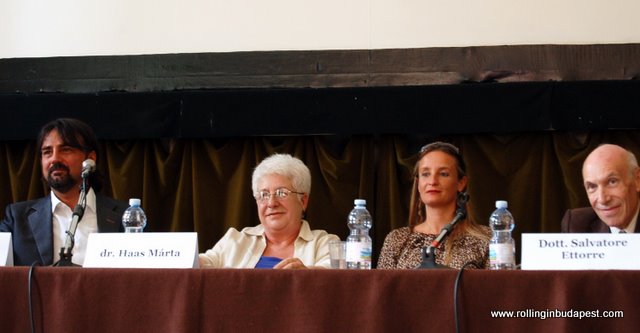
From right to left: Mr. Salvatore Ettore, Director to Hungary at the Italian Institution of Culture, Dott.ssa Rita Faragó, General Editor at the RadioInform Dr. Marta Haas, Editor of the Toothsome Italy “Ízes Itália”, Gianni Annoni, Famous Italy Chef and Program manager.

Update and snaps by: Aggie Reiter