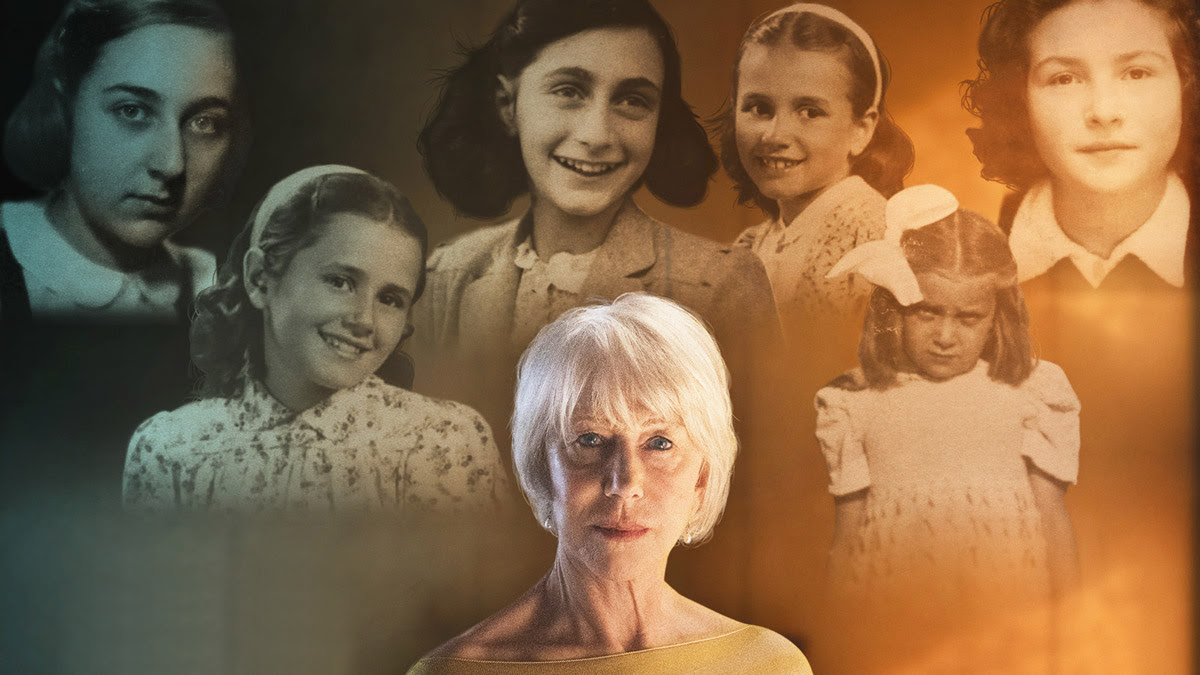
New 90-minute documentary in original language with Hungarian subtitles
Anne Frank’s tragic story unfolds on a new screen from a new perspective Anne Frank: Parallel Lives, premieres in Hungary.
(If Anne had survived she would now be 90).
Anne Frank – Parallel Stories is an extraordinary documentary that evokes the darkest period in human history and the tragic fate of children abducted in an emergency.
The Oscar-winning actress Helen Mirren is the narrator, adding a powerful presence, traces Anne Frank’s life through the pages of her diary by telling a story that has made the tragedy of the Holocaust known to readers all over the world.
The viewers are taken through the confines of Anne Frank House in Amsterdam and reads extracts from The Diary of Anne Frank. (Anneliese Marie “Anne” Frank a German girl of Jewish descent who was born in 1929 and died tragically at a young age, transported to an internal concentration camp. She died of typhoid there at the age of 15.)
The documentary holds intertwining stories with Holocaust survivors who were also sent to concentration camps at a young age of five and share their memories of the emergency. These are those five women who were also deported as children or adolescents to ghettos and then concentration camps and miraculously escaped. The intimate conversations reveal Arianna Szörenyi, an Italian writer of Hungarian descent, Sarah Lichtsztejn-Montard of Polish descent living in France, Helga Weiss, who was deported from Prague to the Terezin ghetto and then to Auschwitz. The personal story of Andra and Tatiana Bucci, who were deported as young children between the ages of 4 and 6. In addition to the survivors, the film features several renowned experts, including Michael Berenbaum, an American university professor, rabbi, writer and filmmaker who specializes in studying the Holocaust. („The Holocaust was the systematic, state-sponsored, persecution and murder of six million Jews by the Nazi regime and its collaborators between 1933 and 1945 across Europe and North Africa. The height of the persecution and murder occurred during World War II. By the end of the war in 1945, the Germans and their collaborators had killed nearly two out of every three European Jews.”)
Italian film-makers Sabina Fedeli and Anna Migotto have taken the known facts of Anne’s life and set them against the stories of five other Jewish women, all in their 90s now, all of whom survived the Holocaust. One of them even met Anne. Their stories are a moving reminder of a generation that was all but destroyed by hatred.
Anne Frank: Parallel Stories needs to be revisited more than we might care to admit!
Nationwide will be shown in the Hungarian cinemas from January, 27. 2022., on the International Holocaust Remembrance Day. Premieres at Cinemas: MOM, Toldi, Pushkin, Tabán, Art + Cinema and the Urania National Film Theater can be seen in Budapest, as well as in many other locations across the country, including cities as: Szeged, Pécs, Szolnok, Szombathely, Miskolc, Kecskemét, Eger, Zalaegerszeg and Mosonmagyaróvár.
(The Diary of Anne Frank, first published by her father Otto in 1947, is one of the best-known books in the world, while the secret annex in Amsterdam where Anne, her parents, sister and four friends hid from the Nazis for two years is now a museum and one of Holland’s most visited tourist attractions. Over the years there have been books, exhibitions, films and even stage productions centered around Anne Frank’s diary, which she started writing soon after her 13th birthday in June 12, 1942. Anne wrote her thoughts and dreams in her diary, which was discovered by one of Otto’s friends, Miep Gies, soon after Anne was arrested and deported by the Nazis in August 1994. Gies kept it in the hope that one day she would be able to return it to Anne.)
Distributor – Pannonia Entertainment Ltd.
Update Aggie Reiter

 Rolling in Budapest