THIS WAS CERTAINLY THE DAY OF RECORDS!
The previous days before the competition it was raining and raining. Therefore, we all expected the rain to be present at the meeting, but the sky above gave us the „present” of the day – forgetting to rain. The sun was shinning, yet only 20 C and the powerful wind blew back-and-forth that pretty much disturb the athletes. This time the athletes fought against nature as well and brought their best and good results.
This athletics meeting commemorated to Mr. István Gyulai – a sprinter in his young adult age, winning 28 National Championships to Hungary. The Hungarian sport diplomat, the former General Secretary of the International Sports Press Association (AIPS) and the International Association of Athletics Federations (IAAF).
The opening ceremony was held by Mr. Pierre Weiss of France, the General Secretary of the IAAF. His first words were: „Mr. István Gyulai was a great boss, a colleague and a friend of mine for almost two decades.”
After many years one chapter of Mr. István Gyulai dream came true today. The Hungarian Athletics Federation (MASZ) cherished and kept the light on that dream. Unfortunately, within this chapter Mr. István Gyulai couldn’t be present, he has gone ahead before he would have been here to vision this superb athletics meeting. As his son, Mr. Marton Gyulai, General Secretary of Hungarian Federation said during the opening ceremony: „Dad, I hope if you look down you’re happy to see your dream come true.”
The list of competitors would be extremely long, therefore I’m just mentioning a couple of outstanding athletes.
The top athletes expressed their thanks to the awesome cheering audience by showing their best of their personal records.
Krisztián Pars, the Hungarian hammer thrower, one of the stars of the “István Gyulai Memorial” opened the Athletics Meeting by throwing his hammer two-time above 79m, marked of 79.37 – 79.04m. He has represented Hungary at the Olympics two occasions – won the men’s senior gold medal with a world junior record marked 84.47m.
Asafa Powell, the American World leader sprinter, was happy to show us twice his blast under 10s/100m. This was his 80th occasion he made his sprint under 10s.
Powell said before the shot: „I am not expecting to get the gold medal, but to bring out the best of me.” When Powell ran 9.86s at 100m the crowd cheered up, the stadium was loud as they expressed their appreciation.
Veronica Campbell-Brown, the Jamaican sprinter, track and field World Champion. Five-time Olympic medallist. Six- time World Championship medallist. This was her best run of the year in the women’s 200m 22.26s. She can also say she won her sprint at Budapest with approaching this year her best time.
No one was fond with the high windy weather, neither was Veronica, but – as she said “the audience was superb and fantastic in support and hopes she will have the same uplifting audience at the IAAF World Championship/Korea.”
Sanya Richards-Ross, the US sprinter, two-time Olympic gold medallist, won a gold medal in 2009 at the World Championship in the 400 meters race. Two-time track and field athlete of the year.
Sanya, gushed about the awesome supportive audience here at the Puskás Stadion, whereas she ran in the women’s 200m 22.63s. So far this was her best sprint of the year.
Zoltán Kővágó, the Hungarian discus thrower, surely gained his best by his biggest shot. At the end he won the discus throw at 69.50m. He has taken the first place in leading the world season list.
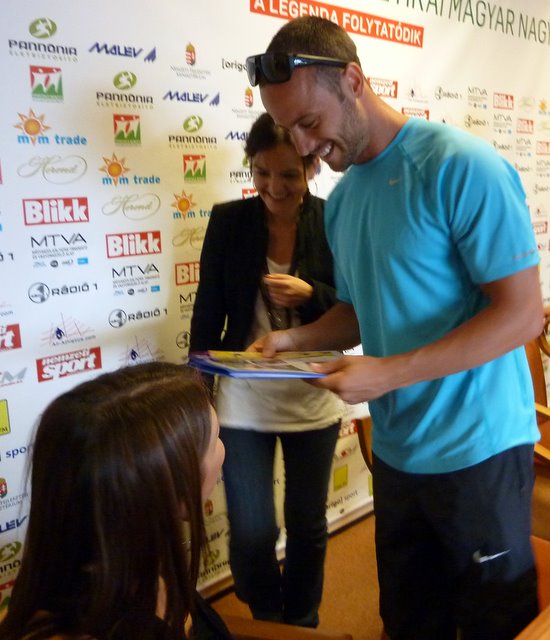
Asafa Powell received the trophy prize for the best athlete at the „István Gyulai Memorial” from the Sports Director of the event, Mr. Attila Spiriev.
The “István Gyulai Memorial” of 2011 was a major step in gathering international athletes and a double major step in the history of the Hungarian Athleteics Federation that made Mr. István Gyulai’s dream come true.
The whole team of the organizers did a great job. Congratulation!
I hope that it wasn’t a one time occasion for gathering great athletes from all around the world and the “István Gyulai Memorial” light will always shine from now on and lead in the future.
Update and snaps by Aggie Reiter.





 Until now experts knew little about the four mummies preserved int he museum’s colection. Their respective ages, histories, the methods employed in their mummification and causes or death were mostly shrouded in mystery. However, thanks to the recently carried out tests, a great deal of light has being shone upon these questions. Tests conducted upon the mumnmy known as RER revealed that shc was a female who died bctween the ages Gr 20 and 24 in the 3rd to 4th centuries BC, and it was concluded from the fairly shattered condition of her skeleton that her death was probably caused by a serious physical trauma. The researchers were able to place the Hortesnaht mummy into a precise historical and cultural context. The analysis of the coffin’s iconography and the CT examination of the mummification technique produced the same results: Hortesnaht’s mummy and coffin can be linked to the cemetery complexes connected to the town of Ahmim in the 3rd century BC. The CT scan conducted of the skull made it possiblce to restore ti life the former facial features of Hortesnaht, who passed away over two thousand years ago. The tests carried out on the body of the so-called Szombathely mummy allowed researchers not only to establish the age of the mummy – which on the basis of the radio carbon tests dates from the 2nd-3rd centuries BC – but also to ascertain that it belongs to a cartonnage coffin with a gold plated face already preserved in the collection. Up until now it had been assumed that the mummy had reached Hungary through Count László Almásy, but according to the most recent research it was purchased by Provost Adolf Kunc in Egypt (1896) and donated by him to the Premonstratensian Secondary School at Szombathely. In the case of the so-called unwrapped mummy the determination of its age was the greatest achievement of the researchers. On the basis of the carbon isotope test of a bone sample it can be stated that the mummy was prepared in the later Ptolemaic period int he 2nd-lst century BC. The chemical tests identified the dark material covering the body as plant resin, which also substantiates its dating.
 Rolling in Budapest
