A day before the grand athletics meeting, the Press Conference continued by the host, Mr. Márton Gyulai, General Secretary of the Hungarian Athletics Federation (MASZ) at the Federation Center.

TWO SPRINTER QUEENS AT ONE ATHLETICS MEETING
One of the two “Queens” in the field of sprinters.

Sanya Richards-Ross – United States of America
“My main goal is to run as fast as I can and to entertain those that are watching the game. When I’m running ain’t giving any thoughts of who is ahead nor beside me, just doing my best. Of course, I always know who will be also on the field, but what really counts is the time and to win. This is my first time here in Budapest and hope to be able to see some parts before leaving.” She admitted, next time she will be coming along to another athletics meeting here at Budapest she will bring her father, who was a great fan of Puskás. Her father already envied her for running in that Stadium named after Puskás.

Oscar Pistorius – South Africa
Pistorius is known as “the fastest man on no legs.” He doesn’t feel different from those walking folks with their two legs. He said: “When I get up in the morning, I buckle on my legs. My brother slips into his shoes and off we go. Simple as that!” Ending the interview, he quoted what he often says: “They say in athletics you can be fit, but you also need to be competition fit.” He also added: “Often individuals think and say the Olympic and Paralympic games are two different games. Many misunderstand the meaning of the word. So let me put it this way, paralympic word stand for parallel and not paralyzed.
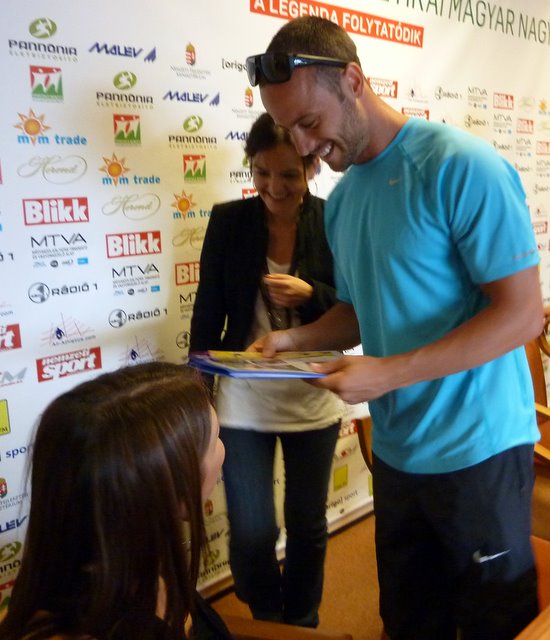
Members of the Hungarian Paralympics Association also joined the press conference and handed over a small gift, an album of photos of the Hungarian Paralympics medal winners.
Two European sprinter champions

Kevin Borlée – Belgium (to the left)
Deák Nagy Marcell – Hungary (to the right)
Both said they are looking forward to a great competition and hope they will run before the wind.
National Athletics Olympic champions
(from left to right)

Zoltán Kővágó – discus throw
Zoltán Kővágó – discus throw
Kisztián Pars – hammer throw
Róbert Fazekas – discus throw
Daniel Kiss – hurdles
As they all said, injuries were around them, but hopefully it won’t disturb their results and in winning tomorrow.

Krisztián Pars – Hungary
Was showing, talking about his previous finger injury.
Showing his “new finger style” that he had to “invent” . He showed the press which finger will do the job – to be able to hold/throw the discus of tomorrow. He hopes he will succeed.
The other “Queen” of sprinter

Veronica Campbell-Brown – Jamaica
Seemed to be excited and looking forward to her run of tomorrow. She would have loved to go for that 400m, but this time it hasn’t been brought into the schedule, therefore she will be in the 200m sprint. She reckons that it’s going to be a great battle between Sanya Richards-Ross and her, here at Budapest. This game will be her last one before attending to the IAAF World Championships at Daegu Stadion/Korea. With a lovely smile on her face she spoke about her love for the 400m run, although it hasn’t been adopted in this program, she will be in the 200m sprint. She also mentioned, she often runs 200m, but now-a-days it is a kind of field outwork for her.
Update and snaps Aggie Reiter



 Until now experts knew little about the four mummies preserved int he museum’s colection. Their respective ages, histories, the methods employed in their mummification and causes or death were mostly shrouded in mystery. However, thanks to the recently carried out tests, a great deal of light has being shone upon these questions. Tests conducted upon the mumnmy known as RER revealed that shc was a female who died bctween the ages Gr 20 and 24 in the 3rd to 4th centuries BC, and it was concluded from the fairly shattered condition of her skeleton that her death was probably caused by a serious physical trauma. The researchers were able to place the Hortesnaht mummy into a precise historical and cultural context. The analysis of the coffin’s iconography and the CT examination of the mummification technique produced the same results: Hortesnaht’s mummy and coffin can be linked to the cemetery complexes connected to the town of Ahmim in the 3rd century BC. The CT scan conducted of the skull made it possiblce to restore ti life the former facial features of Hortesnaht, who passed away over two thousand years ago. The tests carried out on the body of the so-called Szombathely mummy allowed researchers not only to establish the age of the mummy – which on the basis of the radio carbon tests dates from the 2nd-3rd centuries BC – but also to ascertain that it belongs to a cartonnage coffin with a gold plated face already preserved in the collection. Up until now it had been assumed that the mummy had reached Hungary through Count László Almásy, but according to the most recent research it was purchased by Provost Adolf Kunc in Egypt (1896) and donated by him to the Premonstratensian Secondary School at Szombathely. In the case of the so-called unwrapped mummy the determination of its age was the greatest achievement of the researchers. On the basis of the carbon isotope test of a bone sample it can be stated that the mummy was prepared in the later Ptolemaic period int he 2nd-lst century BC. The chemical tests identified the dark material covering the body as plant resin, which also substantiates its dating.
 Rolling in Budapest
