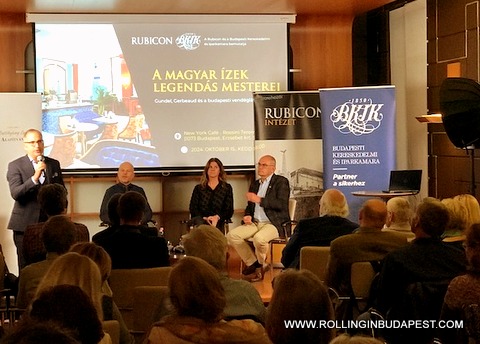
The first to the program series of Rubicon and BKIK was presented at the New York Cafe – Budapest. Two really outstanding people with their ancestor companies who achieved special success in the Hungarian economy from the middle of the 19th century to the First World War were on th spot.
The event was an exclusive stage discussion attended by: Zoltán Kőrössy – founding partner and managing director of Eventrend Group, Anna Niszkács – managing director of Gerbeaud and Gábor Takács – guest Gundel, led by a moderator, in front of a live audience.

The story tellers back-to-the-future were: Zoltán Kőrössy, founding partner and managing director of Eventrend Group – Anna Niszkács, managing director of Gerbeaud – Gábor Takács Gundel.
This evening the legendary masters of Hungarian flavors – Gundel, Gerbeaud and the creators of Budapest a retrospective was given of the hospitality in the 19th and 20th centuries. In this age, the modernization of food and confectionery production began.
The goal of the evening’s events was to paint a new picture of the successes of domestic enterprises with a long history background for the general public with latest research and leading market players. Hungarian catering experienced was the most dynamic development during the Austro-Hungarian Monarchy. In addition to the French and Austrian influences, more and more domestic ideas also appeared on the tables of restaurants and pastry shops. The spread of electrical devices and refrigeration equipment modernized the preparation of food and sweets, and many foreign restaurant and confectionery entrepreneurs found their luck in Budapest. The new locations created in the capital also affected cultural life, and also in the 20th century they had to survive and preserve their image in the midst of new challenges.
Background Past & Future … Gundel
One of the top achievements of the Hungarian hospitality industry and culinary art can be attributed to the Gundel family. The founder of the best-known Hungarian restaurant dynasty – Johann Adam Michael Gundel, a.k.a. János Gundel, born in Ansbach, Bavaria – arrived in Hungary in 1857, at the age of 13. Nagybátya, restaurateur György Gartner from Buda took him under his wing, and after gaining experience in several restaurants in the capital, he started his own business. After opening several restaurants in Pest, his career peaked between 1889 and 1904, when he rented the István Főherceg Hotel (today: 1. Akadémia Str.). In honor of the most famous regular guest, Kálmán Mikszáth, the famous paló soup was first prepared here. In recognition of his merits, he received the Knight’s Cross of the Order of Ferenc József. Three of János Gundel’s five children continued the hospitality profession. The most outstanding of them was Károly Gundel (1883-1956), who learned the trade in the most famous restaurants of Switzerland, Germany, England and France. He returned to Budapest in 1910 to take over the management of the Wampetics restaurant – Városliget. It was not an easy task, since the name Wampetics was already a concept at that time, the restaurant took its current form under the previous management back in 1896, so he had to prove that he was capable of creating a more modern, better and more successful restaurant. He succeeded: Gundel brought the highest standards of elegance and luxury to the Hungarian capital by transforming the new restaurant, which in a short time has now gained world fame. In addition to his daily work, Károly Gundel wrote countless cookbooks, in which he published many of his own recipes and innovations. Some of his works were addressed to the elite of the profession, and others to housewives. One of his main works, the “Little Hungarian Cookbook”, has been translated into thirty-eight foreign languages. In 1939, the Gundel restaurant became the official restaurant of the Hungarian pavilion at the New York World’s Fair. Some foreign guidebooks still quote a New York Times article from that time, according to which their restaurant “provided bigger, better publicity for Budapest than a boat load of tourist brochures”. The success of Gundel, or the “power” of its name, is also well indicated by the fact that in 1949, when the restaurant was nationalized, its name was renamed Május 1. restaurant, but Mátyás Rákosi changed his mind after a few days, so the original name could remain. Imré Gundel was asked to run the nationalized restaurant, but he said no out of pride. After the regime change, the restaurant came into private hands, but no longer in the hands of the Gundel family.
Background Past & Future – Gerbeaud
Émile Jean Antoine Gerbeaud was born in Carouge, in the canton of Geneva, on February 12, 1854, to a famous Swiss pastry family. Continuing the family’s traditions, he also chose this craft: in 1879, he opened his own shop in Saint-Étien in south-eastern France. A decisive moment in his career was when he met Henrik Kugler in Paris in 1882, also a member of a multi-generational confectioner’s family. Kugler, who won the title of imperial and royal court confectioner, operated his confectionary on Gizella Square (today’s Vörösmarty Square) in Budapest, which was popular with both the affluent bourgeoisie and the aristocracy. Since there was no one to carry on his business, Gerbeaud entrusted Emil to run the patisserie after his death.
The Gerbeaud family arrived in Hungary in 1884. Building on his expertise from Switzerland and France, Emil Gerbeaud introduced many innovations in the preparation of food, with which he contributed to the development and competitiveness of the Hungarian confectionery industry. At the turn of the century, he became one of Budapest’s best-known confectioners and industrialists, the name Gerbeaud became a concept, and the company’s products were also interested abroad. Since Emil Gerbeaud was also a master chocolate maker, he introduced cat’s tongue (macskanyelv) and cognac cherries (konyakos meggy) to Hungary. With professional sophistication, he strove to make his products attractive to his guests with their quality. He used packaging materials and gift boxes designed with renowned industrial artists.
In recognition of his work, he received the Knight’s Cross of the Order of Ferenc József in 1896, and a year later the gold medal of the National Industrial Association.
He took part in the World Exhibition in Brussels in 1898 and then in Paris in 1900. At the event in France, as a Swiss-Hungarian confectioner, he was awarded the French Order of Honor. He survived the First World War and died on November 8, 1919. His wife Eszter Ramseyer participated in the management of the store until 1940, maintaining its high standards. The patisserie eventually came under state ownership, and its name was changed to Vörösmarty. Only in 1984 did Gerbeaud become the name of the patina patisserie again.
Riport and snaps by Aggie Reiter

 Rolling in Budapest